Why Illinois Businesses Need an Answering Service
Illinois has over 1.2 million small businesses employing 2.4 million people. These operations account for 99.6% of all businesses in the state. More than 153,000 of them have four or fewer employees, which means the owner is doing everything: sales, service, billing, and somehow also answering the phone.
The challenge is amplified by Illinois's geography and economic structure. A personal injury attorney in the Loop can't take calls while in court. A grain elevator operator in Champaign can't answer during harvest. A general contractor in Naperville can't step off a job site to book the next one. A restaurant owner in Springfield can't leave the kitchen to handle a catering inquiry. In a state where Chicago alone sees 55 million visitors a year and the agricultural economy produces $50 billion annually, every unanswered call is revenue walking away.
An answering service catches those calls. But the right choice depends on whether your business moves at Chicago speed, downstate rhythms, or both.
What Makes Illinois's Business Environment Distinct
Illinois operates as two economies in one state, and that duality shapes which answering service works best:
- Chicago is a top-5 global business city: The metro area generates $860 billion in GDP, ranking 3rd nationally. Roughly 35 Fortune 500 companies are headquartered here, second only to New York City. O'Hare handled 80 million passengers in 2024 and was named the nation's busiest airport by aircraft movements. No single sector accounts for more than 13% of Chicago's GDP, making the economy remarkably diversified. A missed call in this market doesn't wait. The caller moves to the next vendor, the next firm, the next contractor within seconds.
- The nation's freight backbone runs through Illinois: All six Class I railroads operate in Chicago. Twenty-five percent of all U.S. freight trains and 50% of all intermodal trains pass through the metro area. The state's 52 freight railroads move 441 million tons of goods across 6,768 miles of track annually. Freight-dependent industries represent over 25% of regional jobs and add $158 billion per year to the economy. Logistics companies, trucking operators, and warehouse managers need phone coverage that works around shipping schedules, not office hours.
- Agriculture contributes $50 billion annually: Illinois ranks #1 in soybean production and #2 in corn. The state planted 10.8 million acres of each in the most recent season, producing 2.31 billion bushels of corn and 688 million bushels of soybeans. These are operations spread across 93% of the state's land area where growing season demands every hour and harvest season runs nonstop. A grain buyer calling a farm at 6am or a co-op calling about pickup at 8pm reaches voicemail if there's no answering service.
- Healthcare is a $117.7 billion industry: Illinois hospitals inject $117.7 billion into the state economy and support 445,000 jobs across 209 facilities. Medical practices, home health agencies, and dental offices need HIPAA-compliant phone handling that traditional voicemail can't provide. After-hours patient calls need to be documented accurately and routed appropriately, not left as garbled messages on an answering machine.
- Bilingual demand is substantial: Illinois has approximately 2.38 million Hispanic/Latino residents, making up 17-18% of the state's population. Nearly 15% of households speak Spanish at home. In neighborhoods like Pilsen, Little Village, and communities across the collar counties and downstate agricultural regions, bilingual phone capability isn't a bonus feature. It's a basic requirement for businesses serving these populations.
- Winter disrupts everything: Illinois averages five severe winter storms per season. Winter construction productivity drops 20-40% and costs increase 10-30%. O'Hare delays cascade through national air travel. Rail and trucking slow down. For service businesses like plumbers, HVAC companies, and roofers, winter storms simultaneously increase call volume (burst pipes, furnace failures, ice dams) and reduce the ability to answer those calls (crews deployed to emergencies). An answering service handles the surge while the team handles the work.
Top 5 Answering Services for Illinois Businesses
We evaluated these services against Illinois's demands: Chicago's corporate velocity, the downstate agricultural economy, bilingual requirements across both regions, seasonal call surges during winter, and the 24/7 nature of the state's logistics industry.
1. Zinng: Best Overall (AI-Powered)
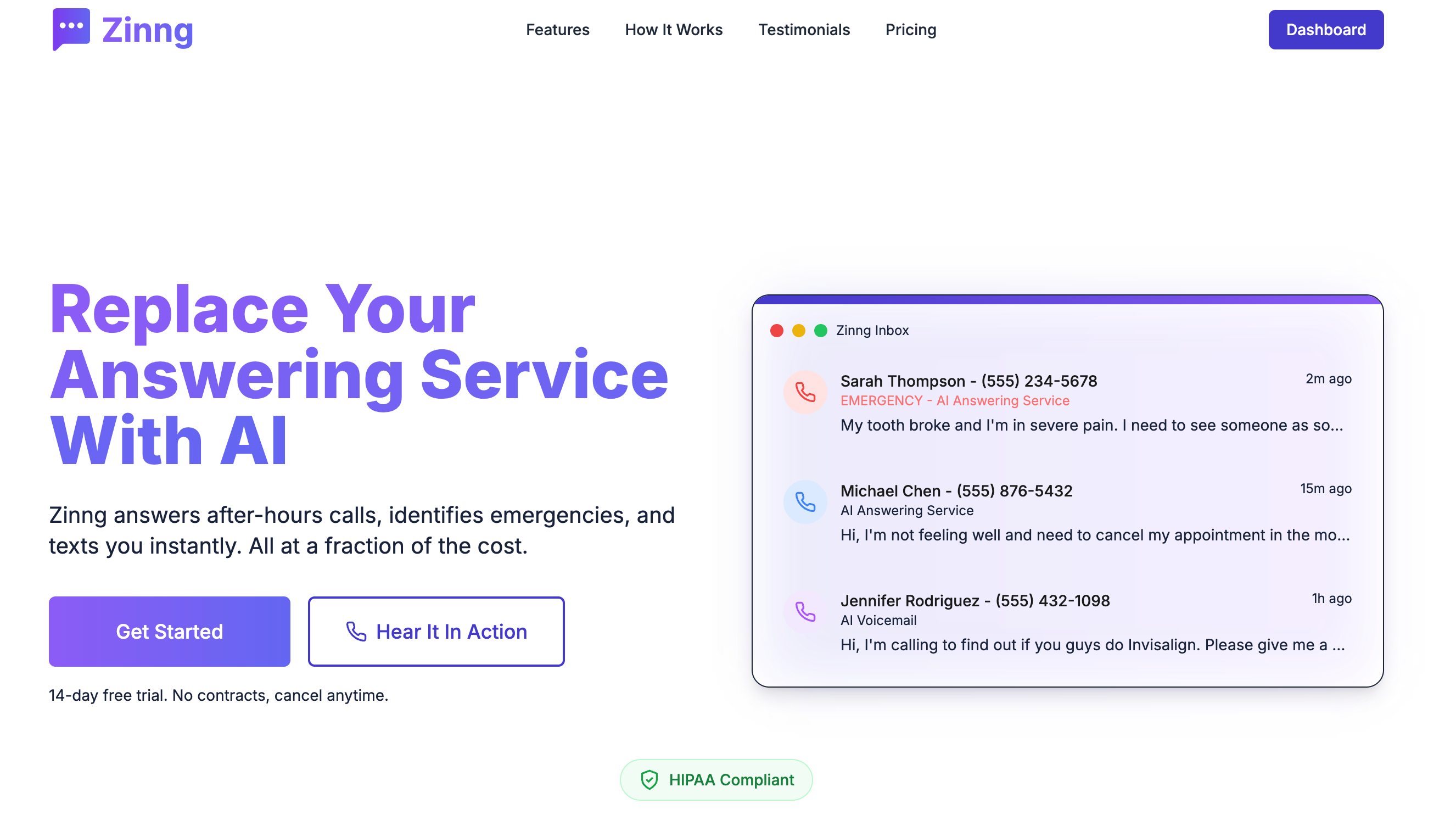
Zinng answers every call with AI trained on your specific business. No hold times, no operator fatigue during a February polar vortex when every furnace in Cook County fails simultaneously, and no variation in quality between a Monday morning rush and a Saturday night emergency. For a state with 1.2 million small businesses competing across the most diversified metro economy in the country, answering every call instantly is a competitive advantage that pays for itself.
Every call generates a complete transcript delivered by email with SMS alerts for urgent items. A logistics coordinator in Joliet gets documented records of every dispatch call. A personal injury firm in Chicago gets word-for-word intake from every potential client. A farm equipment dealer in Peoria gets exact parts specifications from a 6am call during planting season. The transcripts eliminate the "he said/she said" problem that plagues businesses relying on operator notes or voicemail.
- Pricing: $49/month with 100 minutes included. Additional minutes at $0.12 each. Growth plan at $99/month with 250 minutes. Business plan at $199/month with 600 minutes.
- Best for: Illinois businesses across all industries that need affordable, always-on coverage, from Chicago storefronts to downstate agricultural operations.
- Key features: 24/7 AI answering, full call transcripts, SMS alerts for urgent calls, HIPAA compliant, custom call routing, spam blocking, appointment scheduling, 14-day free trial with no credit card.
- Standout: A Chicago-area plumbing company handling 250 minutes monthly pays $67 with Zinng ($49 base + $18 overage). The cheapest traditional alternative with similar volume costs $269+. Over a year, that's $2,400+ back in the business, enough to cover a van payment or fund a marketing campaign that generates new leads.
2. Ruby Receptionists: Best Premium Live Service
Ruby has built its reputation on the quality of live receptionist interactions, and that quality shows. Based in Portland, Oregon, Ruby staffs U.S.-based receptionists who answer with genuine warmth and professionalism. For Illinois law firms, financial advisors, and medical practices where the first phone call shapes the client relationship, Ruby's receptionists create the kind of first impression that a recorded greeting or generic operator cannot.
Ruby provides 24/7 bilingual inbound coverage (English and Spanish) across all plans, with outbound calling available during weekday business hours (5am to 6pm PT, which is 7am to 8pm Central). Their 10-tier pricing structure accommodates everything from a solo practitioner fielding 50 minutes of calls to a mid-size firm handling 2,500. The per-minute cost is high, but businesses paying for Ruby are paying for a specific level of polish that matters in competitive professional markets.
- Pricing: Call Ruby 50 at $250/month for 50 minutes ($5.40/min overage). Call Ruby 100 at $395/month for 100 minutes ($4.50/min overage). Call Ruby 200 at $720/month for 200 minutes ($4.40/min overage). Call Ruby 500 at $1,725/month for 500 minutes ($4.00/min overage). Ten tiers total up to $7,875/month for 2,500 minutes.
- Best for: Illinois law firms, financial services companies, and medical practices in the Chicago metro where caller experience directly impacts client acquisition and retention.
- Key features: 24/7 live U.S.-based receptionists, bilingual English/Spanish (all plans), 10 pricing tiers, call routing, appointment scheduling, outbound calling (Mon-Fri 7am-8pm CT).
- Drawback: Ruby is the most expensive service on this list. A mid-size Chicago law firm handling 200 minutes monthly pays $720, nearly 12 times Zinng's cost for the same volume. Overage rates between $4.00 and $5.40 per minute make unexpected call spikes punishing. During a polar vortex when every HVAC and plumbing company sees calls triple, that $720 can balloon past $1,500 in a single billing cycle.
3. PATLive: Best for 24/7 Reliability
PATLive has delivered live answering from Tallahassee, Florida, since 1990. Over 35 years of continuous operation makes them one of the longest-running services in the industry. Their Flex Platform offers four tiers, all with 24/7 coverage, and their 100% U.S.-based operators handle calls with the consistency that comes from decades of institutional experience. For Illinois businesses that need dependable around-the-clock handling without the premium pricing of Ruby, PATLive is the reliable middle ground.
PATLive's per-minute overage rates decrease as you move up tiers ($2.25 on Starter, down to $1.85 on Pro), and each tier increases the number of simultaneous lines available. The Pro plan at $1,050/month includes 10 lines, which matters for high-volume Illinois operations. Bilingual English/Spanish support is available as a $20/month add-on.
- Pricing: Starter at $235/month for 75 minutes ($2.25/min overage, 1 line). Standard at $415/month for 200 minutes ($2.10/min overage, 3 lines). Premium at $650/month for 350 minutes ($1.90/min overage, 5 lines). Pro at $1,050/month for 600 minutes ($1.85/min overage, 10 lines).
- Best for: Illinois businesses that need dependable 24/7 live answering from an established provider without paying Ruby-level prices.
- Key features: 24/7 live answering, 100% U.S.-based operators, bilingual English/Spanish ($20/month add-on), appointment scheduling, order processing, call transfers, 14-day free trial.
- Drawback: The Starter plan's single line creates a bottleneck. If two Illinois callers ring at the same time, one goes to voicemail. For a Chicago service company fielding 10+ calls per hour during peak periods, that limitation makes the Starter plan impractical. The $235/month price for just 75 minutes ($3.13/min effective) is also steep for low-volume operations that would get far more value from Zinng or SAS.
4. AnswerConnect: Best for Integrations
AnswerConnect operates a fully human, 24/7 answering service with no AI on the line. What differentiates them is their library of over 25 platform integrations. For Illinois businesses running on Salesforce, HubSpot, Zoho, or industry-specific CRMs, having call data flow directly into existing systems eliminates a layer of manual data entry that costs real time. A Chicago marketing agency using HubSpot gets new lead information pushed directly into their pipeline without an admin re-typing notes from a phone message.
Based in Portland, Oregon, AnswerConnect runs a 100% remote workforce, giving them geographic redundancy during regional weather events. Their bilingual English/Spanish support covers Illinois's substantial Hispanic population. The Growth plan at $395/month for 300 minutes waives the setup fee that applies to the Entry and Standard plans, making it the most practical starting point for businesses that expect moderate call volume.
- Pricing: Entry at $350/month for 200 minutes ($2.50/min overage, $49.99 setup fee). Growth at $395/month for 300 minutes ($1.85/min overage, no setup fee). Standard at $575/month for 400 minutes ($1.85/min overage, $49.99 setup fee). Custom plans for higher volumes.
- Best for: Illinois businesses with established CRM workflows that need call data automatically flowing into their sales, support, or case management systems.
- Key features: 24/7 live answering (human only), 25+ CRM integrations, bilingual English/Spanish, live chat answering, appointment scheduling, custom scripts, first 30 short interactions per cycle free.
- Drawback: No free trial and no money-back guarantee. The Entry plan at $350 for 200 minutes includes a $49.99 setup fee, and leaving the service incurs a $300 port-out fee to keep your number. For an Illinois small business testing whether professional answering is worth the investment, AnswerConnect requires more upfront commitment than alternatives offering free trials. The $350/month minimum is also a significant barrier for the many Illinois small businesses with fewer than 5 employees.
5. Specialty Answering Service (SAS): Most Flexible Pricing
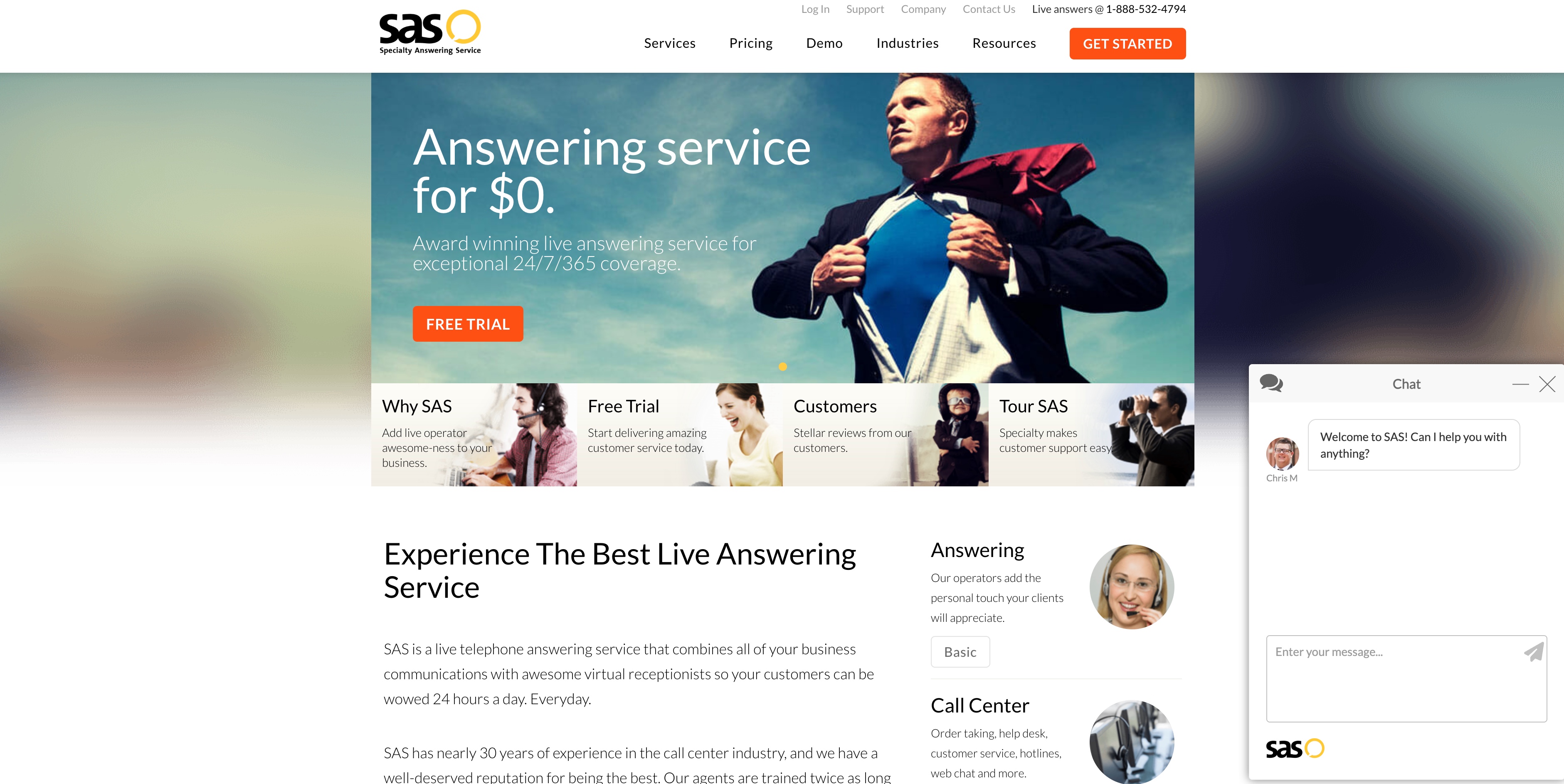
SAS, headquartered in King of Prussia, Pennsylvania, offers the most granular pricing structure in the industry. Eight tiers from $44/month to $10,599/month let businesses match their plan to actual call volume with precision. Their Economy plan at $44/month with pay-per-minute billing is the lowest-commitment entry point for any live answering service on this list. For Illinois small businesses, especially the 153,000+ with four or fewer employees who are testing whether a service like this makes financial sense, SAS lets you try without a meaningful monthly obligation.
SAS bills in one-second increments, which saves money across a month of short calls compared to services that round up to the nearest minute. They offer HIPAA compliance, bilingual support, and a 14-day free trial with no credit card required. For Illinois's healthcare businesses, agricultural operations, and service companies that need affordable 24/7 coverage, SAS provides a genuinely low-risk starting point.
- Pricing: Economy at $44/month with $1.54/min (no included minutes). 100-minute plan at $159/month ($1.44/min overage). 220-minute plan at $269/month ($1.44/min overage). Plans scale to $10,599/month for 10,000 minutes. No setup fees. 14-day free trial, no credit card.
- Best for: Illinois businesses with unpredictable call volumes, micro-businesses testing professional answering, and budget-conscious operations that want maximum plan flexibility.
- Key features: 24/7 live answering, bilingual, HIPAA compliant, one-second billing increments, 8 plan tiers, message taking, order processing, appointment scheduling, no contracts, 14-day free trial.
- Drawback: The $1.54/min rate on the Economy plan adds up at moderate volumes. A Chicago pest control company handling 200 minutes monthly on the Economy plan pays $352 ($44 + $308 in per-minute charges). The 100-minute plan at $159 is the better value for regular call volume, but even that works out to $1.59/min effective. SAS's website and client portal feel dated compared to newer competitors, and their minutes include post-call work time (data entry after the caller hangs up), meaning you're billed for time the operator spends after your caller has already disconnected.
Pricing Comparison
Here's what each service costs for an Illinois business handling approximately 200 minutes of calls per month.
| Service | Starting Price | Cost for 200 min | Per-Min Rate | 24/7? |
|---|---|---|---|---|
| Zinng | $49/mo | $61/mo* | $0.12/min overage | Yes |
| SAS | $44/mo | ~$269/mo** | $1.44/min overage | Yes |
| PATLive | $235/mo | $415/mo | $2.08/min eff. | Yes |
| AnswerConnect | $350/mo | $350/mo | $1.75/min eff. | Yes |
| Ruby | $250/mo | $720/mo | $3.60/min eff. | Yes |
*Zinng's $49 plan includes 100 minutes. 200 minutes = $49 + $12 overage (100 additional minutes at $0.12/min).
**SAS's 220-minute plan at $269/month is the closest match. The Economy plan ($44 base) would cost $352 for 200 minutes at $1.54/min.
Why AI Answering Fits Illinois's Dual Economy
Illinois runs on two tracks: Chicago's corporate speed and downstate's agricultural and manufacturing rhythms. AI answering handles both without compromise:
- Chicago's competition doesn't sleep. With 35 Fortune 500 companies and 55 million annual visitors generating demand, a Chicago-area service business that misses a call loses that customer to a competitor who didn't. AI answers on the first ring, at 2pm on a Tuesday and at 2am on a Sunday. No hold queue, no "all operators are busy," no voicemail during the lunch rush. In a metro where the next option is one Google search away, instant pickup is the baseline expectation.
- Winter surges don't break the budget. When a polar vortex drops temperatures to -20 and every furnace in the suburbs fails, HVAC companies see calls spike 300% or more in a single day. A traditional answering service with 3 lines puts caller 4 on hold. AI handles 50 concurrent calls with the same response time as one. And because billing is per-minute, the extra volume costs more because you're doing more business, not because you needed an emergency plan upgrade you'll have to cancel next month.
- Logistics runs on documentation. Illinois moves 441 million tons of freight annually. When a dispatcher calls about a container at a rail yard in Clearing, or a trucking company confirms a pickup window at a warehouse in Romeoville, the exact details matter. AI produces verbatim transcripts. A traditional operator produces a summary from handwritten notes taken while handling two other calls. In logistics, an incorrect pickup time or misheard container number has downstream consequences that cost far more than the monthly service fee.
- Downstate coverage without downstate overhead. Agricultural operations across 93% of the state's land area need phone coverage during planting and harvest when no one is near a desk. AI works on any phone connection, requires no broadband, and costs the same in Carbondale as it does in the Chicago Loop. A farm supply business in Decatur and a tech startup in Wicker Park pay the same $0.12/min and get the same quality.
- The math works at $15/hour minimum wage. Illinois's $15 minimum wage (higher in Chicago and Cook County) makes in-house reception expensive. A full-time receptionist costs $35,000 to $45,000 annually with benefits. Zinng's Business plan at $199/month costs $2,388/year. That $30,000+ difference funds another hire who directly generates revenue, or marketing, or equipment. For the 153,000+ Illinois businesses with four or fewer employees, that math isn't theoretical. It's the difference between a position that answers calls and a position that makes money.
Human answering services retain clear value for Illinois businesses needing empathetic call handling, complex intake, or CRM-integrated workflows. But for the majority of business calls (scheduling, inquiries, routing, and message-taking), AI delivers faster response, perfect documentation, and a cost structure that works for a $44/month micro-business and a $199/month growing operation alike.
Choosing the Right Service for Your Illinois Business
- Service business, contractor, or growing company? Zinng's $49/month plan with per-minute billing gives you 24/7 coverage that scales automatically with demand. Full transcripts document every call. The 14-day free trial costs nothing to evaluate.
- Law firm, financial firm, or medical practice wanting premium live handling? Ruby's receptionists deliver the highest-quality human interaction on this list. Budget $720+/month for 200 minutes. Worth it if your clients expect a polished first impression.
- Need proven 24/7 reliability? PATLive's 35-year track record speaks for itself. Four tiers with 24/7 coverage. The Standard plan at $415 for 200 minutes is the practical entry point for moderate volume. Add $20/month for bilingual support.
- Running your business on CRM workflows? AnswerConnect's 25+ integrations push call data directly into Salesforce, HubSpot, or Zoho. The Growth plan at $395 for 300 minutes waives the setup fee. No free trial, so commit with confidence.
- Testing answering services for the first time? SAS's $44/month Economy plan with per-minute billing and a 14-day no-credit-card free trial is the lowest-risk way to evaluate. Upgrade to the 100-minute plan at $159 once you confirm the service pays for itself.
- Serving Illinois's Hispanic communities? Zinng, AnswerConnect, and SAS include bilingual support at no extra charge. Ruby includes bilingual inbound on all plans. PATLive charges $20/month for Spanish.
Final Verdict
Zinng is the best answering service for Illinois businesses. At $61/month for 200 minutes of 24/7 coverage, it costs a fraction of every traditional alternative while delivering complete call transcripts, HIPAA compliance, and unlimited simultaneous call capacity. Whether you're fielding booking calls in Wrigleyville or parts inquiries in Peoria, the service operates identically at every hour and every volume level.
Ruby is the right choice for Illinois professionals who need premium live handling. Chicago's legal and financial markets are among the most competitive in the country, and Ruby's receptionists create first impressions that match. Pay $720+/month for 200 minutes and accept that quality at this level carries a premium.
PATLive delivers reliable 24/7 live answering backed by three decades of continuous operation. The Standard plan at $415 for 200 minutes is the practical choice for businesses with moderate, predictable call volume. The 14-day free trial lets you evaluate before committing.
AnswerConnect earns its place for CRM-dependent businesses. If your operation runs on Salesforce or HubSpot and manual data entry from phone messages wastes hours weekly, the $395/month Growth plan pays for itself in administrative time saved. Factor in the lack of a free trial and the $300 port-out fee.
And SAS offers the most flexible entry point in traditional answering. Eight tiers, one-second billing, and a no-credit-card free trial make it the easiest way for an Illinois small business to test live answering with virtually no financial risk.
Illinois's economy rewards businesses that move fast in Chicago and stay connected across every downstate county. From the trading floors of the Loop to the soybean fields of Champaign, the phone is still where business happens. AI answering handles that phone at the speed and scale Illinois demands, at a price point that leaves room for everything else.