Why Maryland Businesses Need an Answering Service
Maryland has over 600,000 small businesses that make up 99.5% of all employers in the state. Those businesses operate in a $564 billion economy shaped by federal government contracting, cybersecurity, biotech, healthcare, port logistics, and tourism. The median household income sits around $103,000, consistently ranking among the top four states nationally. Businesses in Maryland serve a high-income, high-expectation customer base that doesn't tolerate voicemail.
The problem is that Maryland's economy generates calls from multiple directions at unpredictable hours. A cybersecurity contractor in Columbia can't leave a client briefing to answer the phone. A crab house on the Eastern Shore can't take wholesale orders during a Saturday lunch rush. A defense subcontractor in Hanover can't step out of a classified facility to return a call from a program manager at Fort Meade. A biotech startup in Bethesda can't pause a lab procedure to field an investor inquiry. When $46.2 billion in federal contracts flow through the state annually and the Port of Baltimore generates $70 billion in economic impact, every unanswered call risks a contract, a shipment, or a client relationship.
An answering service catches those calls. The question is which one fits Maryland's particular combination of government, defense, technology, and commerce.
What Makes Maryland's Business Environment Distinct
Maryland's economy operates at an unusual intersection of federal power and private enterprise:
- Federal contracting totals $46.2 billion annually: Maryland ranks 4th nationally in defense spending at $30.4 billion and 5th for contracts awarded to defense contractors at $22.4 billion. The Departments of Defense and Health and Human Services account for 60% of contract dollars awarded in the state. Top contractors include Lockheed Martin (headquartered in Bethesda with $65.4 billion in revenue), Northrop Grumman, Leidos, and Johns Hopkins University. The contractor ecosystem extends to thousands of small and mid-size firms providing IT, engineering, logistics, and consulting services to federal agencies. These businesses operate on proposal deadlines, contract modifications, and government fiscal year cycles that generate concentrated call activity. A small defense subcontractor in the Fort Meade corridor missing a call from a contracting officer during a source selection can lose a multi-year award.
- Fort Meade and the NSA employ 60,000 people: Fort George G. Meade is the state's largest employer, generating $9.2 billion in employee compensation and supporting 125,729 jobs across the region. The NSA and U.S. Cyber Command anchor a cybersecurity corridor that runs from Fort Meade to BWI, with over 1,200 cybersecurity firms in Howard County alone and 76,000 people employed in cybersecurity in Central Maryland. Another 19,000 cybersecurity positions remain open. The businesses serving this cluster handle sensitive communications and need documented, reliable phone coverage. Aberdeen Proving Ground adds 12,500 military and civilian workers with $3 billion in local economic impact. Joint Base Andrews contributes 20,000 jobs and $4 billion in Prince George's County.
- Biotech and life sciences generate $18.6 billion: Maryland hosts over 1,800 life science companies, with Montgomery County anchoring the 3rd largest biopharma hub in the U.S. at 350+ companies. NIH in Bethesda employs 18,000. The FDA employs 16,000. NIST in Gaithersburg has 6,000 employees and associates. Goddard Space Flight Center in Greenbelt employs 10,000. These federal research agencies create a demand ecosystem for startups, contract research organizations, and pharmaceutical companies that operate on regulatory timelines. When an FDA reviewer calls a biotech firm about a submission, that call cannot go to voicemail.
- The Port of Baltimore handles $70 billion in economic impact: The port set records in 2025 with 2,223 cargo vessel calls and over 1.1 million TEUs, surpassing pre-Key Bridge collapse levels. The port supports 273,000 jobs statewide and 20,300 direct jobs. The CSX Howard Street Tunnel modernization (completion expected 2026) will allow double-stack container trains and add an estimated 160,000 containers annually. Port logistics companies, freight forwarders, customs brokers, and trucking firms operate around the clock coordinating shipments across time zones. A container arriving from Asia at 3am needs clearance, drayage, and delivery coordination that doesn't wait until 9am.
- Tourism spending reached $21.2 billion: The industry supports 193,845 jobs and generates $2.5 billion in state and local tax revenue. Baltimore's Inner Harbor draws approximately 25 million visitors annually. Ocean City hosts up to 8 million visitors per year, with summer weekends bringing 320,000 to 345,000 vacationers. Chesapeake Bay recreation generates approximately $33 billion annually across the broader watershed. Tourism businesses from Annapolis sailing charters to Deep Creek Lake resorts face seasonal call surges that are difficult to staff for permanently.
- Johns Hopkins is a $40 billion economic engine: Johns Hopkins University and Health System is Maryland's largest private employer, supporting 149,000 jobs statewide and generating a $40 billion total economic impact. In Baltimore alone, the institution creates $19.4 billion in annual economic impact and supports one in five jobs. The Hopkins ecosystem includes research labs, medical practices, affiliated clinics, startups, and the thousands of businesses that serve them. Healthcare operations require HIPAA-compliant call handling, after-hours patient routing, and precise documentation.
- Maryland's Hispanic population has grown significantly: At 12.1% statewide and up to 17% in Montgomery County, the Hispanic/Latino population has seen the largest increase of any demographic group, adding 231,624 residents from 2010 to 2022. Businesses in the D.C. suburbs, construction, hospitality, and healthcare increasingly need bilingual phone handling to serve this growing customer base.
Top 5 Answering Services for Maryland Businesses
We evaluated these services against Maryland's specific demands: federal contracting communication protocols, cybersecurity industry sensitivity, biotech regulatory timelines, port logistics around-the-clock operations, tourism seasonality, healthcare HIPAA compliance, and bilingual needs for a 12.1% Hispanic population.
1. Zinng: Best Overall (AI-Powered)
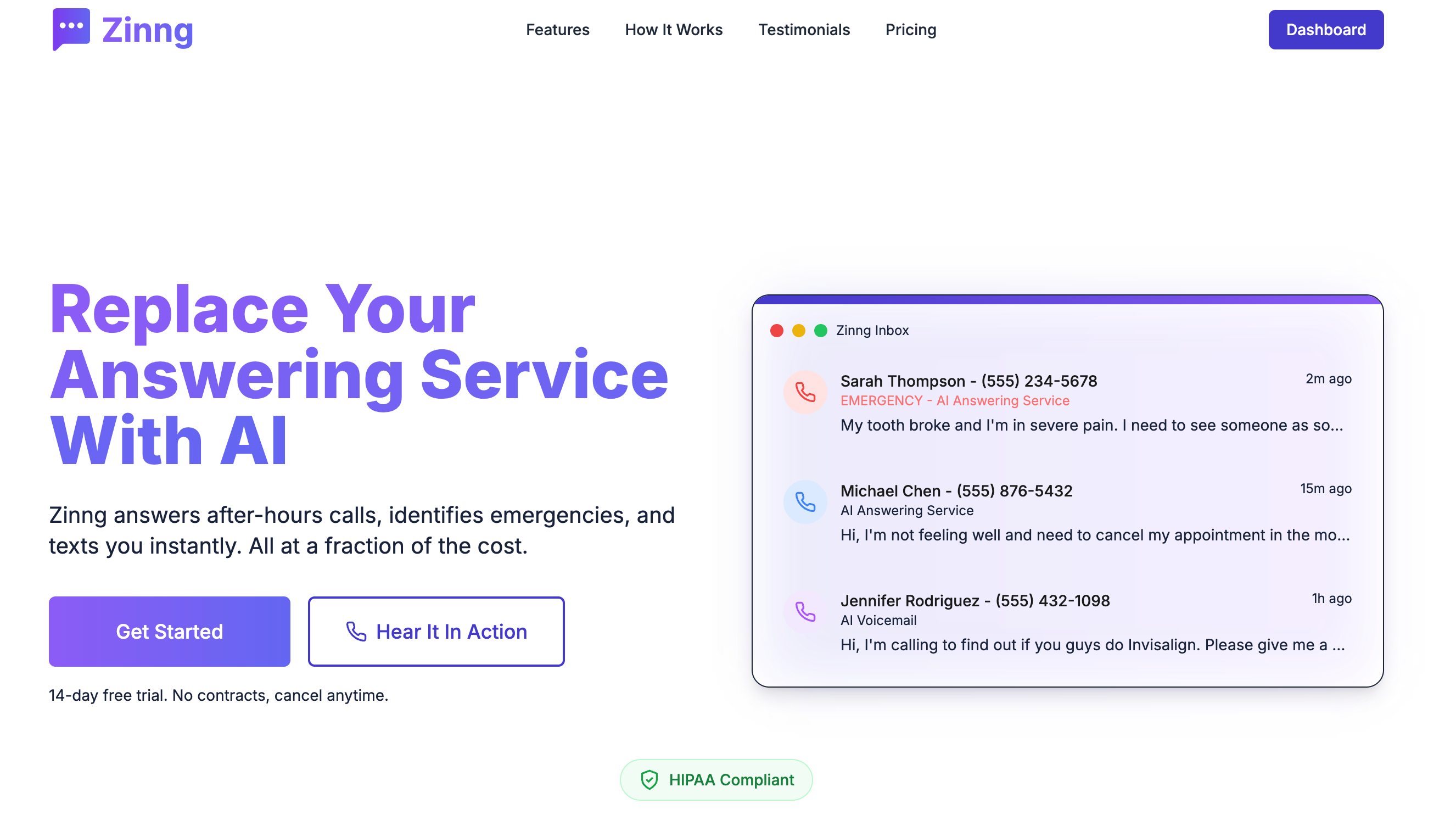
Zinng answers every call with AI trained on your specific business. No hold times, no quality variation between a Tuesday at noon and a Saturday at midnight, and no staffing problems when the Port of Baltimore processes 2,223 vessel calls in a year and the businesses supporting that traffic need around-the-clock phone coverage. For a state with over 600,000 small businesses competing for federal contracts, medical clients, and tourist dollars, answering every call instantly is the starting point for staying competitive.
Every call generates a complete transcript delivered by email with SMS alerts for urgent items. A cybersecurity firm in Columbia gets documented details from a government client calling about a task order at 7pm. A freight forwarder near the Port of Baltimore gets exact container numbers and delivery instructions from an overnight call. A medical practice affiliated with Johns Hopkins gets verbatim patient information from an after-hours call that needs morning follow-up. The transcripts replace operator notes and voicemails, giving Maryland businesses an auditable record of every interaction.
- Pricing: $49/month with 100 minutes included. Additional minutes at $0.12 each. Growth plan at $99/month with 250 minutes. Business plan at $199/month with 600 minutes.
- Best for: Maryland businesses across federal contracting, cybersecurity, healthcare, logistics, and tourism that need affordable, always-on coverage with complete call documentation.
- Key features: 24/7 AI answering, full call transcripts, SMS alerts for urgent calls, HIPAA compliant, custom call routing, spam blocking, appointment scheduling, 14-day free trial with no credit card.
- Standout: A Bethesda consulting firm handling 250 minutes monthly pays $67 with Zinng ($49 base + $18 overage). The cheapest traditional alternative for the same volume costs $250+. In a state where the median household income is $103,000 and business costs run high, the savings compound. Over a year, the difference funds a junior analyst for a week or covers a month of cloud infrastructure.
2. Ruby Receptionists: Best Premium Live Service
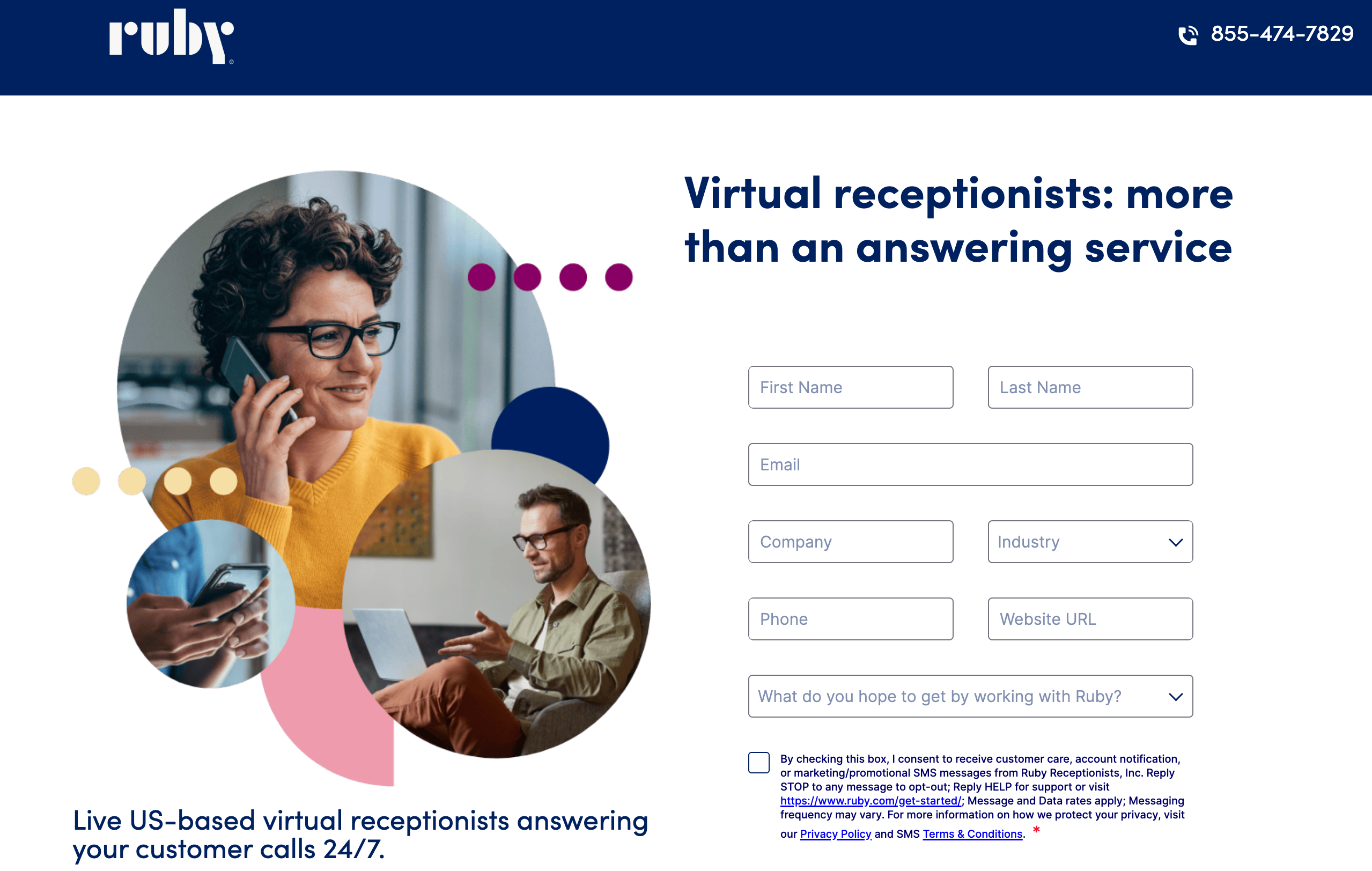
Ruby Receptionists, headquartered in Portland, Oregon, positions itself as the premium live answering service for professional firms. Their receptionists handle calls with a warm, personalized approach that appeals to Maryland's legal, financial, and consulting sectors. With T. Rowe Price headquartered in Baltimore and thousands of investment advisors, accountants, and attorneys serving the D.C. metro corridor, Ruby's reputation for polished call handling aligns with what high-end professional practices expect.
Ruby offers 10 tiers from 50 to 2,500 minutes. All plans include 24/7 inbound answering with bilingual English/Spanish support at no extra charge. Outbound calling is available Monday through Friday, 5am to 6pm Pacific. Ruby integrates with legal practice management tools and CRMs, making it popular with Maryland law firms, especially those in the competitive D.C. suburbs where client experience directly affects referrals and retention.
- Pricing: Call Ruby 50 at $250/month for 50 minutes ($5.40/min overage). Call Ruby 100 at $395/month for 100 minutes ($4.50/min overage). Call Ruby 200 at $720/month for 200 minutes ($4.40/min overage). Call Ruby 500 at $1,725/month for 500 minutes ($4.00/min overage). Higher tiers up to 2,500 minutes at $7,875/month.
- Best for: Maryland law firms, financial advisors, and professional services companies that want premium call handling and are willing to pay for a polished client experience.
- Key features: 24/7 live answering, bilingual English/Spanish included, outbound calling (Mon-Fri 5am-6pm PT), appointment scheduling, call routing, CRM and practice management integrations.
- Drawback: Ruby is the most expensive service on this list by a significant margin. The Call Ruby 200 plan costs $720/month for 200 minutes, an effective rate of $3.60/min. That's nearly twelve times what Zinng charges for identical volume. A Maryland consulting firm that goes 50 minutes over the 200-minute plan pays $220 in overage charges at $4.40/min. For a cybersecurity contractor handling 500 minutes monthly, the $1,725/month cost exceeds the annual salary savings that would come from eliminating a receptionist position. Ruby delivers quality, but the math only works for firms where client experience justifies a premium that can be four to ten times the market average.
3. MAP Communications: Most Budget-Friendly Traditional Service
MAP Communications, founded in 1991 and headquartered in Chesapeake, Virginia (just across the state line from Maryland's Eastern Shore), is 100% employee-owned through an ESOP. That proximity to Maryland means MAP's receptionists are familiar with the region, and the employee-owned structure gives agents a direct financial stake in service quality. For Maryland businesses that want live human answering at the lowest possible monthly cost, MAP's Pay-as-You-Go plan at $49/month with $1.37/min usage billing is the most affordable entry point with a live operator.
MAP offers four tiers, all with 24/7/365 coverage, bilingual English/Spanish support, customizable scripts, and HIPAA compliance. Their HITRUST CSF r2 certification (the first in the answering service industry) adds security validation that matters for Maryland's healthcare and biotech sectors. The 7-day free trial requires no credit card, and accounts go live within 24 to 48 hours. For the thousands of medical practices, dental offices, and home health agencies across Maryland, MAP's combination of HIPAA compliance and affordable pricing fills a specific need.
- Pricing: Pay-as-You-Go at $49/month with $1.37/min (no included minutes). Business at $179/month for 125 minutes ($1.30/min overage). Enterprise at $339/month for 250 minutes ($1.28/min overage). Premium at $649/month for 500 minutes ($1.28/min overage). No setup fees. 7-day free trial, no credit card.
- Best for: Maryland businesses on tight budgets that need live human answering, especially healthcare practices requiring HIPAA and HITRUST compliance.
- Key features: 24/7/365 live answering, bilingual English/Spanish, HIPAA compliant, HITRUST CSF r2 certified, 100% employee-owned (ESOP), customizable scripts, mobile app, 7-day free trial.
- Drawback: The Pay-as-You-Go plan includes zero minutes in the base price. A Maryland plumber handling 200 minutes monthly pays $323 ($49 + $274 in per-minute charges). The Business plan at $179 for 125 minutes is the better match for moderate volume, but the effective rate is still $1.43/min. Some reviews mention inconsistent quality during overnight hours and unexpected holiday surcharges. And unlike Zinng's verbatim call transcripts, MAP relies on operator summaries that vary in detail depending on who takes the call. For a defense contractor that needs precise documentation of every interaction, the summary format may not be sufficient.
4. Nexa: Best for Legal and Medical Practices
Nexa (formerly Answer 1), headquartered in Phoenix, Arizona, focuses on industry-specific call handling for legal, medical, and home services businesses. Their receptionists are trained on legal intake workflows, HIPAA-compliant medical protocols, and service dispatch procedures. For Maryland's dense legal market (the state has approximately 40,000 active attorneys concentrated in Baltimore and the D.C. suburbs) and healthcare sector (anchored by Johns Hopkins' $40 billion economic footprint), Nexa offers specialized handling that generic answering services cannot match.
Nexa operates 24/7/365 across three published plans plus custom Enterprise packages. They integrate with legal CRMs including Clio, PracticePanther, and Filevine, and their medical call handling meets HIPAA documentation requirements. For Maryland personal injury firms, family law practices, and medical offices that need calls handled according to specific intake protocols, Nexa trains its receptionists on those exact workflows.
- Pricing: Plans start at approximately $239/month for 100 minutes. 300-minute and 500-minute tiers available at custom pricing. Overage rates range from $1.59 to $1.99 per minute depending on plan tier. Bilingual English/Spanish support available as a $50/month add-on.
- Best for: Maryland law firms, medical practices, and home services companies that need industry-trained receptionists and CRM integrations specific to their field.
- Key features: 24/7/365 live answering, legal intake and medical call handling, integrations with Clio/PracticePanther/Filevine, HIPAA compliant, appointment scheduling, lead qualification, 14-day free trial.
- Drawback: Nexa does not publish transparent pricing. Billing includes post-call work time (operator data entry after the call counts against your minutes). Holiday surcharges apply on eight major holidays, a technology/compliance fee is added monthly, and credit card payments carry a 3.0% surcharge. These layered fees push the real monthly cost well beyond the base plan price. A Baltimore medical practice handling 200 minutes could see total monthly costs of $500+ once all fees are included. Bilingual support at $50/month extra is also a disadvantage in a state where 12.1% of the population is Hispanic and competitors include it free.
5. Abby Connect: Best for Personalized Service
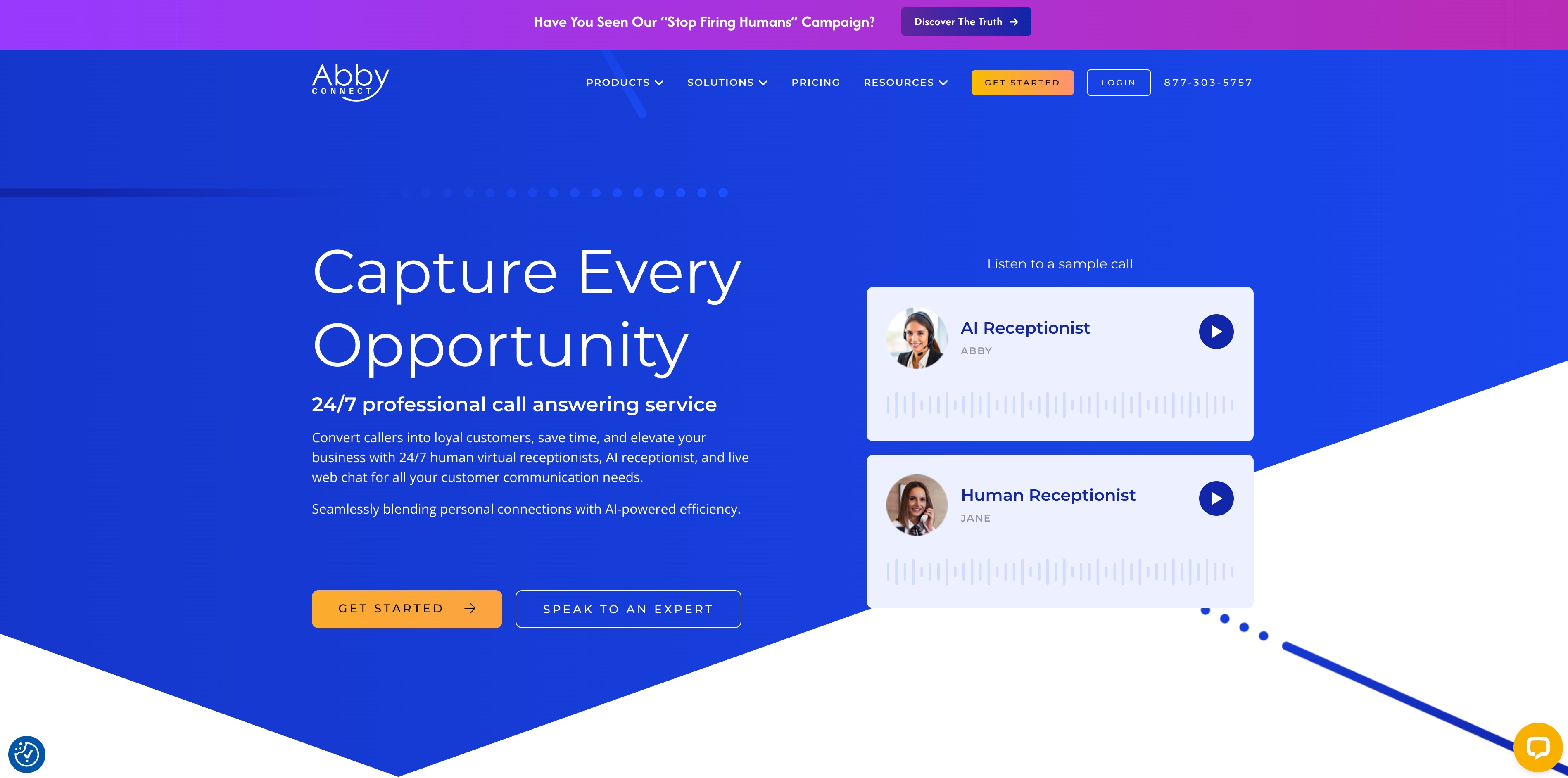
Abby Connect, based in Las Vegas, Nevada, differentiates itself with a dedicated team model. Rather than routing your calls to a pool of hundreds of operators, Abby assigns a small team of receptionists to your account who learn your business, your clients, and your preferences. For Maryland professional services firms where repeat callers expect to be recognized (a financial advisor's long-term client, a law firm's opposing counsel, a consulting firm's government program manager), the dedicated team approach creates a more seamless caller experience.
Abby offers three plans from 100 to 500 minutes. All include bilingual English/Spanish receptionists, a dedicated account manager, voicemail-to-email/text transcription, and unlimited talk time after call transfers. The 14-day free trial provides a genuine test period. For Maryland businesses where client relationships drive revenue (investment advisory firms, boutique law practices, executive consulting shops), Abby's personalized approach can justify the premium pricing.
- Pricing: Essential at $329/month for 100 minutes ($95 one-time setup fee, 14-day free trial). Professional at $599/month for 200 minutes. Growth at $1,380/month for 500 minutes.
- Best for: Maryland professional services firms, boutique law practices, and financial advisors that want dedicated receptionists who know their business and recognize repeat callers.
- Key features: Dedicated receptionist team, bilingual English/Spanish, voicemail-to-email/text, dedicated account manager, unlimited talk time after transfer, appointment scheduling, 14-day free trial.
- Drawback: The Professional plan at $599/month for 200 minutes produces an effective rate of $3.00/min. That's five times what Zinng charges for the same coverage. The $95 setup fee adds to initial costs, and the limited plan flexibility (only three tiers) means businesses that fall between 200 and 500 minutes face either overage charges on the Professional plan or paying for the $1,380 Growth plan with unused minutes. A cybersecurity contractor handling 300 minutes monthly would pay $599 plus overages, while Zinng covers the same volume for $73/month. The dedicated team model is genuinely different from pool-based services, but the cost premium is substantial.
Pricing Comparison
Here's what each service costs for a Maryland business handling approximately 200 minutes of calls per month.
| Service | Starting Price | Cost for 200 min | Per-Min Rate | 24/7? |
|---|---|---|---|---|
| Zinng | $49/mo | $61/mo* | $0.12/min overage | Yes |
| MAP | $49/mo | ~$339/mo** | $1.28/min overage | Yes |
| Nexa | ~$239/mo | ~$437/mo*** | $1.99/min overage | Yes |
| Abby Connect | $329/mo | $599/mo | $3.00/min eff. | Yes |
| Ruby | $250/mo | $720/mo | $4.40/min overage | Yes |
*Zinng's $49 plan includes 100 minutes. 200 minutes = $49 + $12 overage (100 additional minutes at $0.12/min).
**MAP's Enterprise plan at $339/month includes 250 minutes, the closest match for 200-minute usage.
***Nexa's 100-minute plan (~$239) + 100 overage minutes at $1.99/min = ~$438. Additional fees not included.
Why AI Answering Fits Maryland's Economy
Maryland's economy combines federal contracting cycles, cybersecurity operations, biotech timelines, port logistics, and seasonal tourism. AI answering handles all of them:
- Federal contracting runs on deadlines, not business hours. Proposal deadlines don't care if it's 9pm. When a government contracting officer calls a Maryland subcontractor about a modification to a $5 million task order at 6:30pm on a Thursday, that call needs to be answered and documented. AI picks up instantly, captures every detail in a transcript, and sends an SMS alert so the program manager can respond before the deadline passes. Traditional services charge $1.28 to $4.40/min for those after-hours calls. AI charges $0.12/min regardless of when the call comes in. For the thousands of small defense contractors in the Fort Meade-to-BWI corridor, the cost difference over a fiscal year is significant.
- Port logistics operates around the clock. The Port of Baltimore processed 2,223 vessel calls in 2025 with over 1.1 million TEUs. Containers arrive at every hour from every time zone. A freight forwarder coordinating customs clearance at 2am, a trucking company confirming a drayage pickup at 5am, or a warehouse scheduling a delivery window at 11pm needs the same call quality as a noon inquiry. AI answers identically at every hour at $0.12/min. A traditional service at $1.99/min makes those overnight calls thirteen times more expensive for the same information capture.
- Cybersecurity firms handle sensitive communications. With 76,000 cybersecurity workers and 1,200+ firms in the Fort Meade corridor, phone calls in this sector often involve program names, contract numbers, and client identities that require precise handling. AI produces verbatim transcripts of every call. No paraphrasing, no missed details, no operator interpreting technical terminology incorrectly. A cybersecurity contractor in Columbia gets exact documentation of a call from a government client about a vulnerability assessment, not a human operator's summary that omits the CVE number or misspells the system name.
- Tourism seasonality is manageable at flat rates. Ocean City draws 320,000 to 345,000 visitors on summer weekends. Baltimore's Inner Harbor attracts 25 million visitors annually. When an Annapolis sailing charter or an Ocean City vacation rental sees booking calls triple in June, AI handles the surge at the same rate. No overage penalties, no per-minute escalation. The cost increase is proportional to minutes used, not inflated by premium rates that punish seasonal businesses for having a busy month.
- Healthcare documentation meets HIPAA requirements. With Johns Hopkins supporting 149,000 jobs and 15 of the state's medical schools, research hospitals, and affiliated practices fielding patient calls after hours, precise call documentation matters for compliance. AI transcripts provide verbatim records that satisfy HIPAA audit requirements. A patient calling a Bethesda dermatology practice at 8pm about a medication reaction gets their exact words documented, not an operator's interpretation. The transcript becomes part of the clinical communication record.
- Maryland's high cost of living makes outsourcing essential. In a state where the median household income is $103,000 and office space in Bethesda or Columbia runs $30 to $50 per square foot, hiring a full-time receptionist costs $45,000 to $55,000/year before benefits. Zinng's Business plan at $199/month costs $2,388/year for 600 minutes of 24/7 coverage. The receptionist works 40 hours per week. AI works 168. For Maryland's 600,000+ small businesses, the math consistently favors AI for routine call handling.
Human answering services retain clear value for Maryland businesses needing empathetic client interactions, complex legal intake, or the dedicated team approach that Abby Connect provides. But for the majority of business calls, AI delivers faster response, exact documentation, and a cost structure that works for a defense contractor in Hanover and a crab house in St. Michaels alike.
Choosing the Right Service for Your Maryland Business
- Federal contractor, cybersecurity firm, or growing company? Zinng's $49/month plan with per-minute billing gives you 24/7 coverage with verbatim call transcripts that document every interaction. HIPAA compliant. No contracts. The 14-day free trial costs nothing to evaluate against your actual call patterns.
- Law firm, financial advisor, or premium professional practice? Ruby's polished receptionists and practice management integrations make it the prestige choice. Start with Call Ruby 100 at $395/month and budget for $720+/month at 200 minutes. The quality is real, and so is the price.
- Budget-conscious and need live human answering? MAP's $49/month Pay-as-You-Go plan and 7-day free trial offer the lowest-risk entry into professional answering. HIPAA compliant with HITRUST certification. Their Chesapeake, Virginia headquarters means familiarity with the Maryland market.
- Medical practice, legal firm, or home services company needing specialized handling? Nexa's industry-trained receptionists and CRM integrations make them the specialist pick. Budget $239+/month for 100 minutes and request a detailed quote to understand the full fee structure, including the technology fee, holiday surcharges, and credit card processing fees.
- Professional services firm where repeat callers expect recognition? Abby Connect's dedicated team model means the same receptionists handle your calls consistently. At $329+/month, it's a premium, but for a financial advisory firm or boutique law practice where client experience directly drives referrals, the personalization can justify the cost.
- Serving Maryland's Hispanic communities? Zinng, Ruby, MAP, and Abby Connect include bilingual support at no extra charge. Nexa adds it for $50/month. With 12.1% Hispanic population statewide and 17% in Montgomery County, bilingual capability is a business necessity, not a nice-to-have.
Final Verdict
Zinng is the best answering service for Maryland businesses. At $61/month for 200 minutes of 24/7 coverage, it costs a fraction of every traditional alternative while delivering complete call transcripts, HIPAA compliance, and unlimited simultaneous call capacity. Whether you're fielding contract inquiries in the Fort Meade corridor or booking charters in Annapolis, the service operates identically at every hour and every volume level.
Ruby Receptionists is the premium choice for Maryland's professional services sector. The polished call handling and practice management integrations justify the price for law firms, financial advisors, and consulting practices where client experience directly impacts revenue. Budget $720/month for 200-minute coverage.
MAP Communications delivers the most affordable traditional live answering, with HITRUST certification adding security credibility that Maryland's healthcare and biotech sectors need. The employee-owned model and Chesapeake, Virginia headquarters make MAP a regional fit for Eastern Shore and Baltimore-area businesses.
Nexa earns its position for Maryland's legal and medical professionals. Industry-specific training and CRM integrations justify the higher cost for practices where specialized call handling improves case management and patient outcomes. Get a detailed quote before committing.
And Abby Connect fills a specific niche for firms where caller recognition matters. The dedicated team model creates continuity that pool-based services cannot match. At $599/month for 200 minutes, it's a premium, but the personalization is genuine.
Maryland sits at the intersection of government, defense, technology, and commerce. From the cybersecurity firms of Columbia to the container ships at Seagirt Marine Terminal to the crab houses of the Eastern Shore, the phone is where business happens. The right answering service ensures that when Maryland calls, someone always picks up.