Why Minnesota Businesses Need an Answering Service
Minnesota has 547,493 small businesses that represent 99.5% of all employers in the state. Those businesses employ approximately 1.2 million people, 45% of the private workforce. In a state of 5.8 million people with a $395 billion economy and 17 Fortune 500 companies, the expectations for business professionalism are high. But the vast majority of Minnesota businesses are too small for dedicated reception staff and too busy to let calls go unanswered.
The problem intensifies with Minnesota's seasonal swings. A fishing resort on Leech Lake can't answer the phone while launching boats at 5am during opener. A sugar beet farmer near Moorhead can't take a call from the cooperative during October harvest. A medical device sales rep in Minnetonka can't leave a hospital demo to field a new lead. A contractor in Rochester can't climb down from a roof to schedule the next estimate. When 81.6 million visitors spent $14.7 billion across the state last year and agriculture alone generates $26 billion in marketing value, every unanswered call represents money that went somewhere else.
An answering service catches those calls. The question is which one works for Minnesota's particular combination of healthcare, agriculture, manufacturing, tourism, and corporate headquarters.
What Makes Minnesota's Business Environment Distinct
Minnesota punches above its weight economically, with more Fortune 500 companies per capita than nearly any other state:
- Healthcare and medical devices define the economy: Minnesota is the official U.S. Tech Hub for MedTech, with 530+ medical device establishments employing 34,520+ workers at an employment concentration 4.3 times the national average. Mayo Clinic in Rochester employs 40,600 people in Minnesota alone, generates $19.8 billion in annual revenue, and contributes $9.8 billion in economic impact (approximately 4% of the state's entire GDP). The Destination Medical Center initiative is a 20-year, $5.6 billion development plan built around Mayo. UnitedHealth Group in Eden Prairie is the #3 Fortune 500 company with $400.3 billion in revenue and 400,000 employees globally. Medtronic, the world's largest medical device maker, operates from Fridley with 90,000+ employees and $3.7 billion in combined annual R&D spending with Boston Scientific (which has 7,000 Minnesota employees). Solventum, the 3M healthcare spinoff, debuted on the Fortune 500 with $8.2 billion in revenue. The thousands of clinics, specialists, home health agencies, dental practices, and medical suppliers connected to this ecosystem need HIPAA-compliant phone handling and precise after-hours patient routing.
- Agriculture generates $26 billion in marketing value: Minnesota ranks #1 nationally in sugar beets and turkeys, #2 in hogs, #3 in soybeans, and #4 in corn. The state's 65,531 farms produce $8 billion in corn, $5.2 billion in soybeans, $3.6 billion in hogs, and $2.6 billion in dairy across nearly 1,000 food processing establishments employing 53,400 people. Agriculture and food processing together account for about 10% of the state economy at $40.3 billion and 330,000 jobs. Farm operations run on planting and harvest schedules where the operator is in the field from dawn to dark. A grain buyer calling a Fergus Falls elevator at 6am during harvest, a livestock hauler confirming a pickup from a Worthington hog operation at 4:30am, or a cooperative scheduling delivery for a Willmar turkey farm at 7pm needs someone on the phone.
- Tourism spending reached $14.7 billion: Minnesota welcomed 81.6 million visitors in 2024, generating a $24.2 billion total economic impact and supporting 351,292 jobs. The Mall of America in Bloomington draws 40 million+ visitors annually, 80% from out of state, generating $2 to $3 billion in economic impact. The Boundary Waters Canoe Area Wilderness is the most visited wilderness area in the United States with 150,000 to 250,000 visitors per year across 1.1 million acres and 1,100 lakes. Duluth attracts 6.7 million visitors contributing $780 million in direct spending. Minnesota has 11,842 lakes (not 10,000, actually more), 4,500 fishing lakes, and 1.7 million anglers who contribute $2.4 billion in direct retail sales. Tourism businesses from Ely outfitters to Brainerd resorts to North Shore lodges face dramatic seasonal call surges that are impossible to staff permanently.
- Seventeen Fortune 500 companies create massive supply chains: Minnesota's Fortune 500 roster includes UnitedHealth Group (#3, $400.3B), Target (#41, $106.6B), Best Buy (#57, $41.5B), 3M (#77, $24.6B), U.S. Bancorp (#116, $42.7B), General Mills (#147, $19.9B), Ameriprise Financial, C.H. Robinson, Land O'Lakes, Ecolab, Xcel Energy, Hormel Foods, Thrivent Financial, Solventum, Securian Financial, and Fastenal. These corporations anchor supply networks of thousands of small and mid-size businesses across the state. A packaging supplier serving General Mills in Golden Valley, a logistics broker working with C.H. Robinson in Eden Prairie, or a cleaning chemical distributor for Ecolab in St. Paul all need professional phone handling that matches the expectations of their Fortune 500 clients.
- Manufacturing employs 320,000+ workers: Manufacturing produces $46.3 billion in GDP, about 12% of total state economic output, and supports 1 in every 8 jobs. The sector spans food production, computer and electronics, fabricated metal, machinery, and medical devices. Notably, 46% of manufacturing jobs are in Greater Minnesota, not the Twin Cities metro. This geographic spread means thousands of manufacturers operate in rural communities where finding front-desk staff is increasingly difficult as labor force growth has flattened to 0.0% annually.
- The Iron Range produces 85% of U.S. iron ore: Minnesota's Mesabi Range produced 34.6 million dry long tons of taconite pellets in 2024, supporting 11,000 direct and indirect jobs when fully operational. Mining operations, their suppliers, and the communities built around them (Hibbing, Virginia, Eveleth) depend on an industry with cyclical demand and shift-based operations. When Cleveland-Cliffs idles a facility, the contractors and service businesses connected to that mine need to capture every incoming call to stay viable.
- Financial services employ 100,000+ people: The Twin Cities has one of the highest concentrations of finance and insurance employment among large metro areas, with 5,000+ bank and financial services establishments and 4,300 insurance establishments. Five Fortune 500 financial companies are headquartered here. The financial advisors, insurance agents, and wealth managers serving Minnesota's client base handle sensitive communications requiring confidentiality and professionalism at every point of contact.
Top 5 Answering Services for Minnesota Businesses
We evaluated these services against Minnesota's specific demands: healthcare HIPAA compliance, agricultural early hours, lake country tourism seasonality, Fortune 500 supply chain professionalism, manufacturing shift schedules, and bilingual needs for a growing 6.5% Hispanic population.
1. Zinng: Best Overall (AI-Powered)
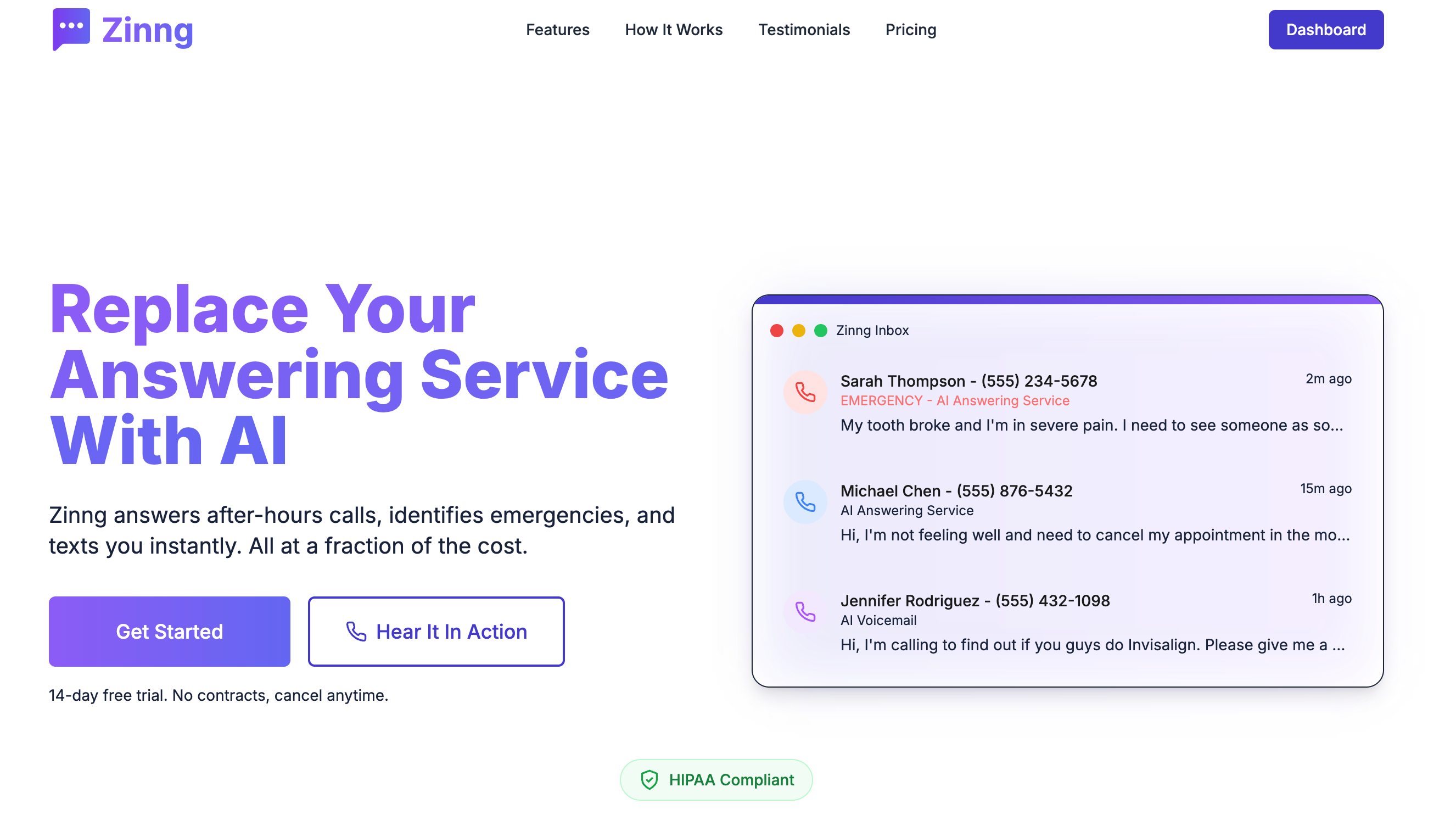
Zinng answers every call with AI trained on your specific business. No hold times, no quality variation between a Tuesday morning in January and a Saturday afternoon in July, and no staffing crisis when lake country tourism triples your summer call volume. For a state with 547,000 small businesses feeding into Fortune 500 supply chains and a healthcare ecosystem anchored by Mayo Clinic, answering every call instantly and documenting it precisely is the starting point for operating at Minnesota's standards.
Every call generates a complete transcript delivered by email with SMS alerts for urgent items. A medical device sales rep in Plymouth gets documented details from a surgeon's office calling at 6pm about a product question. A resort owner on Gull Lake gets the exact party size, dates, and cabin preferences from a booking call at 10pm. A home health agency in Duluth gets verbatim patient information from an after-hours call that needs morning follow-up. The transcripts replace operator notes and voicemails with an auditable record of every interaction.
- Pricing: $49/month with 100 minutes included. Additional minutes at $0.12 each. Growth plan at $99/month with 250 minutes. Business plan at $199/month with 600 minutes.
- Best for: Minnesota businesses across healthcare, agriculture, tourism, manufacturing, and professional services that need affordable, always-on coverage with exact call documentation.
- Key features: 24/7 AI answering, full call transcripts, SMS alerts for urgent calls, HIPAA compliant, custom call routing, spam blocking, appointment scheduling, 14-day free trial with no credit card.
- Standout: A Rochester dental practice handling 250 minutes monthly pays $67 with Zinng ($49 base + $18 overage). The cheapest traditional alternative for the same volume costs $239+. Over a year, that's $2,000+ in savings. For a Minnesota small business operating in a state where labor force growth has flatlined at 0.0%, those savings fund a marketing campaign or cover the difference between hiring and not hiring a part-time employee.
2. MAP Communications: Most Budget-Friendly Traditional Service
MAP Communications, founded in 1991 and headquartered in Chesapeake, Virginia, is 100% employee-owned through an ESOP. That ownership structure means the agents answering your calls have a direct financial stake in service quality. For Minnesota businesses that want live human answering at the lowest possible monthly commitment, MAP's Pay-as-You-Go plan at $49/month with $1.37/min usage billing is the most affordable entry point with a live operator on this list.
MAP offers four tiers, all with 24/7/365 coverage, bilingual English/Spanish support, customizable scripts, and HIPAA compliance. Their HITRUST CSF r2 certification adds security validation that matters for Minnesota's enormous healthcare sector. The 7-day free trial requires no credit card, and accounts go live within 24 to 48 hours. For the medical practices, dental offices, and home health agencies throughout Minnesota connected to Mayo Clinic, UnitedHealth, and the broader healthcare ecosystem, MAP's combination of HIPAA compliance and affordable pricing fills a specific need.
- Pricing: Pay-as-You-Go at $49/month with $1.37/min (no included minutes). Business at $179/month for 125 minutes ($1.30/min overage). Enterprise at $339/month for 250 minutes ($1.28/min overage). Premium at $649/month for 500 minutes ($1.28/min overage). No setup fees. 7-day free trial, no credit card.
- Best for: Minnesota businesses on tight budgets that need live human answering, especially healthcare practices requiring HIPAA and HITRUST compliance.
- Key features: 24/7/365 live answering, bilingual English/Spanish, HIPAA compliant, HITRUST CSF r2 certified, 100% employee-owned (ESOP), customizable scripts, mobile app, 7-day free trial.
- Drawback: The Pay-as-You-Go plan includes zero minutes in the base price. A Minnetonka plumber handling 200 minutes monthly pays $323 ($49 + $274 in per-minute charges). The Business plan at $179 for 125 minutes is a better fit for moderate volume, but the effective rate is still $1.43/min. Some reviews mention inconsistent quality during overnight hours and unexpected holiday surcharges. Unlike Zinng's verbatim transcripts, MAP relies on operator summaries that vary in detail depending on who takes the call. For a medical device company needing precise documentation of product inquiries, the summary format may not capture the technical specificity required.
3. Abby Connect: Best for Personalized Service
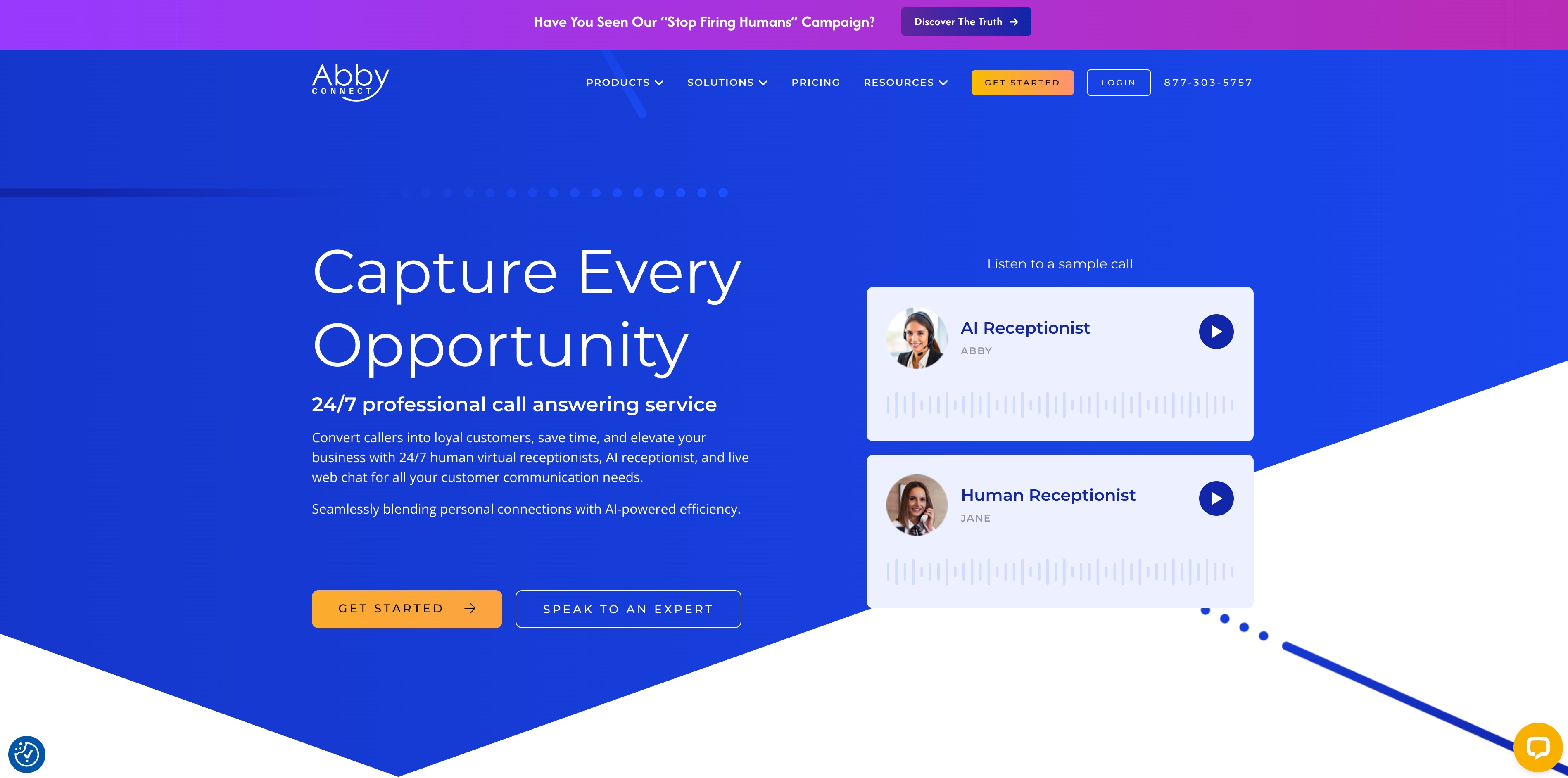
Abby Connect, based in Las Vegas, Nevada, differentiates itself with a dedicated team model. Rather than routing your calls to a rotating pool of operators, Abby assigns a small team of receptionists to your account who learn your business, your clients, and your preferences. For Minnesota professional services firms where repeat callers expect recognition (a financial advisor's long-term client at Ameriprise, a law firm's opposing counsel, an insurance agent's policyholders at Securian), the dedicated team approach creates caller continuity that pool-based services cannot match.
Abby offers three plans from 100 to 500 minutes. All include bilingual English/Spanish receptionists, a dedicated account manager, voicemail-to-email/text transcription, and unlimited talk time after call transfers. The 14-day free trial provides a genuine test period. For Minnesota's dense professional services market (5,000+ financial establishments, thousands of insurance agents, and the legal firms serving 17 Fortune 500 headquarters), Abby's personalized approach can justify the premium.
- Pricing: Essential at $329/month for 100 minutes ($95 one-time setup fee, 14-day free trial). Professional at $599/month for 200 minutes. Growth at $1,380/month for 500 minutes.
- Best for: Minnesota professional services firms, financial advisors, and insurance agencies that want dedicated receptionists who recognize repeat callers and learn business-specific protocols.
- Key features: Dedicated receptionist team, bilingual English/Spanish, voicemail-to-email/text, dedicated account manager, unlimited talk time after transfer, appointment scheduling, 14-day free trial.
- Drawback: The Professional plan at $599/month for 200 minutes produces an effective rate of $3.00/min, five times what Zinng charges for identical coverage. The $95 setup fee adds to initial costs, and the limited plan flexibility (three tiers only) means businesses between 200 and 500 minutes face either overage charges or paying for the $1,380 Growth plan with unused capacity. A Bloomington insurance agency handling 300 minutes monthly pays $599 plus overages, while Zinng covers the same volume for $73/month. The dedicated team model delivers genuine personalization, but the cost premium is substantial for Minnesota businesses where margins are tight.
4. Nexa: Best for Legal and Medical Practices
Nexa (formerly Answer 1), headquartered in Phoenix, Arizona, builds its service around industry-specific call handling for legal, medical, and home services businesses. Their receptionists are trained on legal intake workflows, HIPAA-compliant medical protocols, and service dispatch procedures. For Minnesota's healthcare sector (where Mayo Clinic alone generates a $9.8 billion state economic impact and thousands of affiliated practices operate statewide), Nexa's medical-specific training offers call handling that generic services cannot match.
Nexa operates 24/7/365 with legal CRM integrations including Clio, PracticePanther, and Filevine. Their medical answering meets HIPAA documentation requirements. For the personal injury firms, family law practices, and medical offices across the Twin Cities and Greater Minnesota, Nexa trains its receptionists on the exact intake workflows those practices use. A 14-day free trial allows evaluation before commitment.
- Pricing: Plans start at approximately $239/month for 100 minutes. 300-minute and 500-minute tiers available at custom pricing. Overage rates range from $1.59 to $1.99 per minute depending on plan tier. Bilingual English/Spanish support available as a $50/month add-on.
- Best for: Minnesota law firms, medical practices, and home services companies that need industry-trained receptionists and CRM integrations specific to their field.
- Key features: 24/7/365 live answering, legal intake and medical call handling, integrations with Clio/PracticePanther/Filevine, HIPAA compliant, appointment scheduling, lead qualification, 14-day free trial.
- Drawback: Nexa does not publish transparent pricing. Billing includes post-call work time (operator data entry counts against your minutes). Holiday surcharges apply on eight major holidays, a technology/compliance fee is added monthly, and credit card payments carry a 3.0% surcharge. These layered fees push the real monthly cost well beyond the base plan. A St. Paul medical practice handling 200 minutes could see total costs of $500+ when all fees are included. Bilingual support at $50/month extra is a disadvantage in a state where the Hispanic population has grown 38% since 2010 and competitors include it free.
5. Specialty Answering Service (SAS): Most Flexible Pricing
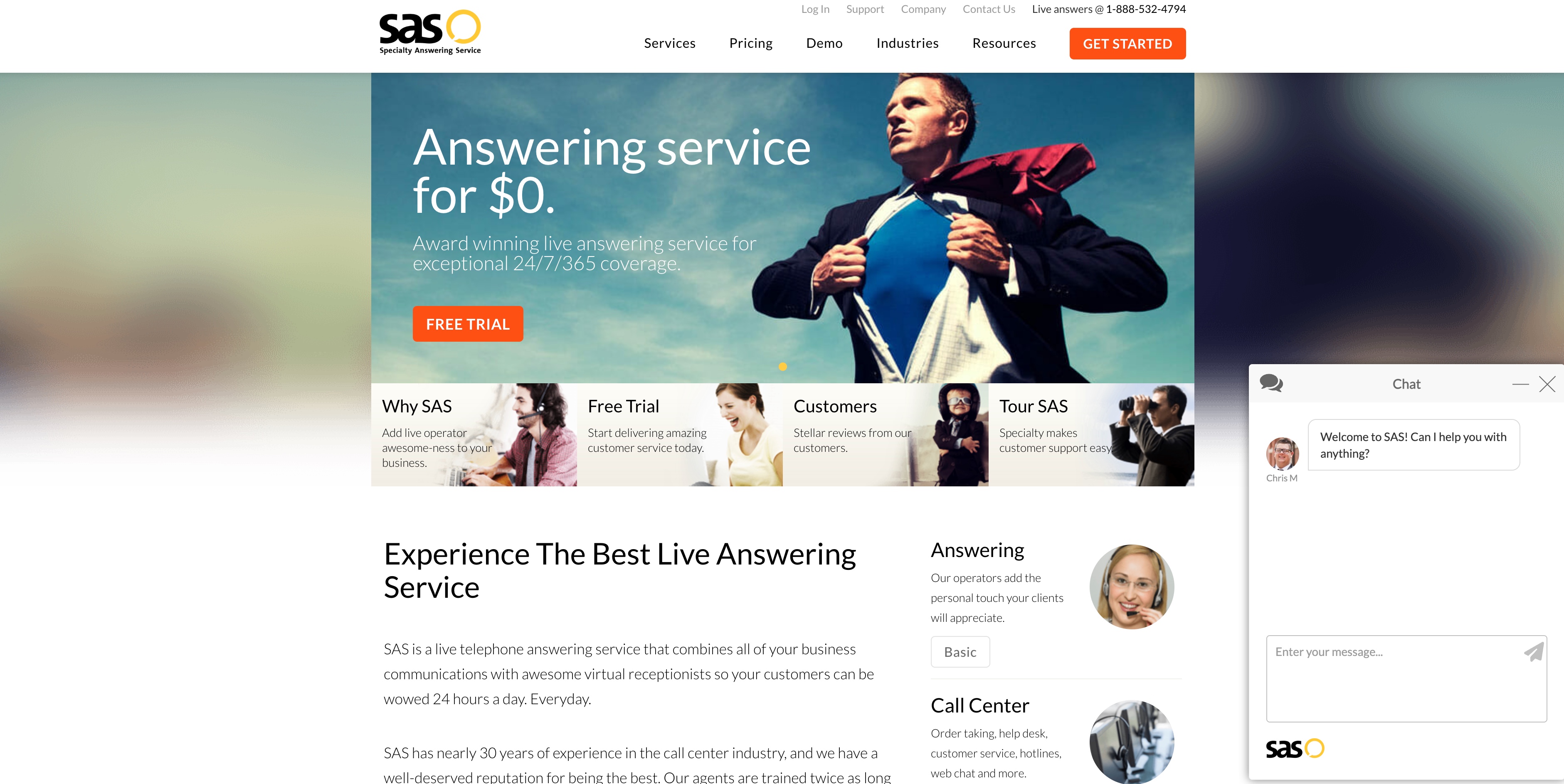
Specialty Answering Service (SAS), headquartered in King of Prussia, Pennsylvania, offers the widest range of pricing tiers of any traditional answering service. Their pay-as-you-go plan starts at $44/month with $1.54/min usage, and flat-rate plans scale from $159/month for 100 minutes up to $10,599/month for 10,000 minutes. For Minnesota businesses with highly variable call volumes (a lake resort that fields 500 minutes in July and 50 in January, or a farm supply dealer that peaks during spring planting and fall harvest), SAS provides a tier for nearly every volume level.
SAS includes 24/7/365 live answering, bilingual English/Spanish support, HIPAA compliance, and a 2-week free trial requiring no credit card. The service handles message taking, order processing, and appointment scheduling on every plan. For Minnesota's seasonal businesses across tourism, agriculture, and outdoor recreation, the ability to adjust between pay-as-you-go in the off-season and a flat-rate plan during peak months offers flexibility that fixed-plan competitors cannot match.
- Pricing: Pay-as-you-go at $44/month base + $1.54/min. Flat-rate plans from $159/month for 100 minutes to $10,599/month for 10,000 minutes. Volume discounts at higher tiers.
- Best for: Minnesota businesses with highly variable or seasonal call volumes that need flexible pricing and the option to scale up or down month by month.
- Key features: 24/7/365 live answering, bilingual English/Spanish, HIPAA compliant, message taking, order processing, appointment scheduling, 2-week free trial (no credit card).
- Drawback: The pay-as-you-go rate of $1.54/min makes moderate volume expensive. A Duluth property management company handling 200 minutes monthly pays $352 ($44 + $308). The $159 flat-rate plan for 100 minutes is a better starting point for regular volume, but 100 additional overage minutes would still add significant cost. Some customer reviews mention inconsistent quality during overnight shifts and a dated website. SAS handles the basics competently, but the operator notes are summaries rather than verbatim transcripts, and the service lacks the deep CRM integrations that Minnesota's tech-forward Fortune 500 supplier network often expects.
Pricing Comparison
Here's what each service costs for a Minnesota business handling approximately 200 minutes of calls per month.
| Service | Starting Price | Cost for 200 min | Per-Min Rate | 24/7? |
|---|---|---|---|---|
| Zinng | $49/mo | $61/mo* | $0.12/min overage | Yes |
| MAP | $49/mo | ~$339/mo** | $1.28/min overage | Yes |
| Nexa | ~$239/mo | ~$437/mo*** | $1.99/min overage | Yes |
| SAS | $44/mo | ~$352/mo**** | $1.54/min (PAYG) | Yes |
| Abby Connect | $329/mo | $599/mo | $3.00/min eff. | Yes |
*Zinng's $49 plan includes 100 minutes. 200 minutes = $49 + $12 overage (100 additional minutes at $0.12/min).
**MAP's Enterprise plan at $339/month includes 250 minutes, the closest match for 200-minute usage.
***Nexa's 100-minute plan (~$239) + 100 overage minutes at $1.99/min = ~$438. Additional fees not included.
****SAS pay-as-you-go: $44 base + 200 minutes at $1.54/min = $352. The $159 flat-rate for 100 minutes + 100 overage is also an option.
Why AI Answering Fits Minnesota's Economy
Minnesota's economy combines world-class healthcare, seasonal agriculture, lake country tourism, and Fortune 500 corporate infrastructure. AI answering addresses all of them:
- Healthcare calls need exact documentation. With Mayo Clinic generating $9.8 billion in state economic impact and 530+ medical device companies in the Twin Cities, after-hours patient calls and product inquiries happen constantly. AI produces verbatim transcripts that satisfy HIPAA documentation requirements. A patient calling a Rochester specialist at 9pm about a post-surgical concern gets their exact words recorded, not an operator's interpretation. A surgeon's office calling Medtronic's local rep at 6pm about a device question gets documented precisely. For an industry where Minnesota leads the nation, the quality of call documentation directly affects patient outcomes and business relationships.
- Tourism seasonality is manageable at flat rates. Minnesota's 11,842 lakes, Boundary Waters, and North Shore attract 81.6 million visitors with massive summer peaks. A Brainerd resort that fields 400 minutes in July pays $85 with Zinng ($49 + $36 overage). The same volume at $1.54/min with SAS costs $660. That's $575/month in savings during each of the four busiest months, totaling $2,300. For a lake resort that makes most of its annual revenue in 16 weeks, every dollar saved on phone handling goes back into the guest experience.
- Agriculture starts before dawn. Sugar beet harvest in the Red River Valley, corn and soybean operations across southern Minnesota, and turkey and hog farms statewide generate calls at predawn hours. A grain buyer calling a Kandiyohi County elevator at 5am, a livestock hauler confirming a pickup from a Pipestone hog operation at 4:30am, or a cooperative scheduling delivery at 6:30am needs the same quality of handling as a noon inquiry. AI answers at 4:30am with identical quality and at $0.12/min. Traditional services charge the same per-minute rate at 4:30am, but overnight operators are less alert and more likely to miss bushel counts or delivery addresses.
- Fortune 500 supply chains expect professionalism. When 17 Fortune 500 companies operate from Minnesota, the small businesses supplying them need phone handling that matches corporate expectations. A packaging company supplying General Mills, a cleaning products distributor for Ecolab, or a temp staffing agency placing workers at Target headquarters all field calls from corporate procurement and operations teams. AI answers instantly, professionally, and consistently. No hold times, no quality variation, no "sorry, we missed your call." For small suppliers competing to retain Fortune 500 contracts, the phone experience is part of the vendor evaluation.
- The Iron Range and Greater Minnesota face staffing challenges. With 46% of manufacturing jobs outside the Twin Cities metro and rural county earnings averaging 75% of the state average, hiring a full-time receptionist in Greater Minnesota is both expensive relative to local wages and difficult in a labor market with 0.0% annual growth. A machine shop in Hibbing, a medical clinic in Fergus Falls, or a resort in Grand Marais can't find and retain reception staff the way a Minneapolis firm can. AI provides 24/7 coverage without competing in one of the tightest rural labor markets in the Midwest.
- Financial services demand confidentiality. With 100,000+ people in finance-related roles and five Fortune 500 financial companies headquartered in Minnesota, phone calls often involve account details, investment discussions, and sensitive financial information. AI produces verbatim transcripts that can be secured and archived without a human operator listening to the conversation. For a wealth manager serving clients through Ameriprise or a claims adjuster at Securian, the confidentiality built into AI answering is a structural advantage.
Human answering services retain value for Minnesota businesses needing empathetic patient interactions, complex legal intake, or the dedicated team approach. But for the majority of calls (scheduling, inquiries, routing, documentation), AI delivers faster response, exact transcripts, and a cost structure that works for a Twin Cities financial advisor and a Boundary Waters outfitter alike.
Choosing the Right Service for Your Minnesota Business
- Healthcare, manufacturing, or any growing business? Zinng's $49/month plan with per-minute billing gives you 24/7 coverage with verbatim call transcripts. HIPAA compliant. No contracts. The 14-day free trial costs nothing to evaluate against your actual call patterns.
- Budget-conscious and need live human answering? MAP's $49/month Pay-as-You-Go plan and 7-day free trial offer the lowest-risk entry into professional answering. HIPAA compliant with HITRUST certification. Graduate to the $179 Business plan once you confirm the service pays for itself.
- Professional services firm where repeat callers expect recognition? Abby Connect's dedicated team model means the same receptionists handle your calls consistently. At $329+/month, it's a premium, but for financial advisory firms and boutique law practices where client experience drives referrals, the personalization can justify the cost.
- Medical practice, legal firm, or home services company needing specialized handling? Nexa's industry-trained receptionists and CRM integrations make them the specialist pick. Budget $239+/month for 100 minutes and request a detailed quote to understand the full fee structure.
- Highly seasonal business needing maximum pricing flexibility? SAS's range from pay-as-you-go to 10,000-minute flat-rate plans means you can scale with the seasons. Use the $44/month pay-as-you-go in winter and switch to a flat-rate plan for summer peak. The 2-week free trial (no credit card) lets you test without risk.
- Serving Minnesota's Hispanic communities? Zinng, MAP, Abby Connect, and SAS include bilingual support at no extra charge. Nexa adds it for $50/month. With 6.5% Hispanic population statewide (38% growth since 2010), bilingual capability is increasingly important for healthcare, legal, and service businesses.
Final Verdict
Zinng is the best answering service for Minnesota businesses. At $61/month for 200 minutes of 24/7 coverage, it costs a fraction of every traditional alternative while delivering complete call transcripts, HIPAA compliance, and unlimited simultaneous call capacity. Whether you're fielding patient calls in Rochester or booking cabin rentals on Mille Lacs, the service operates identically at every hour and every volume level.
MAP Communications delivers the most affordable traditional live answering with HITRUST certification that Minnesota's healthcare sector demands. The employee-owned model and $49/month starting price make MAP a solid choice for budget-conscious businesses that want human receptionists at the lowest possible cost.
Abby Connect fills a specific niche for firms where caller recognition matters. The dedicated team model creates continuity that pool-based services cannot match. At $599/month for 200 minutes, it's a premium, but for Minnesota's financial advisors and boutique law practices, the personalization is genuine.
Nexa earns its position for Minnesota's legal and medical professionals. Industry-specific training and CRM integrations justify the cost for practices where specialized call handling directly improves case management and patient care. Get a detailed quote before committing to understand the full fee structure.
And SAS provides the most flexible pricing for Minnesota's seasonal businesses. The ability to toggle between pay-as-you-go and flat-rate plans mirrors the reality of running a lake resort, a farm supply business, or a North Shore outfitter where call volumes swing dramatically by season.
Minnesota built its economy on healthcare innovation, agricultural production, corporate leadership, and the lakes that draw millions every summer. From Mayo Clinic's corridors in Rochester to the taconite mines of the Iron Range to the canoe routes of the Boundary Waters, the phone is where Minnesota business happens. The right answering service ensures that when Minnesota calls, someone always picks up.