Why Texas Businesses Need an Answering Service
Texas has 2.9 million small businesses employing 5.1 million workers, roughly 44% of the state's private workforce. With a $2.77 trillion GDP that grew 3.95% in 2024 (compared to 2.79% nationally), 54 Fortune 500 company headquarters, and no state income tax, the Lone Star State is the most competitive business environment in America. But 2.9 million small businesses means 2.9 million phone lines that need answering, and most of those businesses are run by owners who are also the plumber under the sink, the attorney in court, or the oilfield supervisor on location.
The scale of Texas creates a geography problem that compounds the phone problem. It is 800 miles from El Paso to Beaumont. A roofing contractor in Dallas cannot stop mid-inspection to take a booking call. An immigration attorney in Houston cannot leave a client meeting for a prospective client's intake call. A ranch supply store outside San Angelo cannot leave the counter during feeding season to schedule deliveries. An urgent care clinic in the Rio Grande Valley cannot have front desk staff answering phones and checking in patients simultaneously during flu season. When 62 million travelers spent $97.5 billion across the state last year, and the Texas Medical Center alone sees 10 million patients annually, every unanswered call is revenue that goes to the next name on Google.
An answering service makes sure those calls get handled. Here are five that work for Texas's enormous, diverse business environment.
What Shapes Texas's Business Environment
Texas is not one economy; it is several, each with distinct communication demands:
- Energy dominates the global stage: Texas produces more crude oil, natural gas, and wind power than any other state. It generates more electricity than any other state, more than double the second-place finisher. The Energy Corridor along I-10 west of Houston hosts over 2,500 energy-related businesses employing 300,000+ people regionally. From Permian Basin drilling operations in Midland-Odessa to wind farms in the Panhandle, energy businesses run around the clock. A wellsite supervisor 90 miles from the nearest town gets calls from supply vendors, safety inspectors, and corporate dispatchers at all hours. The 24/7 operational rhythm of energy production means 9-to-5 phone coverage is inadequate for a large share of the state's employers.
- Healthcare is a trillion-dollar sector: The Texas Medical Center in Houston is the largest medical complex on earth, with 61 institutions, 106,000 employees, and 10 million annual patient encounters. But healthcare in Texas extends far beyond TMC. Dallas-Fort Worth, San Antonio, and Austin each have major hospital systems, and rural Texas has hundreds of clinics serving populations spread across immense distances. HIPAA compliance, after-hours patient calls, and appointment scheduling generate a constant volume of phone traffic that clinics cannot staff internally without pulling nurses from patient care.
- Technology has made Texas its second home: Austin's Silicon Hills hosts Tesla's Gigafactory, Oracle's relocated headquarters, Apple's billion-dollar campus, Samsung's $17 billion chip fabrication plant, and thousands of startups. Texas is the nation's largest exporter of semiconductors. Dallas-Fort Worth has become a major tech hub with Texas Instruments, AT&T, and a deep bench of enterprise software companies. San Antonio's cybersecurity industry, anchored by the NSA Texas Cryptologic Center and USAA, employs thousands. Tech companies require fast, professional phone handling for customer support overflow, investor relations, and vendor management, often across multiple time zones.
- Military installations are a state within the state: Fort Cavazos (formerly Fort Hood) is one of the largest active-duty military posts in the world. Fort Bliss near El Paso, Joint Base San Antonio (Lackland, Randolph, and Fort Sam Houston), and Naval Air Station Corpus Christi anchor regional economies. The defense contractors, military families, and service businesses surrounding these bases generate communication flows with specific documentation requirements. A family law attorney near Fort Cavazos handling military divorces, a moving company serving PCS transfers at Fort Bliss, or a property manager renting to Lackland trainees all need responsive phone systems.
- Agriculture produces over $30 billion annually: Texas leads the nation in cattle, cotton, and hay production. The state has 248,000 farms and ranches covering 127 million acres. Ranchers in the Hill Country, cotton farmers in the South Plains, citrus growers in the Rio Grande Valley, and rice producers along the Gulf Coast operate on schedules dictated by weather and seasons, not business hours. A cattle buyer calling a Hereford auction barn at 5am or a cotton gin operator coordinating loads from Lubbock County at midnight needs the call answered.
- A 40% Hispanic population requires bilingual service: Texas is roughly 40% Hispanic, with South Texas, El Paso, and San Antonio being majority-Hispanic markets. A business serving these communities without bilingual phone capability is leaving revenue on the table. From insurance agencies in the Valley to dental practices in East Austin to HVAC companies in Laredo, bilingual phone answering is not an add-on; it is a baseline requirement.
- Tourism generated $97.5 billion in 2024: Texas welcomed 62 million travelers who spent a record $97.5 billion. The San Antonio River Walk, Big Bend National Park, South Padre Island, the Fort Worth Stockyards, and hundreds of other destinations create hospitality and service businesses that experience dramatic seasonal and event-driven call surges. A South Padre hotel during spring break, a Fredericksburg B&B during wildflower season, or a Dallas event venue during State Fair of Texas week each face temporary call volumes that would require hiring seasonal staff to handle by phone alone.
Top 5 Answering Services for Texas Businesses
We evaluated these services against Texas's business profile: 24/7 energy operations, massive healthcare infrastructure, rapid tech growth, military base demands, agricultural schedules, bilingual requirements, and the sheer scale of 2.9 million small businesses competing for customers across 268,596 square miles.
1. Zinng: Best Overall (AI-Powered)
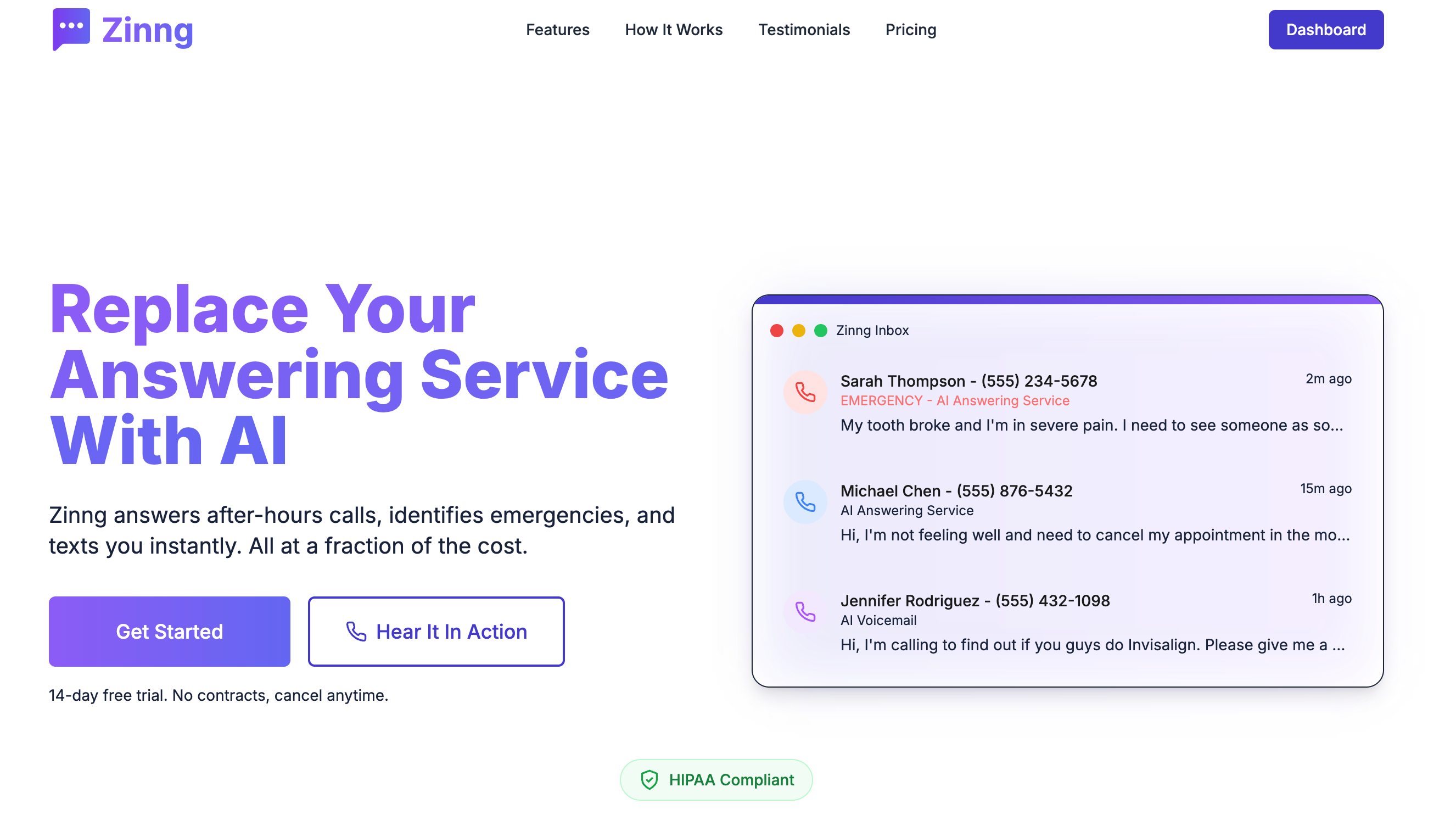
Zinng is built for the kind of business environment Texas creates. AI trained on your specific business answers every call identically at 2pm and 2am, on a slow Tuesday in January and during State Fair week in October. No hold queues. No quality fluctuation. No cap on simultaneous calls. For a state where an HVAC company in August might field ten calls at once and a Permian Basin services company receives dispatch requests at midnight, Zinng's ability to scale without degradation is not a luxury. It is what keeps your business competitive.
Every call generates a complete transcript delivered by email with SMS alerts for anything urgent. A Houston immigration attorney gets the caller's case type, visa status, and callback number documented precisely. A Dallas property management company gets the tenant's unit number, maintenance issue, and urgency level transcribed verbatim. An Austin startup's investor relations line captures fund interest and contact details without a human intermediary. In Texas's fast-moving business culture, where deals close over the phone and the next caller is not willing to wait, Zinng captures every one of them.
- Pricing: $49/month with 100 minutes included. Additional minutes at $0.12 each. Growth plan at $99/month with 250 minutes. Business plan at $199/month with 600 minutes.
- Best for: Texas businesses of any size and any industry that need scalable 24/7 coverage without paying $2+ per minute for overflow.
- Key features: 24/7 AI answering, full call transcripts, SMS alerts for urgent calls, HIPAA compliant, custom call routing, spam blocking, appointment scheduling, 14-day free trial with no credit card.
- Standout: A San Antonio HVAC company handling 400 minutes during a July heat wave pays $87 on the Growth plan ($99 base + $18 overage for 150 extra minutes). The same volume on a traditional service at $2.10/min overage costs $735+. Over a three-month Texas summer, Zinng saves $1,944 compared to the traditional alternative. For seasonal businesses where summer revenue funds the entire year, that savings goes directly to the bottom line.
2. Ruby Receptionists: Best Premium Live Service
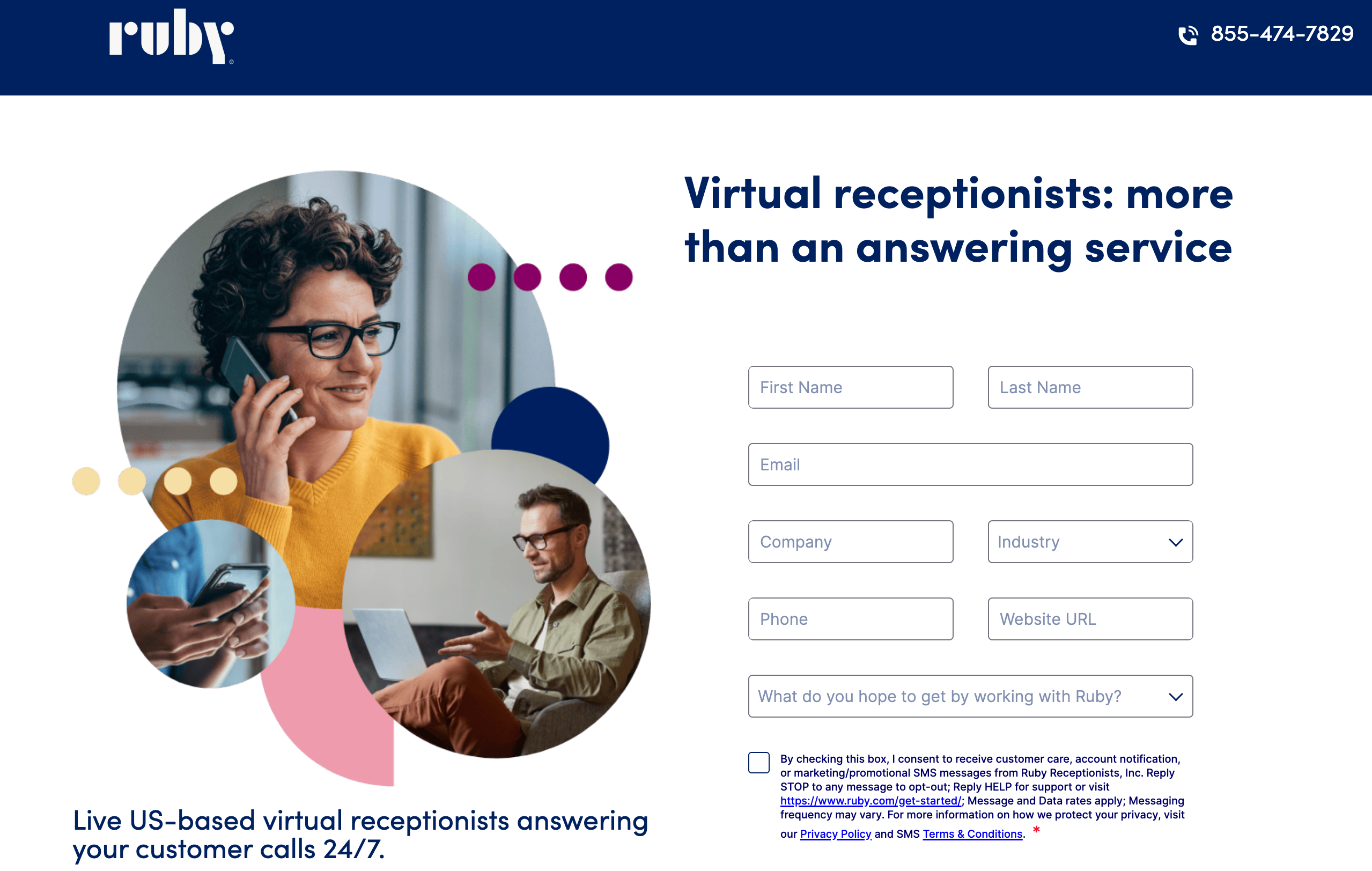
Ruby Receptionists, headquartered in Portland, Oregon, has built its reputation on the quality of its live receptionists. Callers speak to a human who is trained, warm, and capable of handling complex conversations. For Texas law firms, especially the personal injury practices in Houston, corporate litigation firms in Dallas, and immigration attorneys along the border, Ruby's premium receptionists provide the kind of polished first impression that can convert a prospective client into a retained one. The bilingual inbound English/Spanish service (available 24/7) is particularly relevant in a state where 40% of the population speaks Spanish.
Ruby offers ten pricing tiers from 50 to 2,500 minutes, making them one of the few traditional services that can scale with larger Texas businesses. The Call Ruby 200 plan at $720/month for 200 minutes is the most common mid-range option. Outbound calling is available Monday through Friday, 5am to 6pm Pacific. For Texas firms whose brand depends on the caller experience (a luxury real estate brokerage in Highland Park, a boutique wealth management firm in the Galleria area), Ruby delivers a human touch that AI cannot fully replicate.
- Pricing: Call Ruby 50 at $250/month for 50 minutes ($5.40/min overage). Call Ruby 100 at $395/month for 100 minutes ($4.50/min overage). Call Ruby 200 at $720/month for 200 minutes ($4.40/min overage). Call Ruby 500 at $1,725/month for 500 minutes ($4.00/min overage).
- Best for: Texas law firms, luxury service businesses, and professional practices where the quality of the caller experience directly affects client acquisition and retention.
- Key features: Live virtual receptionists, bilingual English/Spanish (24/7 inbound), outbound calling (Mon-Fri 5am-6pm PT), call routing, appointment scheduling, 10 plan tiers.
- Drawback: The cost is substantial. At $720/month for 200 minutes, Ruby's effective rate is $3.60/min. Overages at $4.40/min punish volume spikes. A Houston personal injury firm fielding 300 minutes in a busy month pays $720 + $440 overage (100 minutes at $4.40), totaling $1,160. Zinng covers the same 300 minutes for $73/month ($49 + $24 overage). The annual difference at 200 minutes is $7,908. Ruby's ten-tier structure helps manage costs at higher volumes, but even the 500-minute plan at $1,725/month costs $3.45/min effective. For the vast majority of Texas's 2.9 million small businesses, this pricing puts Ruby out of reach.
3. Abby Connect: Best for Dedicated Service
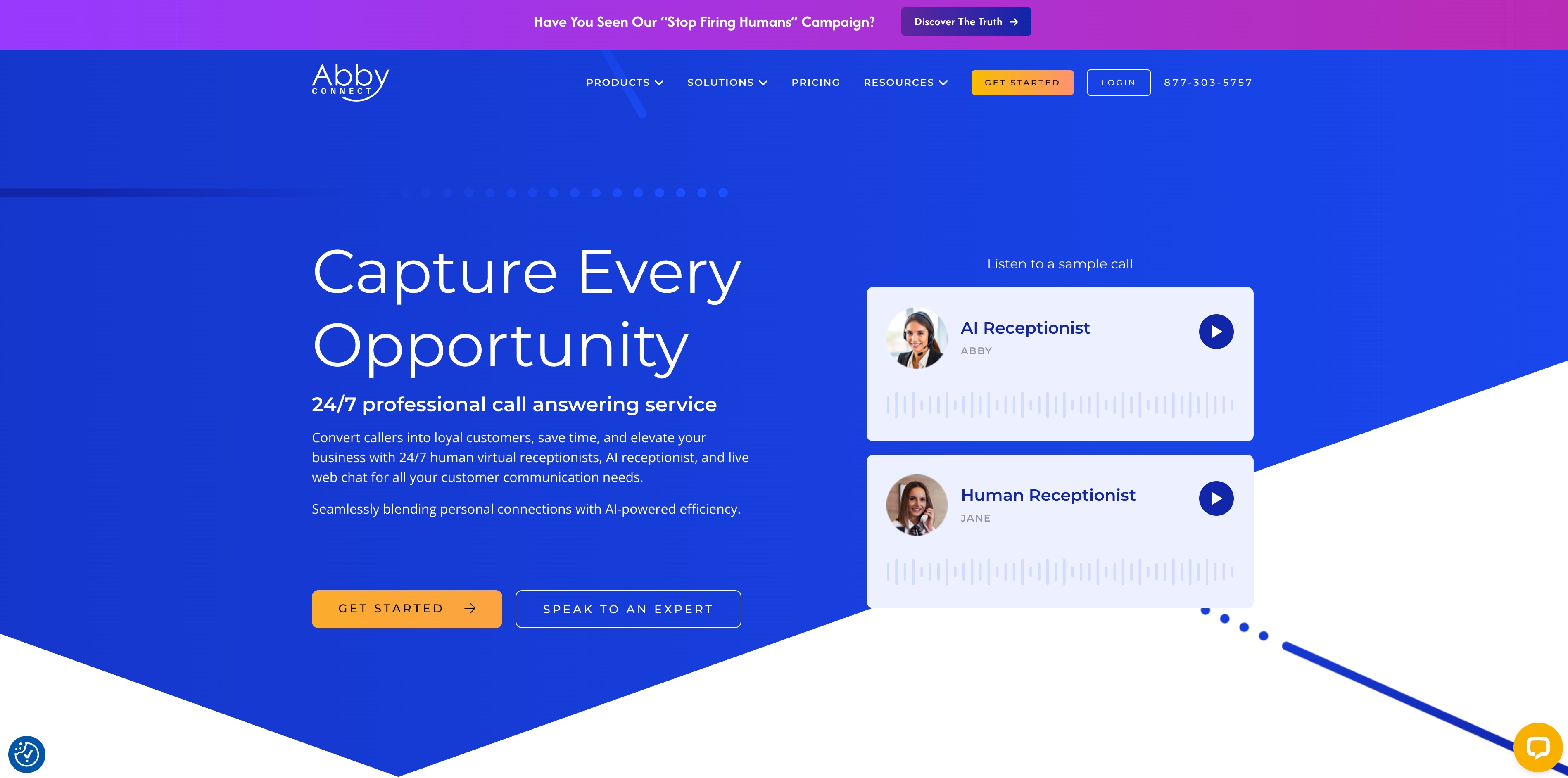
Abby Connect operates from Las Vegas, Nevada, and differentiates itself by assigning a dedicated team of receptionists to each account. Rather than your calls landing with whichever operator is available, the same small group learns your business, remembers your regular callers, and follows your specific preferences. For Texas professional services firms where repeat client communication is central (a Dallas accounting firm whose clients call monthly, a San Antonio estate planning attorney whose families call across generations), Abby's dedicated model creates genuine continuity.
Three plan tiers cover 100 to 500 minutes, all with bilingual English/Spanish receptionists, voicemail-to-email/text transcription, and a dedicated account manager. The 14-day free trial lets you evaluate whether the dedicated approach matches your business before paying. For Texas businesses where the caller relationship extends beyond a single transaction (financial advisors, family law attorneys, concierge medical practices), Abby's team model provides something that pool-based services and AI fundamentally do not: recognition.
- Pricing: Essential at $329/month for 100 minutes ($95 one-time setup fee, 14-day free trial). Professional at $599/month for 200 minutes. Growth at $1,380/month for 500 minutes.
- Best for: Texas professional services firms, financial advisors, and law practices where ongoing client relationships benefit from caller recognition and personalized handling.
- Key features: Dedicated receptionist team, bilingual English/Spanish, voicemail-to-email/text, dedicated account manager, unlimited talk time after transfer, appointment scheduling, 14-day free trial.
- Drawback: Three plan tiers leave little room for businesses between the tiers. A Fort Worth insurance agency using 250 minutes either overpays for the 200-minute Professional plan with expensive overages or jumps to the $1,380 Growth plan. At $599/month for 200 minutes, the effective rate is $3.00/min. The $95 setup fee adds first-month cost. Zinng covers 200 minutes for $61/month. Over twelve months at 200 minutes, Abby costs $7,283 (including setup) versus $732 for Zinng. The dedicated team model has real value for specific use cases, but $6,551 in annual savings buys a lot of alternatives for the other 2.9 million Texas businesses that need good phone coverage without a premium concierge price.
4. Specialty Answering Service (SAS): Best Flexible Pricing
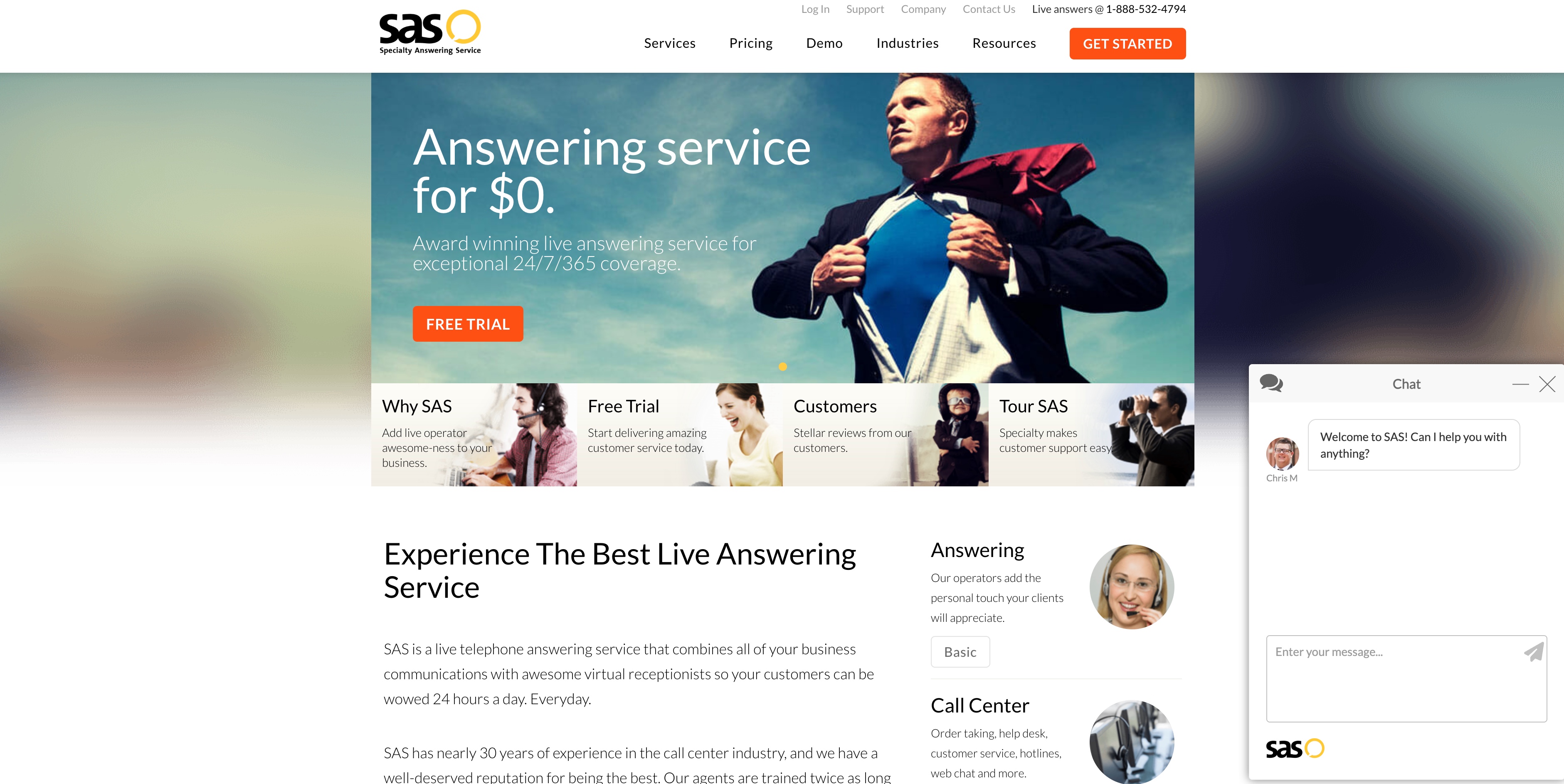
Specialty Answering Service, based in King of Prussia, Pennsylvania, offers the most flexible pricing structure among traditional answering services. Their pay-as-you-go plan starts at $44/month with a $1.54/min usage rate, meaning you only pay for what you use. For Texas businesses with irregular call patterns (a Lubbock cotton broker whose phone explodes during harvest and goes quiet in winter, an Amarillo livestock auction that operates two days a week), SAS's model avoids the trap of paying $300+/month for capacity you only need part of the time.
The flat-rate plans range from $159/month for 100 minutes up to $10,599/month for 10,000 minutes, covering everything from a solo practitioner to a multi-location operation. SAS provides 24/7 live answering, bilingual service, HIPAA compliance, appointment scheduling, and order processing. Their two-week free trial requires no credit card, making it the lowest-risk way to test a traditional answering service. For the price-conscious Texas small business owner who needs reliable phone coverage but is not ready to commit $300+/month, SAS hits the entry point.
- Pricing: Pay-as-you-go at $44/month base + $1.54/min. Flat rate plans from $159/month for 100 minutes up to $10,599/month for 10,000 minutes.
- Best for: Texas businesses with irregular or seasonal call volumes that want to avoid locked-in plans, and budget-conscious small businesses testing answering services for the first time.
- Key features: 24/7 live answering, bilingual, HIPAA compliant, message taking, order processing, appointment scheduling, 2-week free trial (no credit card), pay-as-you-go option.
- Drawback: The pay-as-you-go rate of $1.54/min adds up with volume. A Corpus Christi dental practice handling 200 minutes pays $44 + $308 (200 minutes at $1.54), totaling $352. The 100-minute flat rate at $159/month is more efficient if you consistently hit that volume, but overages beyond the included minutes still carry the $1.54/min rate. Quality reviews are mixed, with some users reporting inconsistency among operators at scale. The website feels dated compared to competitors, which may not matter for phone quality but signals less investment in the product. Zinng handles 200 minutes for $61/month with perfect consistency on every call. SAS is a reasonable traditional option for low-volume and variable-volume businesses, but the per-minute economics still favor AI for any business handling 100+ minutes monthly.
5. Davinci Virtual: Best for Solopreneurs
Davinci Virtual, headquartered in Salt Lake City, Utah, bundles live receptionist service with a full virtual office package including a business address, local or toll-free phone number, and online faxing. For the enormous population of Texas solopreneurs and micro-businesses (consultants in Austin, freelance engineers in Houston, independent financial advisors in Dallas, photographers in San Antonio), Davinci provides a complete business infrastructure in a single subscription. You get a professional address, a receptionist who answers your phone, and a business phone number without renting office space.
Plans start at $129/month for 50 minutes with a $95 one-time setup fee. The receptionist service covers weekdays from 8am to 8pm Eastern (7am to 7pm Central, relevant for Texas businesses). Higher tiers reach 300 minutes at $649/month. For Texas startups bootstrapping their way through the early stages, or independent professionals who need to project credibility without the overhead of a physical office, Davinci's bundled approach addresses multiple needs at once.
- Pricing: $129/month for 50 minutes. Up to $649/month for 300 minutes. $95 one-time setup fee. Overage at $1.75/min (Business plans) or $2.50/min (Premium plans).
- Best for: Texas solopreneurs, consultants, and micro-businesses that need a professional phone presence bundled with a virtual office address and business phone number.
- Key features: Live receptionists, free local or toll-free number, business address, call forwarding/screening, online faxing, full virtual office packages.
- Drawback: Davinci does not offer 24/7 service. Coverage runs weekdays 8am to 8pm Eastern only (7am to 7pm Central for Texas). No weekends, no holidays, no overnight. For a state where energy operations, healthcare, and hospitality run around the clock, this gap eliminates Davinci from consideration for any business needing after-hours or weekend coverage. At $129/month for 50 minutes, the effective rate is $2.58/min. The $95 setup fee adds to first-month cost. A Houston consultant handling 100 minutes pays $129 + $87.50 overage (50 minutes at $1.75), totaling $216.50/month for weekday-only coverage. Zinng provides 24/7 coverage for the same 100 minutes at $49/month. Davinci's value is in the bundle (address + phone + receptionist), not in the answering service alone. If your only need is phone answering, the economics do not compete.
Pricing Comparison
Here is what each service costs for a Texas business handling approximately 200 minutes of calls per month.
| Service | Starting Price | Cost for 200 min | Per-Min Rate | 24/7? |
|---|---|---|---|---|
| Zinng | $49/mo | $61/mo* | $0.12/min overage | Yes |
| Ruby | $250/mo | $720/mo | $4.40/min overage | Yes |
| Abby Connect | $329/mo | $599/mo | $3.00/min eff. | Yes |
| SAS | $44/mo | $352/mo** | $1.54/min | Yes |
| Davinci Virtual | $129/mo | $391/mo*** | $1.75/min overage | No**** |
*Zinng's $49 plan includes 100 minutes. 200 minutes = $49 + $12 overage (100 additional minutes at $0.12/min).
**SAS pay-as-you-go: $44 base + $308 (200 minutes at $1.54/min). The 100-minute flat rate at $159/month plus overages is comparable at higher volume.
***Davinci's 50-minute plan at $129 + $262.50 overage (150 minutes at $1.75/min). Higher tier plans reduce the per-minute cost.
****Davinci operates weekdays 8am-8pm ET only (7am-7pm CT for Texas). No weekends, no overnight coverage.
Why AI Answering Makes Sense for Texas
Texas's scale, diversity, and operational intensity create a business environment where AI answering services have structural advantages:
- Energy never sleeps, and neither should your phone. Texas's oil and gas industry operates 24/7/365, with drilling crews, pipeline operators, and service companies active through the night. A Permian Basin oilfield services company fielding dispatch calls at 3am needs the same call quality as at 3pm. AI delivers that consistency without the performance variation inherent in overnight human operators. When a driller in Pecos calls at midnight requesting a cementing crew, the transcript captures the well name, location, service type, and timeline precisely. No context lost. No details missed because the operator was fatigued.
- Bilingual capability is not optional in Texas. With 40% of the state's population identifying as Hispanic and large swaths of South Texas, El Paso, and San Antonio functioning as majority-Spanish-speaking markets, businesses need bilingual phone coverage as a default. AI handles both languages with native fluency on every call, at no additional charge. Traditional services charge $20/month extra for bilingual support or restrict Spanish capability to certain hours. For a McAllen insurance agency, a Laredo auto repair shop, or an El Paso dental practice, AI provides bilingual service that matches the community without surcharges.
- Texas weather creates unpredictable call surges. Hurricane season along the Gulf Coast, severe thunderstorms and tornadoes across North Texas, ice storms in the Panhandle, and extreme heat across the state all trigger sudden spikes in call volume. When a hailstorm damages 5,000 roofs in a DFW suburb, every roofing company's phone rings simultaneously for the next 72 hours. AI handles unlimited simultaneous calls without hold queues. A human answering service with three phone lines puts callers on hold or sends them to voicemail. During the 72-hour window after a major weather event, the businesses that answer every call book the work; the rest get leftovers.
- Healthcare documentation requires precision. Texas has 621 hospitals and thousands of clinics, many in rural areas where the nearest specialist is a multi-hour drive. When a patient calls a rural clinic in the Texas Hill Country at 10pm describing symptoms, the call transcript needs to be accurate enough for the on-call provider to triage effectively. AI captures every word without the interpretation, abbreviation, or omission that occurs when a human operator paraphrases a medical call into a message slip. For HIPAA compliance, the verbatim transcript is inherently more defensible than a human operator's summary.
- The math at Texas scale is unambiguous. At 2.9 million small businesses, even modest per-minute savings compound into enormous numbers. If the average Texas small business uses 150 minutes of answering service per month, the difference between $0.12/min (Zinng overage) and $2.00/min (typical traditional) is $282/month per business. Multiply that across even 1% of Texas small businesses (29,000) and the aggregate savings reach $97.9 million annually. This is not a marginal efficiency gain; it is a category-level disruption. Texas businesses are pragmatic about value, and the per-minute economics of AI answering are impossible to argue with.
Human answering services still serve specific Texas businesses well: luxury real estate firms where the caller expects to hear a human voice, boutique law firms where relationship-driven client intake matters, and high-touch medical concierge practices. But for the vast majority of Texas's 2.9 million small businesses, AI handles the front line more reliably, documents more accurately, and costs a fraction of what traditional services charge.
Choosing the Right Service for Your Texas Business
- Need affordable, scalable 24/7 coverage? Zinng's $49/month plan handles energy, healthcare, HVAC, legal, and every other Texas industry with consistent quality at $0.12/min overage. Bilingual. HIPAA compliant. Unlimited simultaneous calls. No contracts. The 14-day free trial lets you test it through your next busy period at zero cost.
- Willing to pay a premium for the best live receptionists? Ruby delivers polished, professional human voices on every call. Ten plan tiers accommodate businesses from 50 to 2,500 minutes. The cost is 10x+ what AI charges, but for firms where caller experience directly generates revenue (luxury real estate, high-end legal), the investment has a clear rationale.
- Want the same receptionists learning your business? Abby Connect assigns a dedicated team to your account. At $329+/month, this approach works for professional services firms, financial advisors, and law practices where caller recognition and relationship continuity justify the premium.
- Budget-conscious or have irregular call volumes? SAS's $44/month pay-as-you-go plan means you only pay for the calls you actually receive. Ideal for seasonal businesses, part-time practices, and startups testing whether an answering service delivers value before committing to a higher-cost option.
- Solopreneur who needs a complete business presence? Davinci Virtual bundles a receptionist with a business address, phone number, and fax. The weekday-only limitation is significant, but for consultants and independent professionals who primarily receive calls during business hours, the bundled package creates professional credibility at an accessible price.
Final Verdict
Zinng is the best answering service for Texas businesses. At $61/month for 200 minutes of 24/7 coverage with full transcripts, bilingual capability, HIPAA compliance, and unlimited simultaneous calls during storm surges and summer peaks, it matches the scale and intensity of the Texas business environment at a price that makes sense for all 2.9 million small businesses. Whether you run an oilfield services company in Midland, a medical practice in Houston, a law firm in Dallas, a tech startup in Austin, or a ranch supply store in the Hill Country, Zinng provides the same quality on every call, every time, at any volume.
Ruby Receptionists is the clear choice for Texas businesses where live human voice quality drives revenue. The premium pricing ($720/month for 200 minutes) puts Ruby in a different category from the others on this list, but for law firms, luxury services, and professional practices where the phone experience is part of the brand, Ruby's receptionists deliver.
Abby Connect fills the dedicated service niche. For Dallas financial advisors, San Antonio estate planners, and Houston accountants whose clients expect continuity, Abby's team model provides genuine relationship-based phone handling. The pricing limits the audience, but the value proposition is real for the right firms.
SAS provides the most accessible entry point for Texas businesses exploring answering services. The $44/month pay-as-you-go model, two-week free trial with no credit card, and HIPAA compliance make SAS a low-risk first step for the budget-conscious small business owner who wants to test the concept before investing further.
And Davinci Virtual serves the solopreneur market with a bundled virtual office that combines phone answering, a business address, and a professional number. The weekday-only limitation is a dealbreaker for many Texas industries, but for daytime-only professionals, the package delivers meaningful infrastructure at a single price.
Texas does everything bigger, and its phone needs are no exception. From the Permian Basin to the Port of Houston to the tech corridors of Austin, from the cattle ranches of the Panhandle to the citrus groves of the Rio Grande Valley, the businesses that answer every call are the ones that win. The right answering service makes sure that when Texas calls, you are always there.