Why Vermont Businesses Need an Answering Service
Vermont has roughly 80,000 small businesses operating in a state of 647,818 people spread across 9,616 square miles of mountains, valleys, and farmland. Tourism is a $4.2 billion industry supporting over 30,000 jobs, which means more than 10% of Vermont's entire workforce serves the 16 million visitors who arrive each year. The problem is straightforward: the same person running the inn, managing the farm, or staffing the clinic is also the person who needs to answer the phone, and they cannot do both simultaneously.
Vermont's four distinct seasons each bring their own phone demands. Winter means 4.1 million ski visits and a flood of booking, cancellation, and condition calls. Fall foliage draws 2.5 million visitors spending $500 million in a concentrated six-week window. Summer brings 5 million visitors, the busiest season overall. And spring means maple season, when 8.4 million taps across the state produce 3.1 million gallons of syrup worth $95 million, and sugarmakers field calls from buyers, distributors, and tourists wanting to visit the sugarhouse. An innkeeper in Stowe cannot check in ski guests and take phone reservations at the same time. A sugarmaker in Cabot cannot tap trees and negotiate prices with a wholesaler on the phone. A nurse at the University of Vermont Medical Center cannot leave a patient to schedule the next appointment.
An answering service captures every call across every season. Here are five that fit Vermont's intimate, quality-driven business culture.
What Shapes Vermont's Business Environment
Vermont's economy is small in absolute terms but distinctive in character:
- Tourism generates $4.2 billion and drives the calendar: Vermont welcomed 16 million visitors in 2024 who contributed $293.5 million in state and local taxes. The tourism calendar creates four overlapping peaks: ski season (November through April, 4.1 million skier visits), summer recreation (June through August, 5+ million visitors), fall foliage (September through October, 2.5 million visitors spending $500 million), and maple season (March through April, when sugarhouses become visitor attractions). Each peak brings a different type of call: ski condition inquiries, hiking trail questions, foliage color reports, and sugarhouse tour bookings. A single bed-and-breakfast in Woodstock might field calls about leaf-peeping packages in October, ski-and-stay deals in January, summer wedding bookings in June, and maple breakfast events in March.
- Dairy is a $5.4 billion industry: Vermont's dairy farms generate approximately 70% of the state's agricultural sales and use over 80% of its working land. The industry's total economic impact reached $5.4 billion in 2024 (up from $2.6 billion a decade ago), supporting 17,318 jobs and $812 million in wages. In 2024, Vermont's farms produced 2.48 billion pounds of milk. Dairy operations run from before dawn through evening milking, with equipment suppliers, haulers, veterinarians, and cooperative representatives calling at hours that do not respect a business-hours schedule. A dairy farmer in Addison County answering a milk hauler's 4am call about a pickup change cannot also be sleeping.
- Maple syrup production leads the nation: Vermont produced 3.1 million gallons of maple syrup in 2024, 53% of the entire national supply, valued at $95 million. The 8.4 million taps represent 49% of all taps in the country. During the concentrated March-April sugaring season, producers field calls from wholesale buyers, retail customers, tour groups, and equipment suppliers while simultaneously monitoring sap flow, boiling schedules, and weather conditions. The retail price averaged $58.30 per gallon in 2024, up $1.10 from the prior year. For a sugarmaker moving product directly to consumers and wholesalers, every missed buyer call during the narrow season window represents revenue gone to another producer.
- Vermont has the most B Corps per capita in America: The state's progressive business culture, rooted in the back-to-the-land movement of the 1960s and 70s, has produced an outsized concentration of certified B Corporations and mission-driven enterprises. Cabot Creamery, The Alchemist brewery, Lawson's Finest Liquids, Vermont Creamery, and dozens more operate with triple-bottom-line values. These businesses attract customers who expect thoughtful, values-aligned communication. When a consumer calls a B Corp, they expect the phone experience to match the brand's ethos, which means responsive, knowledgeable, and consistent.
- Healthcare serves an aging, rural population: Vermont's population skews old: 20.1% are 65 or older, compared to roughly 17% nationally. The University of Vermont Medical Center is one of the state's largest employers. Rural clinics scattered across mountainous terrain serve communities that may be an hour from the nearest hospital. After-hours patient calls, appointment scheduling, and prescription refill requests flow continuously. HIPAA-compliant documentation of those calls is a requirement, and the aging population means a higher volume of medical calls per capita than younger states.
- Geographic isolation creates staffing challenges: Vermont's rugged, mountainous terrain and dispersed population make it difficult for small businesses to hire and retain front-desk staff. Broadband access remains limited in some areas (only 73% statewide meet FCC minimums, and just 47% in the Northeast Kingdom). The state faces a workforce gap, with about 14,800 workers projected to retire annually through the end of the decade, only partially offset by 6,600 graduates staying. For a small business in a rural Vermont town, hiring a dedicated receptionist may not even be possible given the labor constraints. An answering service provides what the local talent pool cannot.
Top 5 Answering Services for Vermont Businesses
We evaluated these services against Vermont's specific needs: extreme seasonal tourism peaks, dairy and maple predawn operations, an aging population requiring healthcare calls, mission-driven business culture, rural staffing shortages, and the intimate scale of a state where your answering service needs to feel like a neighbor, not a call center.
1. Zinng: Best Overall (AI-Powered)
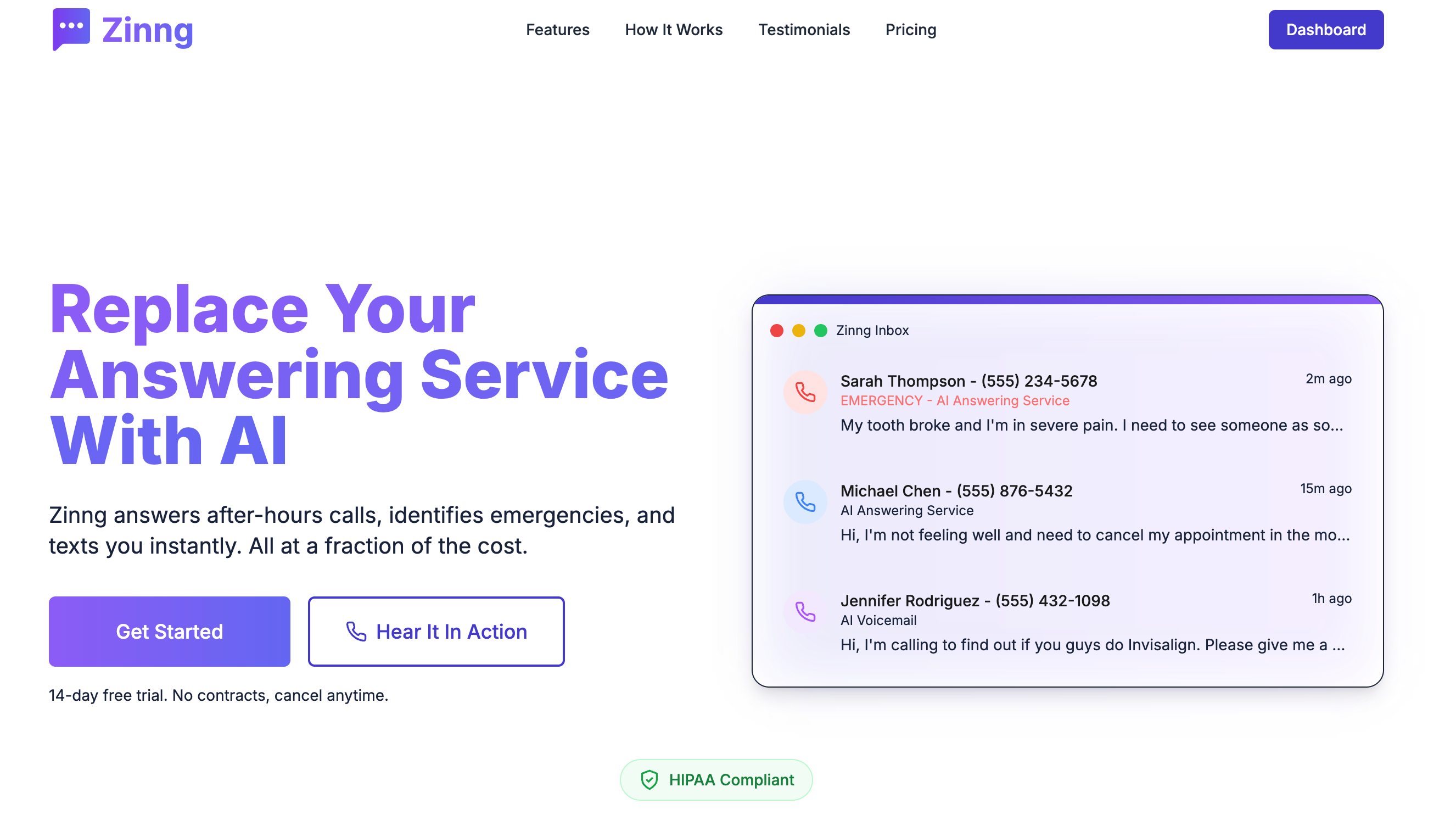
Zinng handles Vermont's seasons with the same quality in every one. AI trained on your business answers calls identically whether it is a January ski booking, an October foliage inquiry, or a March maple tour request. No hold times, no training ramp-up for seasonal staff, and no quality variation. For a Stowe inn that goes from 30 calls per day in mud season to 200 per day during foliage, Zinng scales without a single dropped call.
Every call produces a complete transcript delivered by email with SMS alerts for urgent matters. A Burlington law firm gets precise case details documented from an after-hours call. A Montpelier insurance agency gets the policy number, claim description, and callback information captured verbatim. A sugarmaker in the Northeast Kingdom gets the wholesale buyer's volume request, delivery timeline, and pricing inquiry recorded accurately while they are monitoring evaporator temperatures. In a state where business is personal and every customer interaction matters, Zinng provides the documentation that lets you follow up effectively.
- Pricing: $49/month with 100 minutes included. Additional minutes at $0.12 each. Growth plan at $99/month with 250 minutes. Business plan at $199/month with 600 minutes.
- Best for: Vermont businesses across tourism, agriculture, healthcare, and professional services that need affordable year-round coverage with the ability to absorb seasonal call surges.
- Key features: 24/7 AI answering, full call transcripts, SMS alerts for urgent calls, HIPAA compliant, custom call routing, spam blocking, appointment scheduling, 14-day free trial with no credit card.
- Standout: A Manchester B&B handling 300 minutes during peak foliage pays $73 on the Growth plan ($99 base is more than enough, with leftover minutes). The same 300 minutes on a traditional service at $1.80/min overage would cost $400+. Over a six-week foliage season, Zinng saves hundreds. Multiply that across four seasonal peaks, and the annual savings fund actual business improvements rather than phone bills.
2. Ruby Receptionists: Best Premium Live Service
Ruby Receptionists, headquartered in Portland, Oregon, provides live virtual receptionists known for warmth, professionalism, and attention to detail. Vermont's business culture prizes authenticity and personal touch, and Ruby's receptionists deliver a caller experience that aligns with the way Vermonters do business. For Burlington law firms, Middlebury financial advisors, and Stowe luxury properties where the phone is part of the brand experience, Ruby's human voice creates an impression that AI cannot fully replicate.
Ten pricing tiers from 50 to 2,500 minutes accommodate businesses from solo attorneys to multi-location operations. Bilingual English/Spanish inbound service is available 24/7. Outbound calling runs Monday through Friday, 5am to 6pm Pacific. The Call Ruby 100 plan at $395/month for 100 minutes is a common starting point for Vermont professional services firms. For businesses whose brand identity depends on the warmth of human interaction, Ruby delivers.
- Pricing: Call Ruby 50 at $250/month for 50 minutes ($5.40/min overage). Call Ruby 100 at $395/month for 100 minutes ($4.50/min overage). Call Ruby 200 at $720/month for 200 minutes ($4.40/min overage). Call Ruby 500 at $1,725/month for 500 minutes ($4.00/min overage).
- Best for: Vermont law firms, luxury hospitality, and professional services businesses where the caller experience is central to the brand and budget is not the primary concern.
- Key features: Live virtual receptionists, bilingual English/Spanish (24/7 inbound), outbound calling (Mon-Fri 5am-6pm PT), call routing, appointment scheduling, 10 plan tiers.
- Drawback: The pricing is steep for Vermont's scale. At $395/month for 100 minutes, Ruby's effective rate is $3.95/min. Overages at $4.50/min punish any month where calls spike. A Woodstock inn handling 200 minutes during foliage season pays $395 + $450 overage (100 extra at $4.50), totaling $845 for one month. Zinng covers the same 200 minutes for $61. The annual difference is significant for a Vermont small business where margins are tight and revenue is seasonal. Ruby's quality is genuine, but the economics work only for a narrow segment of Vermont businesses with premium pricing that absorbs the cost.
3. MAP Communications: Most Budget-Friendly Traditional
MAP Communications, founded in 1990 and 100% employee-owned (ESOP since 2002), operates from Chesapeake, Virginia. The employee-ownership structure resonates with Vermont's cooperative business culture, where Cabot Creamery (a farmer-owned co-op) and similar enterprises demonstrate that shared ownership models produce better outcomes. MAP's pay-per-call base plan at $49/month with $1.37/min for usage lets Vermont businesses test traditional answering without a large upfront commitment.
MAP provides 24/7 live answering, bilingual service, HIPAA compliance, and customizable scripts. The 125-minute plan at $179/month is the most practical fixed-rate option for a Vermont business with moderate call volume. For a Brattleboro medical practice, a Rutland plumbing company, or a Mad River Valley property manager, MAP's affordable traditional model provides live human answering at the most accessible price point in the traditional category.
- Pricing: $49/month base + $1.37/min (pay-per-call). $179/month for 125 minutes ($1.30/min overage). $339/month for 250 minutes. $649/month for 500 minutes.
- Best for: Vermont businesses that want the most affordable traditional live answering service, especially those with moderate and predictable call volumes.
- Key features: 24/7 live answering, bilingual, HIPAA compliant, customizable scripts, 100% employee-owned, overflow call handling.
- Drawback: The $49 base plan includes zero minutes, so every second of call time costs $1.37/min on top. A Vermont ski shop handling 150 minutes on the 125-minute plan pays $179 + $32.50 overage (25 minutes at $1.30), totaling $211.50. Zinng covers 150 minutes for $55 ($49 + $6 overage). Quality can vary between operators, which is a common criticism of larger traditional services handling calls for thousands of different businesses. The employee-owned model is admirable and genuine, but it does not resolve the fundamental cost and consistency limitations of human operators handling high volumes of diverse accounts.
4. Nexa: Best for Legal and Medical
Nexa, headquartered in Phoenix, Arizona, specializes in industry-specific answering for legal, medical, and home services businesses. Their operators are trained in the terminology and workflows of these industries, which reduces the friction that occurs when a general-purpose operator handles a legal intake call or a medical triage situation. For Vermont's legal community (concentrated in Burlington, Montpelier, and Rutland) and healthcare sector (where the University of Vermont Medical Center and rural clinics serve an aging population), Nexa's specialization provides relevant expertise.
Nexa uses custom quoting based on volume, with published starting prices around $200-$250/month for 100 minutes. Overage rates range from $1.59 to $1.99/min depending on the tier. Their capabilities include emergency dispatch, appointment scheduling, intake forms, and CRM integrations. For a Burlington personal injury attorney or a Barre medical clinic where after-hours calls have specific legal or clinical requirements, Nexa's industry-trained operators handle the nuances better than generalist services.
- Pricing: Starting around $200-$250/month for 100 minutes (custom quoting). Overage at $1.59-$1.99/min depending on tier.
- Best for: Vermont legal, medical, and home services businesses that need industry-specific call handling with trained operators familiar with legal intake, medical triage, and emergency dispatch.
- Key features: 24/7 live answering, bilingual, industry-specialized operators, emergency dispatch, appointment scheduling, intake forms, CRM integrations.
- Drawback: No transparent public pricing makes comparison difficult. You must call for a quote, which creates friction for the Vermont business owner who wants to evaluate options independently. At an estimated $200-$250 for 100 minutes, the effective rate ($2.00-$2.50/min) is significantly above AI alternatives. A Montpelier law firm handling 200 minutes may pay $400+ per month. Zinng covers 200 minutes for $61 with HIPAA-compliant transcripts that document legal and medical details more precisely than any human operator summary. The industry specialization has genuine value for complex intake scenarios, but for routine call handling, the premium over AI is difficult to justify.
5. AnswerForce: Best for Phone + Chat
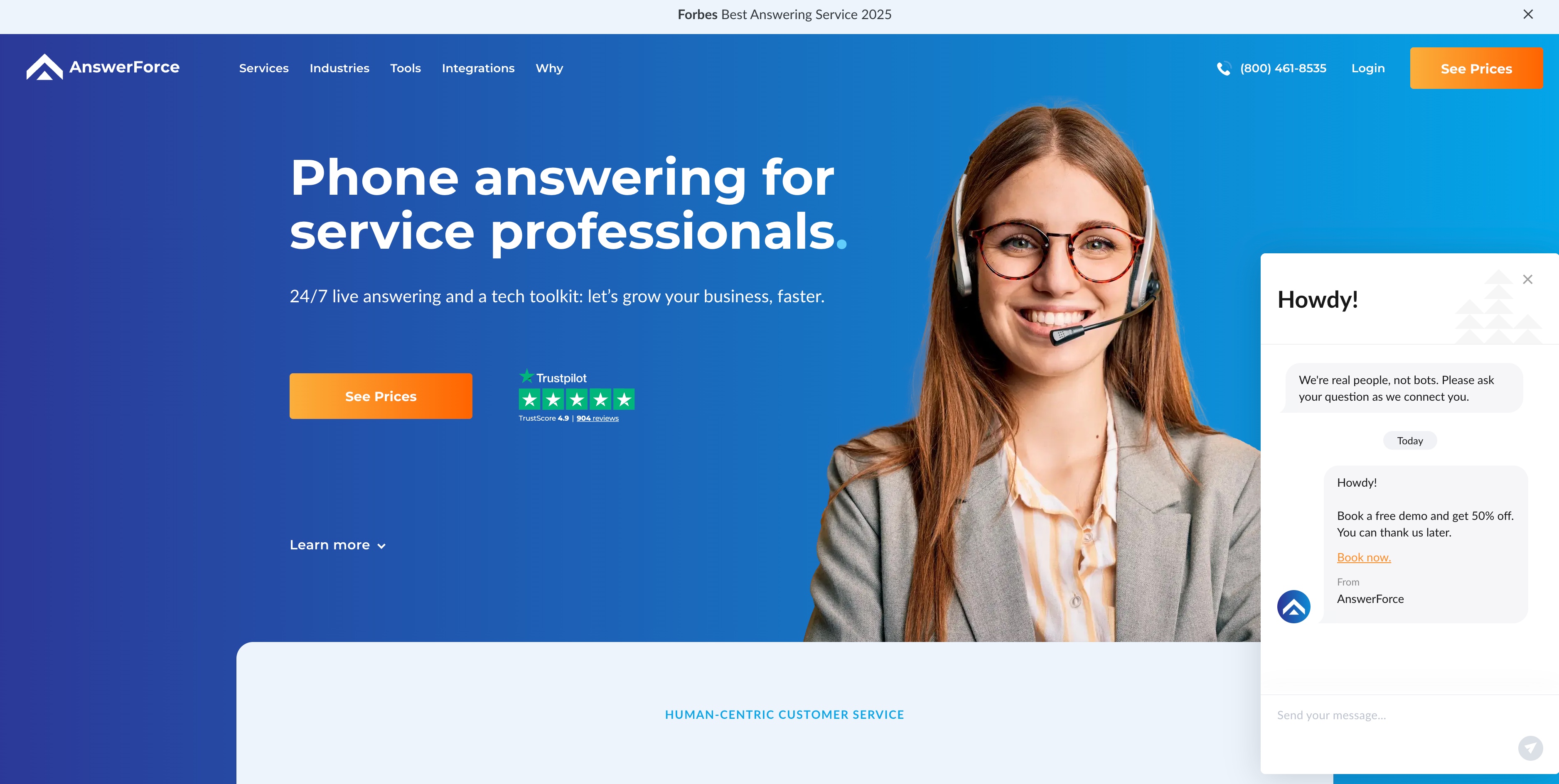
AnswerForce, headquartered in Portland, Oregon, bundles live phone answering with live chat support. For Vermont businesses with active websites (craft breweries selling online, ski resorts taking web reservations, B&Bs attracting out-of-state visitors through search), the phone-plus-chat combination covers both communication channels from a single provider. The Best Value plan at $359/month for 300 minutes plus 100 chats eliminates setup fees and offers the most balanced economics.
All plans include 24/7 live answering, bilingual English/Spanish, appointment scheduling, and lead capture. The first 30 calls under 30 seconds are free each month, which benefits Vermont businesses that receive frequent short calls (ski condition checks, hours-of-operation inquiries, directions to the farm stand). For Vermont tourism businesses where website visitors and phone callers represent the same audience, AnswerForce consolidates both into one service.
- Pricing: Intro at $259/month for 200 minutes + 50 chats ($99 setup fee, $1.80/min overage). Best Value at $359/month for 300 minutes + 100 chats (no setup fee, $1.70/min overage). Standard at $649/month for 500 minutes + 150 chats (no setup fee, $1.70/min overage).
- Best for: Vermont tourism and hospitality businesses with active websites that need both phone answering and live chat from a single provider.
- Key features: 24/7 live answering, live chat included, bilingual English/Spanish, appointment scheduling, lead capture, first 30 calls under 30 seconds free monthly.
- Drawback: The $259 starting price is high for a state where most businesses are very small. The $99 setup fee on the Intro plan adds first-month friction. A Killington ski lodge handling 400 minutes during peak season on the Best Value plan pays $359 + $170 overage (100 extra at $1.70), totaling $529. Zinng covers 400 minutes for $87 ($99 Growth plan + $18 overage). The live chat is a real value-add for web-active businesses, but if your primary need is phone answering, AnswerForce's pricing is hard to justify when AI handles the phone side at a fraction of the cost. Consider whether you actually need both channels from one provider, or whether adding a separate chat tool costs less.
Pricing Comparison
Here is what each service costs for a Vermont business handling approximately 200 minutes of calls per month.
| Service | Starting Price | Cost for 200 min | Per-Min Rate | 24/7? |
|---|---|---|---|---|
| Zinng | $49/mo | $61/mo* | $0.12/min overage | Yes |
| Ruby | $250/mo | $720/mo | $4.40/min overage | Yes |
| MAP | $49/mo | $276/mo** | $1.30/min overage | Yes |
| Nexa | ~$200/mo | ~$400/mo*** | $1.59-$1.99/min | Yes |
| AnswerForce | $259/mo | $259/mo | $1.80/min overage | Yes |
*Zinng's $49 plan includes 100 minutes. 200 minutes = $49 + $12 overage (100 additional minutes at $0.12/min).
**MAP's 125-minute plan at $179 + 75 overage minutes at $1.30/min = $276.50. The pay-per-call plan at $49 + 200 minutes at $1.37/min = $323.
***Nexa uses custom quoting. Estimated based on published starting prices and overage rates. Actual costs may vary.
Why AI Answering Fits Vermont's Economy
Vermont's small scale, extreme seasonality, rural geography, and quality-driven culture create conditions where AI answering provides structural advantages:
- Four seasonal peaks require elastic phone capacity. No other state packs as many distinct tourism seasons into a single year. Ski, foliage, summer recreation, and maple season each generate their own call surge. A Warren ski lodge handling 50 minutes in May handles 400 in February. Zinng covers February for $87 ($99 Growth plan) and May for $49 (well within the 100-minute base). A traditional service sized for peak wastes $300+/month for eight shoulder and off-peak months. AI scales with the seasons automatically, and the billing reflects reality rather than forcing you to choose between overpaying for capacity or underserving callers.
- Dairy and maple operations start before dawn. Vermont's 2.48 billion pounds of annual milk production and 3.1 million gallons of maple syrup require predawn operations. A milk hauler calling a Shelburne Farms dairy at 4am about a route change, or a syrup buyer calling a Hardwick sugarmaker at 5am to confirm a spring delivery, needs the call handled with the same care as a midday business inquiry. AI delivers identical quality at 4am and 4pm. Human operators on overnight shifts often exhibit lower attentiveness and higher error rates. For Vermont's agricultural businesses, the predawn hours are when the most important operational calls happen.
- Rural staffing shortages make in-house reception impractical. With 14,800 workers retiring annually and only 6,600 graduates staying, Vermont's labor market is among the tightest in the country. A small business in the Northeast Kingdom, where broadband access reaches only 47% of the population, may not be able to find or afford a receptionist even if they wanted one. AI provides professional phone handling without competing in a labor market where every employer is already short-staffed. The answering service does not need to commute through a Vermont winter, does not call in sick during mud season, and does not retire.
- Healthcare documentation requires precision for an aging population. With 20.1% of residents over 65, Vermont's healthcare system handles a disproportionately high volume of patient calls per capita. When an 80-year-old patient calls a rural clinic in St. Johnsbury at 9pm describing dizziness and shortness of breath, the exact symptoms need to reach the on-call provider. AI transcribes every word. A human operator may condense "intermittent dizziness when standing up quickly, accompanied by shortness of breath that started three hours ago after taking evening medication" into "dizzy, SOB." The clinical difference between those two descriptions affects triage decisions.
- Vermont's B Corp culture values efficiency alongside values. The state's concentration of mission-driven businesses means cost savings do not come at the expense of quality. AI answering actually aligns with Vermont's values: it eliminates the carbon footprint of a physical call center, provides consistent quality that respects every caller, and frees business owners to focus on the work that matters. For a B Corp sugarmaker, a values-driven brewery, or a farm-to-table restaurant, AI phone handling is the efficient, quality-first choice.
Human answering services retain value for specific Vermont businesses: luxury resort properties (The Pitcher Inn, Twin Farms) where the phone experience is part of the premium, law firms conducting sensitive client intake, and medical practices where a live human voice provides reassurance to elderly patients. But for the vast majority of Vermont's 80,000 small businesses, AI handles calls faster, documents them completely, and costs a fraction of human alternatives.
Choosing the Right Service for Your Vermont Business
- Need affordable coverage that scales with Vermont's seasons? Zinng's $49/month plan handles ski, foliage, summer, and maple season at $0.12/min overage. HIPAA compliant. Complete transcripts. Unlimited simultaneous calls during peak. The 14-day free trial lets you test through your next busy period at zero cost.
- Want the warmest human voice in the industry? Ruby Receptionists deliver premium live answering that matches Vermont's quality-first culture. At $250+/month, the cost is substantial, but for luxury hospitality and professional services where caller experience is the brand, Ruby's reputation is earned.
- Looking for the most affordable traditional option? MAP Communications' $49/month base with $1.37/min usage and employee-owned structure aligns with Vermont's cooperative values. The pricing is the most accessible among traditional services, though per-minute costs still add up at volume.
- Running a legal or medical practice? Nexa's industry-specialized operators handle legal intake and medical triage with trained expertise. Custom pricing means you will need to call for a quote, but the specialization is genuine for practices where standard operators fall short.
- Need phone and website chat from one provider? AnswerForce bundles live answering with live chat. At $259+/month, the combined package works for Vermont tourism businesses with active websites where both channels serve the same audience.
Final Verdict
Zinng is the best answering service for Vermont businesses. At $61/month for 200 minutes of 24/7 coverage with full transcripts, HIPAA compliance, and the ability to absorb seasonal surges without overpaying during quiet months, Zinng fits the rhythm of a state where business ebbs and flows with the seasons. Whether you run an inn in Stowe, a sugarhouse in Cabot, a law firm in Burlington, or a medical clinic in St. Johnsbury, Zinng provides the same quality on every call, in every season, at every hour.
Ruby Receptionists delivers the premium live experience that Vermont's luxury hospitality and professional services sector demands. The per-minute cost is the highest on this list, but for businesses where the phone is part of the brand, Ruby's warmth is worth the investment.
MAP Communications offers the most affordable traditional option, with employee-owned values that match Vermont's cooperative culture. The $49 base plan provides a low-risk entry for businesses testing whether live human answering converts more effectively than voicemail.
Nexa brings industry-specific expertise for Vermont's legal and medical communities. The custom pricing model requires a sales conversation, but the trained operators handle legal intake and medical triage with a precision that generalist services cannot match.
And AnswerForce bundles phone and chat for Vermont tourism businesses with active web presences. The combined approach covers both channels, though the cost makes it most practical for businesses with sufficient volume across both.
Vermont runs on maple sap, fresh milk, mountain snow, autumn color, and the quiet determination of 80,000 small businesses spread across one of the most beautiful and challenging landscapes in America. From the dairy barns of Addison County to the ski slopes of Killington, from the sugarhouses of the Northeast Kingdom to the tech offices of Burlington, the phone is where Vermont business begins. The right answering service makes sure that when Vermont calls, someone always answers.