Why Washington Businesses Need an Answering Service
Washington is home to over 610,000 small businesses employing roughly 1.5 million workers across a state that generates $725 billion in annual GDP. The state's economy spans a remarkable range: global tech headquarters on the Eastside, apple orchards across the Yakima Valley, container ships moving through Puget Sound, military operations at Joint Base Lewis-McChord, and 27.2 million visitors exploring national parks and wine country each year. All of these industries depend on phone calls that cannot go unanswered.
The problem in Washington is not a lack of economic activity. It is too much of it, spread across too many time zones and seasons. A Seattle SaaS startup fielding support tickets at 2am cannot also answer a sales inquiry from the East Coast at 5am Pacific. A Wenatchee fruit packer coordinating harvest logistics from 4am through dusk cannot leave their warehouse to pick up a buyer's call. A Tacoma maritime contractor cannot answer while aboard a vessel in the harbor. A Leavenworth hotel cannot check guests in at the front desk while fielding reservation calls during Oktoberfest. When your state's economy produces $725 billion annually and every missed call sends potential revenue to a competitor, an answering service is not a luxury. It is infrastructure.
Here are five answering services built for Washington's blend of tech innovation, agricultural scale, military precision, and maritime commerce.
What Shapes Washington's Business Environment
Washington punches well above its population of 8.1 million. The state's economy is one of the most diversified and productive in the nation:
- Tech dominates the Puget Sound corridor: Amazon employs roughly 90,000 people in Washington. Microsoft employs 58,400 at its Redmond campus. Boeing maintains around 60,200 employees across its Washington operations. These three companies alone anchor a tech ecosystem that includes thousands of startups, cloud computing firms, cybersecurity companies, and IT consultancies. The ripple effect creates demand for commercial real estate, legal services, accounting, recruiting, and countless B2B services that all depend on responsive phone communication. When a tech startup's potential investor calls at 7pm or a client in Tokyo reaches out at midnight Pacific time, the call needs to be captured professionally.
- Agriculture generates $51 billion: Washington is the nation's largest apple producer, grows over 70% of the country's hops, and ranks second nationally in wine production with more than 1,100 wineries. The state's agricultural GDP reaches $51 billion when you include food processing, distribution, and related industries. Yakima Valley orchardists, Walla Walla wine estate operators, and Skagit Valley tulip farmers all operate on schedules dictated by weather and seasons, not business hours. A fruit broker calling a Chelan cherry packer at 5am during harvest expects the call answered. A wine distributor from New York calling a Woodinville tasting room at 2pm Eastern (11am Pacific) needs a real conversation, not voicemail.
- Military and defense center around JBLM: Joint Base Lewis-McChord near Tacoma is one of the largest military installations in the country, home to I Corps and the 62nd Airlift Wing. The base directly employs thousands of military and civilian personnel and generates billions in economic impact across Pierce County. Defense contractors, veteran services organizations, military family support businesses, and government-adjacent firms throughout the South Sound handle communications with strict documentation requirements and security protocols. Calls related to government contracts, facility maintenance bids, and personnel coordination need complete, accurate records.
- Maritime trade moves $76 billion through Puget Sound: The Port of Seattle and Port of Tacoma form the Northwest Seaport Alliance, handling 3.3 million twenty-foot equivalent units (TEUs) and facilitating $76 billion in trade annually. Seattle is a major cruise port as well, with over 1.5 million cruise passengers each season. The maritime industry operates around the clock, with cargo ships arriving at all hours, customs paperwork flowing continuously, and logistics coordinators managing tight schedules. Freight brokers, customs agents, shipping companies, and marine service providers cannot afford to miss calls when a container ship's schedule changes or a cargo release needs authorization.
- Tourism brings 27.2 million visitors and $28.4 billion: Mount Rainier, Olympic National Park, the San Juan Islands, Leavenworth, and the Columbia River Gorge draw visitors year-round. Seattle alone attracts millions for its food scene, Pike Place Market, and cultural attractions. Ski resorts at Stevens Pass, Crystal Mountain, and Mount Baker extend the season through winter. Tourism businesses face extreme demand fluctuations: a San Juan Island kayak outfitter books heavily from May through September, a Leavenworth inn peaks during December's Christmas lighting festival, and a Winthrop ranch stay fills up for summer trail rides. The phone volume swings are enormous, and staffing receptionists to match every peak is impractical.
- Washington has no state income tax: One of only seven states without a personal income tax, Washington attracts entrepreneurs, remote workers, and businesses relocating from higher-tax states. This creates a steady pipeline of new business registrations, commercial real estate transactions, legal incorporations, and accounting engagements. The professional services firms handling these relocations and formations field high volumes of calls from prospective clients who expect immediate, polished responses.
- Forest products employ 100,000: Washington's timber industry supports approximately 100,000 jobs across logging, sawmills, paper production, and wood product manufacturing. The industry operates in remote forested areas of the Olympic Peninsula, North Cascades, and eastern Washington where cell coverage is spotty and workers are in the field from dawn to dusk. A sawmill operator in Forks, a logging contractor near Darrington, or a timber buyer in Longview cannot stop operations to answer every call, yet the calls keep coming from buyers, inspectors, and transportation companies.
Top 5 Answering Services for Washington Businesses
We measured these services against what Washington businesses actually face: tech-sector expectations for speed and professionalism, agricultural operations running before sunrise, military-grade documentation requirements, maritime logistics on 24-hour cycles, and tourism surges that can triple call volume in a single week.
1. Zinng: Best Overall (AI-Powered)
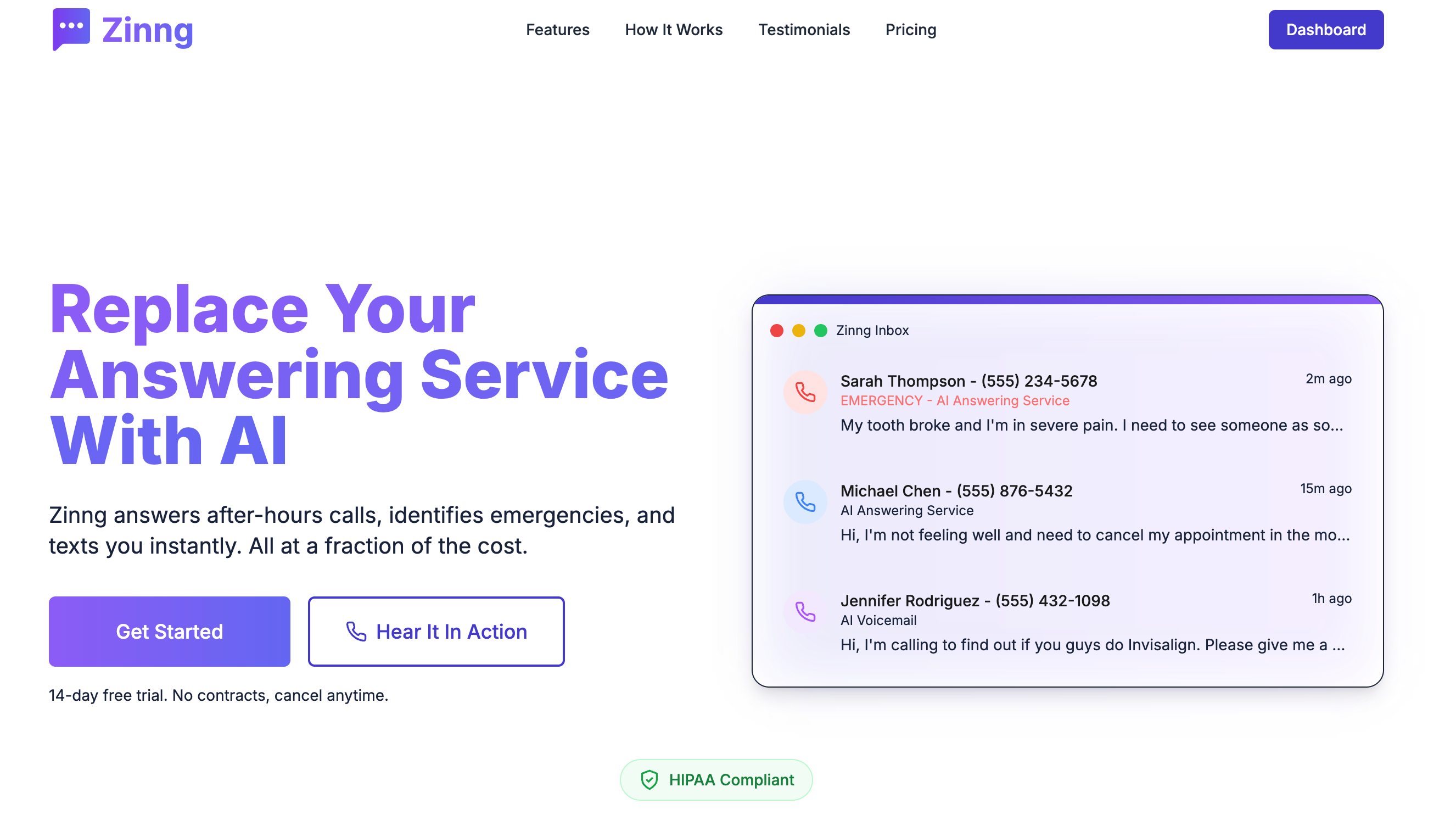
Zinng handles every call with AI that learns your business, delivering the same polished quality whether a Bellevue tech executive calls at noon or an international shipping coordinator rings at 3am. No hold times. No quality variation between shifts. No ceiling on simultaneous calls. For Washington businesses that operate across Pacific, Eastern, and international time zones simultaneously, Zinng's around-the-clock consistency eliminates the timezone gap that causes most human-staffed services to degrade during overnight hours.
Each call generates a complete transcript sent by email with SMS alerts for urgent matters. A Redmond software company gets precise technical details from a client's after-hours support request. A Yakima apple exporter gets the exact variety, volume, and shipping timeline from a buyer calling during harvest. A Tacoma freight broker gets the container number, vessel name, and customs reference from a logistics call at midnight. These verbatim transcripts replace the abbreviated notes of human operators with records accurate enough for contract disputes, regulatory audits, and customer relationship management.
- Pricing: $49/month with 100 minutes included. Additional minutes at $0.12 each. Growth plan at $99/month with 250 minutes. Business plan at $199/month with 600 minutes.
- Best for: Washington businesses of all sizes that need reliable 24/7 coverage across tech, agriculture, maritime, tourism, and defense sectors without paying premium per-minute rates.
- Key features: 24/7 AI answering, full call transcripts, SMS alerts for urgent calls, HIPAA compliant, custom call routing, spam blocking, appointment scheduling, 14-day free trial with no credit card.
- Standout: A Seattle tech company handling 250 minutes of monthly calls pays $99 on the Growth plan. A Yakima agricultural operation with the same volume pays the same $99. A traditional service charges $720 for 200 minutes and $1,485 in overage at $4.40/min for 50 extra. The annual savings exceed $7,400. For a state where no income tax already keeps business costs competitive, Zinng extends that advantage to phone operations.
2. Ruby Receptionists: Best Premium Live Service
Ruby Receptionists operates from Portland, Oregon, just across the Columbia River, making them a Pacific Northwest neighbor with a deep understanding of West Coast business culture. Their receptionists are trained to deliver warm, professional greetings that match the conversational tone many Washington tech companies and professional services firms prefer. Ten pricing tiers from 50 to 2,500 minutes accommodate everything from a solo Bellingham attorney to a multi-location Seattle property management firm.
All plans include bilingual English/Spanish inbound answering available 24/7 and outbound calling during business hours (Mon-Fri, 5am-6pm Pacific). The Call Ruby 200 plan at $720/month for 200 minutes is the most common tier for growing Washington businesses. For law firms in Pioneer Square, architecture studios in Capitol Hill, or financial advisors in downtown Bellevue, Ruby's premium receptionists create first impressions that match the quality expectations of the Pacific Northwest professional market.
- Pricing: Call Ruby 50 at $250/month for 50 minutes ($5.40/min overage). Call Ruby 100 at $395/month for 100 minutes ($4.50/min overage). Call Ruby 200 at $720/month for 200 minutes ($4.40/min overage). Call Ruby 500 at $1,725/month for 500 minutes ($4.00/min overage). Higher tiers up to Call Ruby 2,500 at $7,875/month.
- Best for: Washington law firms, professional services companies, and tech-adjacent businesses that want premium live receptionists with West Coast sensibility and do not mind paying a significant premium for human warmth.
- Key features: Live virtual receptionists, bilingual English/Spanish (24/7 inbound), outbound calling (Mon-Fri 5am-6pm PT), call routing, appointment scheduling, mobile app for call management.
- Drawback: Ruby is the most expensive per-minute service on this list. The Call Ruby 200 plan works out to $3.60/min effective, and overage at $4.40/min makes exceeding your allocation extremely costly. A Kirkland marketing agency that uses 300 minutes on the 200-minute plan pays $720 + $440 in overage (100 minutes at $4.40), totaling $1,160 for the month. Zinng covers 300 minutes for $73. That is a $1,087 monthly difference, or $13,044 per year. Outbound calling is restricted to weekday business hours, which limits follow-up capability. For Washington businesses accustomed to competitive pricing thanks to no state income tax, Ruby's premium represents a significant overhead that most cannot justify when AI delivers comparable professionalism.
3. PATLive: Best for 24/7 Dependability
PATLive has been answering phones from Tallahassee, Florida since 1990. That is 35 years of continuous operation, a track record that appeals to Washington businesses built on reliability: maritime firms that cannot afford a missed cargo release call, defense contractors where consistent documentation is non-negotiable, and healthcare providers where after-hours patient calls require 24/7 live coverage. PATLive's four Flex Platform tiers start at 75 minutes and scale to 600, all with round-the-clock live answering, 365 days a year.
Appointment scheduling, order processing, call transfers, and customizable scripts come standard on every plan. Bilingual English/Spanish support is available for an additional $20/month. The Standard plan at $415/month for 200 minutes is the most popular tier. For Washington's South Sound military-adjacent businesses, medical practices serving JBLM families, and logistics companies operating around the Port of Tacoma, PATLive provides the steady, no-surprises coverage that operations-focused businesses value.
- Pricing: Starter at $235/month for 75 minutes (1 line, $2.25/min overage). Standard at $415/month for 200 minutes (3 lines, $2.10/min overage). Premium at $650/month for 350 minutes (5 lines, $1.90/min overage). Pro at $1,050/month for 600 minutes (10 lines, $1.85/min overage).
- Best for: Washington defense contractors, healthcare providers, and logistics companies that prioritize absolute 24/7 reliability and want a long-standing human answering service with a proven track record.
- Key features: 24/7/365 live answering, appointment scheduling, order processing, call transfers, customizable scripts, bilingual English/Spanish ($20/month add-on), 14-day money-back guarantee.
- Drawback: PATLive's Standard plan at $415/month for 200 minutes is $2.08/min effective. A Spokane HVAC company that exceeds 200 minutes during a summer heat wave pays $2.10/min for every extra minute. Fifty minutes over adds $105, bringing the bill to $520. Scale that to 300 minutes total and the monthly cost hits $625. Zinng handles 300 minutes for $73. The $552 monthly gap, $6,624 annually, represents the real cost of insisting on a human voice when AI provides the same 24/7 reliability with better documentation. Bilingual support as a $20/month add-on is another cost that competitors bundle in for free.
4. AnswerConnect: Best for CRM Integrations
AnswerConnect is headquartered in Portland, Oregon, another Pacific Northwest company with local perspective on West Coast business culture. Their standout feature is CRM integration: call data feeds directly into Salesforce, HubSpot, Zoho, and other platforms, which matters for Washington's tech-heavy business landscape where companies already run their operations through these tools. For a Redmond IT consulting firm or a Seattle digital marketing agency, having call data automatically populate their CRM eliminates manual data entry and keeps the sales pipeline flowing without gaps.
AnswerConnect runs a fully remote workforce and plants trees as part of their sustainability commitment, details that resonate with the Pacific Northwest's environmentally conscious business community. Three main tiers start at $350/month for 200 minutes with 24/7 live answering and bilingual support. The Growth plan at $395/month for 300 minutes drops the setup fee and provides a better per-minute rate. For Washington companies with established tech stacks, AnswerConnect's integrations can save hours of weekly data entry.
- Pricing: Entry at $350/month for 200 minutes ($2.50/min overage, $49.99 setup fee). Growth at $395/month for 300 minutes ($1.85/min overage, no setup fee). Standard at $575/month for 400 minutes ($1.85/min overage, $49.99 setup fee). Custom plans available for higher volume.
- Best for: Tech-forward Washington businesses that use CRM platforms and want call data to flow directly into Salesforce, HubSpot, or Zoho without manual entry.
- Key features: 24/7 live answering, bilingual English/Spanish, CRM integrations (Salesforce, HubSpot, Zoho), appointment scheduling, live chat support, eco-friendly remote workforce.
- Drawback: The Entry plan charges $350/month for 200 minutes with a $49.99 setup fee, producing a $1.75/min effective rate before overages. Exceed by 50 minutes at $2.50/min and the monthly bill hits $475. The Growth plan offers better economics at $395 for 300 minutes ($1.32/min effective), but the odd pricing structure between tiers, with the Standard plan reintroducing the setup fee, creates confusion. Zinng handles 300 minutes for $73/month. Even AnswerConnect's most efficient tier costs more than five times what Zinng charges for the same volume. The CRM integrations are genuinely useful, but paying 5x for call handling just to auto-populate a CRM is a hard sell when Zinng's transcripts can be forwarded to any system via email integrations.
5. MAP Communications: Most Affordable Traditional Service
MAP Communications, headquartered in Chesapeake, Virginia, has operated since 1990 and became 100% employee-owned through an ESOP in 2002. The employee-ownership structure gives MAP a distinctive culture: operators who own a stake in the company tend to invest more in call quality. For Washington businesses looking for a traditional human answering service at the lowest possible price point, MAP's pay-per-call base plan at $49/month with $1.37/min usage charges offers the most budget-conscious entry into live answering.
Four tiers range from the $49/month pay-per-call model up to $649/month for 500 minutes. MAP is HIPAA compliant, which serves Washington's growing healthcare sector, including the community clinics, urgent care centers, and specialty practices that serve the state's 8.1 million residents. Customizable scripts allow businesses to tailor how calls are handled, whether that is a Kennewick medical office routing patient calls or a Bellingham property manager dispatching maintenance requests.
- Pricing: $49/month for 0 included minutes ($1.37/min pay-per-call). $179/month for 125 minutes ($1.30/min overage). $339/month for 250 minutes. $649/month for 500 minutes.
- Best for: Cost-conscious Washington businesses seeking the most affordable traditional human answering service, especially healthcare providers needing HIPAA compliance without premium pricing.
- Key features: 24/7 live answering, bilingual English/Spanish, customizable scripts, HIPAA compliant, overflow call handling, 100% employee-owned (ESOP).
- Drawback: MAP's $49/month base plan includes zero minutes. Every single call is billed at $1.37/min from the first second. A Seattle plumber fielding 200 minutes of monthly calls on the base plan pays $49 + $274 (200 minutes at $1.37), totaling $323. The 125-minute plan at $179 is more efficient, but 200 minutes on that plan costs $179 + $97.50 (75 overage at $1.30), reaching $276.50. Zinng covers 200 minutes for $61. MAP is the most affordable traditional option, but "most affordable traditional" still costs 4.5x what AI charges. The employee-owned model is admirable, but call quality can vary between individual operators, something you never encounter with AI's consistent performance.
Pricing Comparison
Here is what each service charges for a Washington business handling approximately 200 minutes of calls per month.
| Service | Starting Price | Cost for 200 min | Per-Min Rate | 24/7? |
|---|---|---|---|---|
| Zinng | $49/mo | $61/mo* | $0.12/min overage | Yes |
| Ruby | $250/mo | $720/mo | $4.40/min overage | Yes |
| PATLive | $235/mo | $415/mo | $2.10/min overage | Yes |
| AnswerConnect | $350/mo | $350/mo** | $2.50/min overage | Yes |
| MAP Comms | $49/mo | $277/mo*** | $1.30/min overage | Yes |
*Zinng's $49 plan includes 100 minutes. 200 minutes = $49 + $12 overage (100 additional minutes at $0.12/min).
**AnswerConnect's Entry plan includes 200 minutes for $350/month. Setup fee of $49.99 may apply.
***MAP's 125-minute plan at $179 + 75 overage minutes at $1.30/min = $276.50, rounded to $277.
Why AI Answering Fits Washington's Economy
Washington's combination of tech-forward business culture, global trade schedules, agricultural intensity, and defense-grade documentation needs makes AI answering a natural match:
- Tech companies expect speed and precision. With Amazon, Microsoft, Boeing, and 17 Fortune 500 companies headquartered in Washington, the state's business culture prizes efficiency. Tech professionals are accustomed to automated systems, AI assistants, and digital-first workflows. AI answering fits seamlessly into that environment. A Bellevue cloud computing firm's prospects are not put off by AI answering their call; they expect it. The complete transcript delivered by email integrates directly into the company's existing project management and CRM tools without an extra step. For a state that builds the technology powering the rest of the economy, using AI for phone answering is not futuristic. It is overdue.
- International trade requires round-the-clock availability. The Port of Seattle and Port of Tacoma handle $76 billion in annual trade, with shipping partners in Asia, Europe, and South America operating across every time zone. A cargo agent in Shanghai calling about container availability at 3am Pacific, a customs broker in Rotterdam confirming documentation at 4am, or a logistics coordinator in Sao Paulo arranging a shipment at midnight all need their calls handled with the same precision as a 10am local call. AI provides identical quality regardless of when the call arrives, without the quality dropoff that occurs when human operators work overnight shifts after midnight.
- Agriculture runs on predawn schedules. Washington produces $51 billion in agricultural output. Apple harvest in Chelan County starts before dawn. Hop picking in the Yakima Valley runs from first light. Dairy operations in Whatcom County begin milking at 4am. Grain shipments from the Palouse roll out before sunrise. When a fruit buyer, equipment supplier, or transportation coordinator calls at 5am, AI answers with the same greeting quality and documentation accuracy as it would at noon. Human operators on overnight shifts often show fatigue and inattention. AI does not know what fatigue is.
- Tourism peaks demand elastic capacity. Washington's 27.2 million annual visitors create sharp seasonal spikes. A San Juan Island whale watching company that fields 30 calls a day in February may field 300 in July. A Leavenworth hotel that takes 50 reservation calls monthly in March takes 500 during December's Christmas festival. Zinng handles 500 minutes for $109 on the Growth plan. Ruby charges $720 for 200 minutes and $4.40/min for every additional minute. During a peak month at 500 minutes, Ruby costs $2,040 ($720 + $1,320 overage). The difference for a single month is $1,931. For seasonal businesses where summer or holiday revenue funds the entire year, that savings is not marginal. It changes the math on profitability.
- Defense and government work demands complete records. JBLM and the defense contracting ecosystem across the South Sound generate calls that require thorough documentation for compliance, audit trails, and contract management. AI transcribes every word of every call, producing records that satisfy the documentation standards federal contractors face. Human operators summarize and abbreviate, introducing gaps. When a government auditor asks for the exact wording of a contractor coordination call from three months ago, the AI transcript provides it. A human operator's summary does not.
- Forest products and remote industries need coverage without staff. Timber operations, fishing fleets, and rural manufacturing employ over 100,000 Washingtonians in locations where recruiting a full-time receptionist is impractical. A sawmill in Forks, a commercial fishing operation out of Westport, or a wood products manufacturer in Longview cannot hire and retain front-desk staff when the nearest population center is 50 miles away and every available worker is already employed. AI provides professional phone coverage without competing for scarce rural labor.
Human answering services still have a place for Washington businesses that require complex empathy, such as grief counseling intake, high-touch client onboarding at wealth management firms, or sensitive patient conversations. But for the vast majority of business calls in Washington, AI handles them faster, records them completely, and costs a fraction of the human alternative.
Choosing the Right Service for Your Washington Business
- Tech, agriculture, maritime, tourism, or any business needing affordable 24/7 coverage? Zinng's $49/month plan with $0.12/min overage provides complete transcripts, HIPAA compliance, and unlimited simultaneous calls. The 14-day free trial requires no credit card and no commitment. Test it through your next busy period and compare the results to whatever you are using now.
- Want a premium live receptionist with West Coast polish? Ruby delivers the warmest human greeting on this list. The Call Ruby 200 plan at $720/month works for Seattle law firms, architecture studios, and professional services companies where a premium voice creates measurable client conversion improvements. Be prepared for significant costs if you exceed your minute allocation.
- Need the longest track record in 24/7 live answering? PATLive has answered phones continuously for 35 years. The Standard plan at $415/month for 200 minutes provides proven reliability for defense contractors, medical practices, and logistics firms where uninterrupted live human coverage is non-negotiable.
- Run your business through Salesforce, HubSpot, or Zoho? AnswerConnect's CRM integrations push call data directly into your existing tools. The Growth plan at $395/month for 300 minutes makes sense for tech companies that measure the hourly cost of manual data entry and want to eliminate it.
- Looking for the lowest-cost traditional option? MAP Communications offers live human answering starting at $49/month plus usage. The 125-minute plan at $179/month is the most accessible traditional service for small Washington businesses testing whether live answering is worth the investment. HIPAA compliance makes MAP a viable choice for budget-conscious healthcare practices.
Final Verdict
Zinng is the best answering service for Washington businesses. At $61/month for 200 minutes of 24/7 coverage with complete transcripts, HIPAA compliance, and the ability to handle unlimited simultaneous calls during peak season, Zinng delivers what Washington's diverse economy demands: tech-caliber performance at a price that makes sense for a startup in South Lake Union, an orchard in Wenatchee, a freight broker in Tacoma, or a lodge on the Olympic Peninsula. Washington businesses already embrace technology. Zinng applies that same principle to the phone.
Ruby Receptionists is the best premium live option for businesses where human warmth directly drives client conversion. Their Portland base gives them Pacific Northwest cultural fluency, and ten pricing tiers provide granular control. The per-minute cost is the highest on this list, but for firms where the ROI on a polished first impression is measurable and significant, Ruby delivers.
PATLive provides the reliability that operations-heavy Washington businesses need. Thirty-five years of continuous 24/7 service makes PATLive the safe choice for defense contractors, healthcare providers, and logistics operations where phone availability is mission-critical and a proven track record outweighs cost considerations.
AnswerConnect stands out for tech-stack integration. If your Washington business lives inside Salesforce or HubSpot, AnswerConnect's direct data flow saves meaningful time. The Pacific Northwest roots and sustainability commitment resonate with the local market, though the pricing is hard to defend when AI handles the same calls at a fraction of the cost.
And MAP Communications brings traditional live answering within reach of Washington's smallest businesses. Employee-owned since 2002, HIPAA compliant, and priced lower than any other human service on this list, MAP gives budget-conscious operations a way to test live answering before committing to a larger spend.
Washington builds the technology that powers the global economy. From the server farms east of the Cascades to the container ports on Puget Sound, from the apple orchards of the Yakima Valley to the flight lines at JBLM, the state runs on precision, speed, and innovation. The right answering service brings those same qualities to every call. When Washington calls, someone should always answer.