At a Glance
- •The best Phoenix answering service for most businesses is Zinng, an AI-powered service at $49/month with 100 minutes included and $0.12/minute overage.
- •Traditional live answering services in Phoenix range from $44/month (SAS, pay-as-you-go) to $720/month (Ruby, 200 minutes), with per-minute rates between $1.54 and $5.40.
- •Phoenix is the fastest-growing large city in the U.S. with 1.65 million residents, a 5+ million metro, and 70,000+ new residents in 2024. Key sectors include healthcare (Mayo Clinic, Banner Health, Barrow Neurological #1 nationally), real estate (80,000+ annual transactions), and semiconductor manufacturing (TSMC's $65 billion fab).
- •42% of Phoenix residents are Hispanic or Latino and over 35% of households speak Spanish at home. Bilingual English/Spanish answering is a baseline requirement for healthcare, legal, real estate, and home services across the Valley.
- •Zinng offers a 14-day free trial with no credit card required. Full call transcripts, bilingual support, spam filtering, and unlimited simultaneous calls included.
Why Phoenix Businesses Need an Answering Service
Phoenix added more residents than any other large American city over the past decade. The metro area now exceeds 5 million people, the city proper has crossed 1.65 million, and every sector from healthcare to semiconductor manufacturing is scaling to match. TSMC is building a $65 billion chip fabrication complex in north Phoenix. Intel operates a major campus in Chandler. Banner Health runs 30+ hospitals across the state with its administrative headquarters in Phoenix. The real estate market processes over 80,000 transactions annually. And 45 million visitors spend $25 billion each year across the Valley of the Sun.
The people running these businesses are not sitting at desks waiting for the phone to ring. A Banner Health cardiologist is in the catheterization lab. A real estate agent is walking a buyer through a $450,000 listing in Scottsdale. A TSMC construction project manager is on-site at the semiconductor fab in north Phoenix. A personal injury attorney is in a deposition at the Maricopa County Superior Court. A hotel general manager at a Camelback Mountain resort is handling a 300-guest conference. These calls do not go to voicemail and come back tomorrow. In a market growing this fast, a missed call becomes a missed opportunity within minutes.
An answering service catches what Phoenix's pace would otherwise leave behind. The question is which service handles the Valley's particular combination of explosive growth, bilingual requirements, healthcare density, and year-round demand.
What Drives Phoenix's Communication Needs
Phoenix is not simply a large Sunbelt city. Its economy is shaped by specific forces that create distinct answering service requirements:
- Healthcare is one of the Valley's largest employers: Banner Health operates 30+ hospitals and employs over 50,000 people across Arizona. Mayo Clinic Arizona in north Phoenix provides world-class specialty care and draws patients from across the western U.S. HonorHealth runs 6 hospitals across Scottsdale and north Phoenix. Barrow Neurological Institute at St. Joseph's Hospital is ranked #1 in neurology nationally by U.S. News. Phoenix Children's Hospital is one of the largest freestanding pediatric hospitals in the country. The Valley has thousands of private practices, specialty clinics, dental offices, urgent care centers, and behavioral health providers. After-hours patient calls, prescription refill requests, referral coordination, and appointment scheduling generate enormous call volume that requires HIPAA-compliant handling.
- Real estate fuels a massive transaction engine: The Phoenix metro processes more than 80,000 home sales annually. The median home price sits near $420,000, and inventory moves fast in a market that absorbed over 70,000 new residents in 2024 alone. Real estate agents, mortgage brokers, title companies, property managers, and home inspectors rely on immediate responsiveness. A buyer calling about a listing that went live an hour ago will contact the next agent if no one answers. Property management firms overseeing hundreds or thousands of rental units receive maintenance requests, tenant inquiries, and prospective renter calls at all hours. In a market this active, every unanswered call has a measurable dollar value.
- Semiconductor manufacturing is transforming north Phoenix: TSMC's Arizona fab represents a $65 billion investment, the largest foreign direct investment in Arizona history. The facility will produce the world's most advanced chips for Apple, NVIDIA, and AMD. Intel's Chandler campus has been fabricating chips in the Valley for over 40 years. These operations generate enormous supply chain and contractor communication: equipment vendors, logistics providers, construction subcontractors, and engineering consultants all need to reach project managers and procurement teams who spend their days on the fabrication floor or the construction site, not at a desk.
- 42% of Phoenix residents are Hispanic or Latino: Over 35% of Phoenix households speak Spanish at home. This is not a secondary market consideration; it is the reality of who calls. A Spanish-speaking patient calling their doctor's office at 7pm, a tenant calling property management about a broken AC unit in 115-degree heat, or a parent calling a law firm about an immigration case all need to communicate in the language they are most comfortable with. Any Phoenix answering service that does not offer reliable bilingual English/Spanish coverage is turning away a substantial portion of the market.
- Tourism runs year-round with a winter peak: Phoenix welcomed over 45 million visitors in 2023, generating approximately $25 billion in economic impact. Unlike seasonal destinations, the Valley draws visitors year-round: spring training baseball in February and March (15 Major League teams), winter snowbirds from November through April, convention traffic at the Phoenix Convention Center, and resort tourism across Scottsdale and Paradise Valley. The resorts, golf courses, tour operators, restaurants, and event venues that serve this tourism economy handle reservation requests, concierge inquiries, and group booking calls that intensify during peak season but never truly stop.
- Arizona does not observe daylight saving time: Phoenix stays on Mountain Standard Time (MST) year-round. From November through March, Phoenix aligns with MST. From March through November, while the rest of Mountain Time shifts to MDT, Phoenix effectively operates on Pacific Time. This creates scheduling confusion for national clients, out-of-state patients, and multistate business partners. An answering service that operates 24/7 eliminates the timezone ambiguity entirely, because it is always available regardless of what time Phoenix happens to align with.
Top 5 Answering Services for Phoenix Businesses
We evaluated these services against Phoenix's specific demands: bilingual English/Spanish as a baseline (42% Hispanic population), HIPAA compliance for the Valley's enormous healthcare sector, scalability for rapid growth, around-the-clock availability for a city that generates calls in every time zone, and cost efficiency in a market where businesses are growing fast but managing margins carefully.
1. Zinng: Best Overall (AI-Powered)
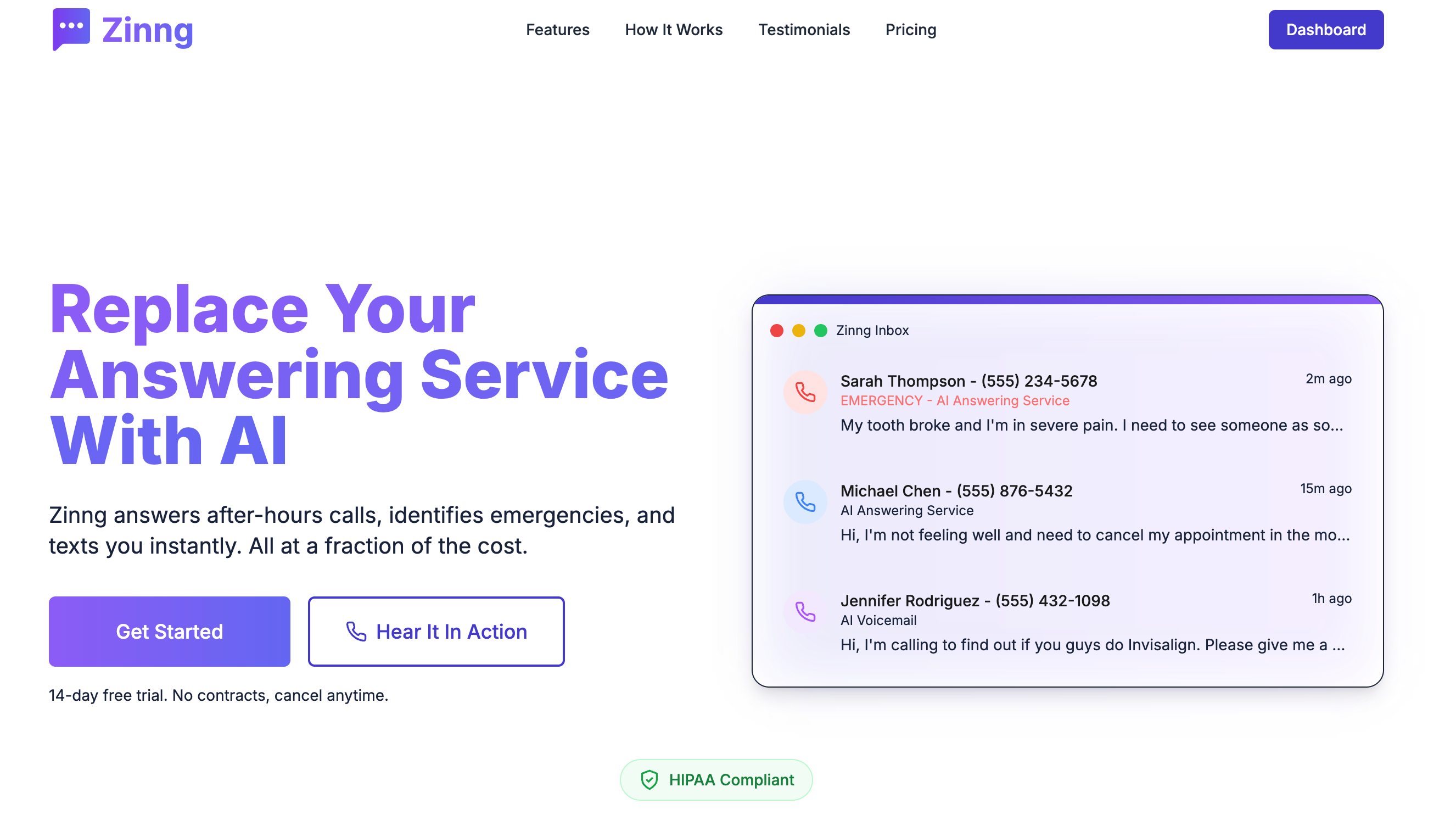
Zinng answers every call with AI trained on your business. No hold queue when summer temperatures push call volume for HVAC companies through the roof, no staffing gap during Arizona's unique time zone transitions, and no limit on simultaneous calls. For healthcare practices fielding after-hours patient calls, real estate agents who cannot afford to miss a single buyer inquiry, and semiconductor supply chain firms coordinating with vendors across time zones, Zinng provides consistent 24/7 coverage that scales with the Valley's growth.
Every call produces a verbatim transcript delivered by email with SMS alerts for urgent items. A Banner Health-affiliated primary care physician gets the exact symptoms, medication list, and insurance details from a patient who called at 10pm with chest pain. A Scottsdale real estate agent gets the buyer's name, budget, preferred neighborhoods, and timeline from a call that came in during an open house. A TSMC construction project coordinator gets the equipment specification, delivery date, and vendor contact from a supplier call that arrived during a site walk. Verbatim transcription replaces the paraphrased summaries that human operators produce with an auditable, searchable record.
- Pricing: $49/month with 100 minutes included. Additional minutes at $0.12 each. Growth plan at $99/month with 250 minutes. Business plan at $199/month with 600 minutes.
- Best for: Phoenix businesses across healthcare, real estate, technology, legal, and home services that need affordable 24/7 coverage with HIPAA compliance, verbatim transcripts, bilingual support, and unlimited call capacity.
- Key features: 24/7 AI answering, full call transcripts, SMS alerts for urgent calls, HIPAA compliant, custom call routing, spam blocking, appointment scheduling, bilingual support, 14-day free trial with no credit card.
- Standout: A Phoenix medical practice or real estate team handling 250 minutes pays $67 with Zinng ($49 + $18 overage). The next cheapest option at that volume is SAS at approximately $429 (pay-as-you-go: $44 + 250 min at $1.54). Over a year, the difference is $4,344. In a city adding 70,000+ residents annually, the businesses that control overhead during growth are the ones that survive it.
2. Ruby Receptionists: Best Premium Live Service
Ruby Receptionists built its reputation on warm, personalized call handling. The Portland-based company trains receptionists to sound like they work in your office, which matters for Phoenix law firms, financial advisors, and high-end professional services where callers expect a human voice and a polished first impression. Ruby offers bilingual English/Spanish inbound support 24/7 on all plans, covering Phoenix's large Spanish-speaking population without any add-on fee.
The 10-tier pricing structure starts at 50 minutes and extends to 2,500 minutes, giving Phoenix businesses room to scale. Outbound calling is available Monday through Friday, 5am to 6pm Pacific, which aligns well with Phoenix business hours for most of the year. For a Scottsdale wealth management firm or a Paradise Valley boutique law practice where the brand experience starts with the first phone call, Ruby delivers a premium impression.
- Pricing: Call Ruby 50 at $250/month for 50 minutes ($5.40/min overage). Call Ruby 100 at $395/month for 100 minutes ($4.50/min overage). Call Ruby 200 at $720/month for 200 minutes ($4.40/min overage). Call Ruby 500 at $1,725/month for 500 minutes ($4.00/min overage).
- Best for: Phoenix law firms, financial advisors, and premium professional services that prioritize a polished, human-first caller experience and can absorb the cost.
- Key features: Live virtual receptionists, bilingual inbound English/Spanish 24/7, outbound calling (Mon-Fri 5am-6pm PT), call routing, appointment scheduling, 10-tier plan flexibility.
- Drawback: Ruby is the most expensive service on this list by a wide margin. The 200-minute plan at $720/month is nearly 12 times what Zinng charges for the same volume ($61). Per-minute overage rates range from $3.30 to $5.40 depending on your tier. A Phoenix personal injury firm handling 300 minutes on the 200-minute plan pays $720 + $440 (100 overage minutes at $4.40), totaling $1,160 per month. The premium quality is genuine, but the price is difficult to justify when AI produces more accurate documentation at a fraction of the cost.
3. Smith.ai: Best AI-Human Hybrid
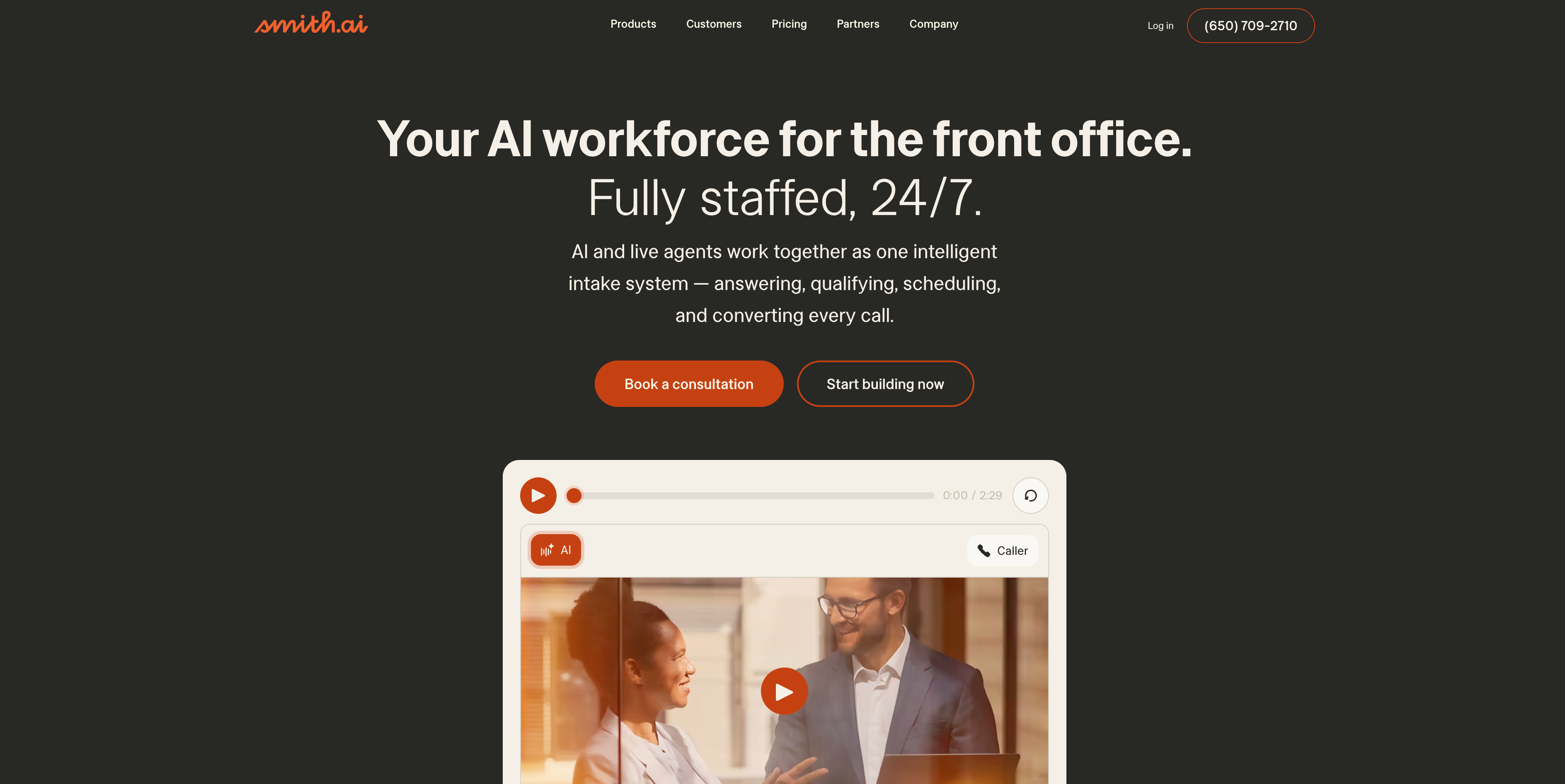
Smith.ai blends AI and live receptionists into a single service. The AI handles initial screening, answers common questions, and qualifies leads. Complex calls route to a trained human receptionist. For Phoenix businesses that want some AI efficiency but are not ready to go fully automated, Smith.ai provides a middle path. The service is popular with law firms and professional services, which aligns with Phoenix's large legal market (Maricopa County has one of the busiest court systems in the country).
Smith.ai's per-call pricing model differs from the per-minute model most services use. The AI receptionist tier costs $95/month for approximately 60 calls (about 2 per day), with $2.40 per additional call. The live receptionist tier starts at $300/month for 30 calls, with $11.50 per additional call. Add-ons include $1.50 to book appointments and $1 to take payments. For a Phoenix immigration law firm qualifying Spanish-speaking potential clients, or a medical aesthetics practice screening consultation requests, Smith.ai's lead qualification capabilities can pre-filter calls before they reach your team.
- Pricing: AI receptionist at $95/month for ~60 calls ($2.40/call overage). Live receptionist at $300/month for 30 calls ($11.50/call overage). Add-ons: $1.50/appointment booked, $1/payment taken.
- Best for: Phoenix law firms, medical practices, and professional services that want AI efficiency with human backup for complex calls, plus built-in lead qualification.
- Key features: AI + live hybrid model, lead qualification, new client intake, CRM integrations (Clio, Salesforce, HubSpot), fast answer times (4-7 seconds), appointment booking.
- Drawback: The per-call model can become expensive quickly. A Phoenix law firm receiving 100 calls per month on the AI tier pays $95 + $96 (40 overage calls at $2.40), totaling $191. On the live tier, that same volume costs $300 + $805 (70 overage calls at $11.50), totaling $1,105. The add-on fees for booking appointments ($1.50 each) and taking payments ($1 each) add up for practices that perform these actions on most calls. Zinng includes appointment scheduling and full transcription at no additional per-action cost.
4. Nexa: Best for Legal and Medical (Phoenix HQ)
Nexa is headquartered in Phoenix, which gives it a local advantage that no other service on this list can claim. The company specializes in legal and medical answering, two of the Valley's largest professional services categories. Nexa's receptionists are trained on industry-specific workflows: legal intake for personal injury, family law, and immigration cases; medical scheduling with insurance verification; and emergency dispatch protocols for after-hours healthcare calls.
For Phoenix law firms handling the volume of cases that flow through Maricopa County's courts, or medical practices serving a metro that adds tens of thousands of new patients every year, Nexa's industry expertise is a genuine differentiator. The company offers bilingual English/Spanish on all plans, 24/7 coverage, and integrations with legal and medical practice management software. Custom quoting means pricing adjusts to your specific call volume and complexity.
- Pricing: Starts around $200-250/month for 100 minutes (custom quoting). Overage rates $1.59-$1.99/min depending on tier. Requires a sales call for exact pricing.
- Best for: Phoenix law firms and medical practices that need industry-trained receptionists, legal intake, medical scheduling, bilingual support, and a Phoenix-based provider.
- Key features: 24/7 live answering, bilingual English/Spanish, legal intake and medical scheduling, emergency dispatch, CRM integrations (Clio, Dentrix, Salesforce), HIPAA-capable.
- Drawback: No transparent public pricing. You must schedule a sales call to get a quote, which creates friction for busy Phoenix professionals who want to compare options quickly. Estimated costs for 200 minutes land between $400 and $500, making Nexa roughly 7 to 8 times more expensive than Zinng for the same volume. The industry specialization is valuable, but it comes at a significant premium, and Zinng's AI can be trained on the same legal and medical workflows at a fraction of the cost.
5. SAS (Specialty Answering Service): Most Flexible Pricing
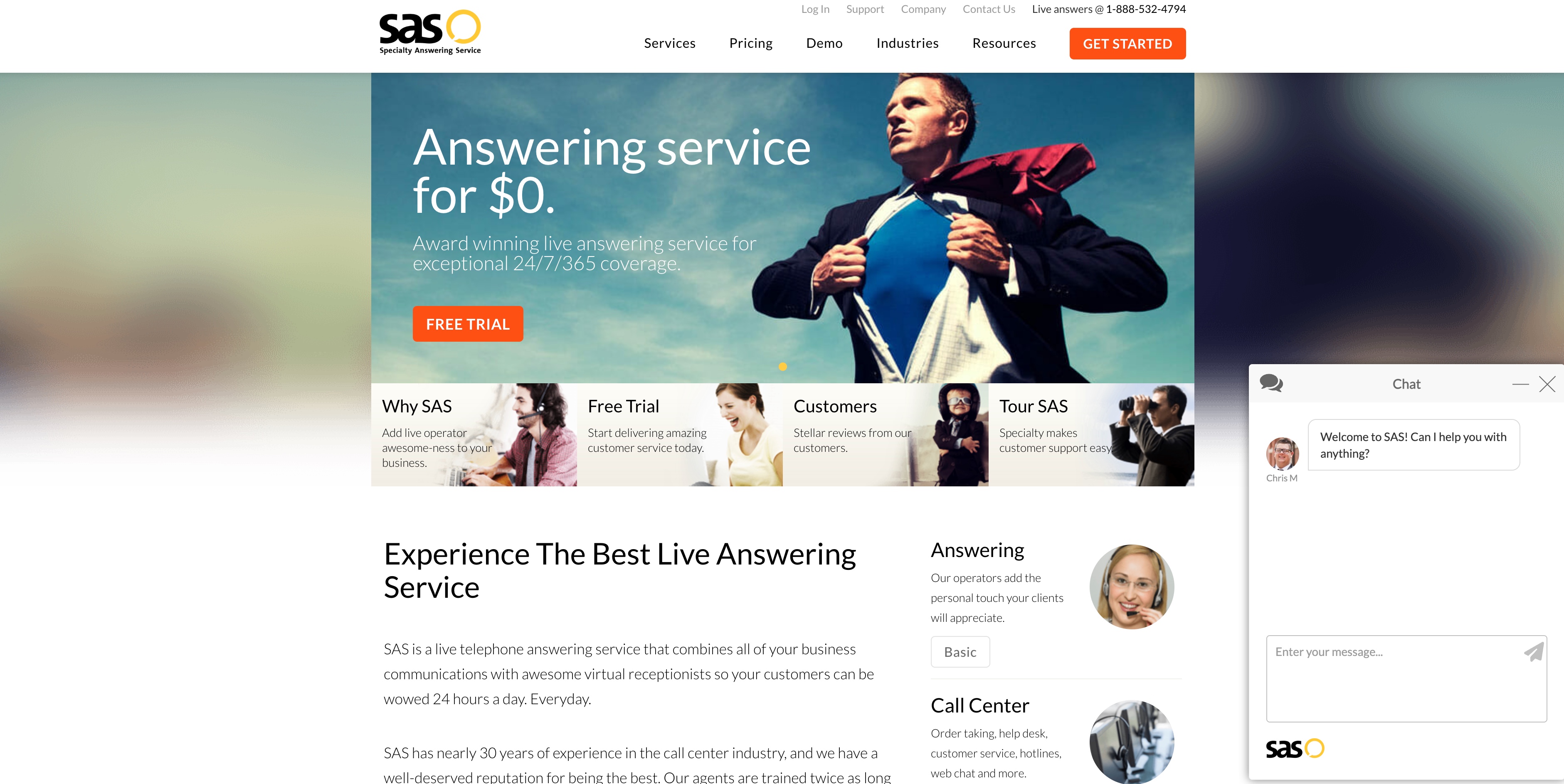
SAS provides the lowest barrier to entry of any traditional answering service. The pay-as-you-go plan costs $44/month with no included minutes and charges $1.54 per minute of actual usage. For a Phoenix solo attorney who only receives a handful of calls during court appearances, a startup founder testing whether an answering service improves lead capture, or a seasonal pool maintenance company whose call volume drops during winter months, SAS lets you pay only for what you use.
SAS is HIPAA-compliant, which matters for the private practices and dental offices spread across the Valley. The 2-week free trial with no credit card required lets Phoenix businesses test the service before committing. Flat-rate plans scale from $159/month for 100 minutes to $10,599/month for 10,000 minutes, covering everything from a solo chiropractor to a high-volume real estate brokerage. Bilingual English/Spanish is included.
- Pricing: Pay-as-you-go at $44/month base + $1.54/min. Flat rate at $159/month for 100 minutes. Plans scale to $10,599/month for 10,000 minutes. 2-week free trial, no credit card.
- Best for: Phoenix solo practitioners, seasonal businesses, and startups that need HIPAA-compliant, pay-per-use answering with no long-term commitment.
- Key features: 24/7 live answering, bilingual English/Spanish, HIPAA compliant, message taking, order processing, appointment scheduling, 2-week free trial.
- Drawback: Per-minute costs accumulate at moderate volume. A Phoenix property management company handling 200 minutes pays $44 + $308 (200 min at $1.54), totaling $352. Zinng covers the same volume for $61. Even the flat-rate 100-minute plan at $159 is more than triple Zinng's $49 for 100 minutes. The website feels dated compared to newer providers, and quality can vary between operators. For businesses handling consistent monthly volume, SAS's flexibility becomes a cost disadvantage.
Pricing Comparison
Here is what each service costs for a Phoenix business handling approximately 200 minutes of calls per month.
| Service | Starting Price | Cost for 200 min | Per-Min Rate | 24/7? |
|---|---|---|---|---|
| Zinng | $49/mo | $61/mo* | $0.12/min overage | Yes |
| Ruby | $250/mo | $720/mo | $4.40/min overage | Yes |
| Smith.ai | $95/mo | ~$191/mo** | Per-call model | Yes |
| Nexa | ~$200/mo | ~$400-500/mo*** | $1.59-$1.99/min | Yes |
| SAS | $44/mo | ~$352/mo**** | $1.54/min | Yes |
*Zinng's $49 plan includes 100 minutes. 200 minutes = $49 + $12 overage (100 additional minutes at $0.12/min).
**Smith.ai AI tier: $95 base for ~60 calls. Assumes ~100 calls at average 2 min each. $95 + 40 overage calls at $2.40 = $191.
***Nexa uses custom quoting. Estimate based on 100-minute base plan plus overage at $1.59-$1.99/min.
****SAS pay-as-you-go: $44 base + 200 minutes at $1.54/min = $352.
Why AI Answering Fits Phoenix
Phoenix's growth trajectory and business mix create communication patterns where AI answering provides specific advantages over traditional services:
- Rapid growth demands scalable phone coverage. Phoenix added over 70,000 new residents in 2024. A pediatric dental practice that opens with 200 patients will have 500 within a year. A property management company that starts with 50 rental units will be managing 150 by next spring. Traditional answering services require plan upgrades, contract renegotiations, and sometimes entirely new service tiers as your call volume grows. AI scales automatically. The same Zinng account that handles 100 minutes in month one handles 600 in month six at the same per-minute rate. In a city growing this fast, your phone system cannot be a bottleneck.
- 42% Hispanic population makes bilingual support non-negotiable. Over 35% of Phoenix households speak Spanish at home. A traditional service that charges extra for bilingual support or limits Spanish-speaking operators to certain hours is inadequate for the Valley. Zinng provides bilingual English/Spanish on every call, at every hour, with no add-on fee. When a Spanish-speaking parent calls a pediatrician's office at 8pm because their child has a rash, the answering service cannot say "press 1 for English" and leave them in a queue. The call must be handled fluently, immediately, in the language the caller needs.
- Healthcare volume requires HIPAA compliance at scale. Banner Health alone has over 50,000 employees in Arizona. Mayo Clinic Arizona, HonorHealth, Barrow Neurological Institute, and Phoenix Children's Hospital anchor a healthcare ecosystem that generates millions of patient calls annually. The private practices, specialty clinics, and mental health providers affiliated with these systems need HIPAA-compliant call handling that produces auditable records. AI generates verbatim transcripts automatically. A human operator's shorthand note that says "patient called, wants callback" lacks the clinical detail that a provider needs to triage appropriately and the documentation trail that HIPAA requires.
- Real estate moves too fast for voicemail. Phoenix's median days on market for residential listings hovers around 30-40 days, but competitive properties in Scottsdale, Tempe, and Gilbert move within days. When a pre-approved buyer calls about a listing at 7pm on a Saturday, waiting until Monday morning to return the call means that buyer has already toured three other properties. AI answers immediately, captures the buyer's criteria and budget, and sends the agent a transcript they can act on within minutes. No hold time, no missed call, no lost lead. In a market processing 80,000+ transactions annually, the math on missed calls is straightforward: each one has a measurable cost.
- Arizona's time zone quirk eliminates scheduling assumptions. Phoenix does not observe daylight saving time. For half the year, a client in Denver calling at "5pm Mountain Time" is actually calling at 4pm Phoenix time. A patient in Los Angeles scheduling a "9am Pacific" appointment is calling at the same time as Phoenix for part of the year and one hour earlier for the rest. National businesses, out-of-state patients, and snowbird visitors from the Midwest all bring different time zone assumptions. A 24/7 AI answering service eliminates this confusion entirely, because it operates identically at every hour. There is no "after hours" to misalign with a caller's expectations.
- Summer heat drives seasonal call spikes for home services. When Phoenix temperatures exceed 110 degrees for weeks at a stretch, HVAC emergencies, pool equipment failures, and plumbing issues spike simultaneously. A residential HVAC company may receive three times its normal call volume on the first 115-degree day of the summer. Traditional services sized for your March volume either overcharge during mild months or understaff during July. AI handles 5 simultaneous calls as easily as 50. There is no hold queue when every homeowner in the Valley calls about their AC unit on the same afternoon.
Human answering services retain value for Phoenix's luxury market: Scottsdale wealth management firms, Paradise Valley concierge medical practices, and high-end hospitality brands where callers specifically expect a live human. For the daily call volume that the Valley's 5+ million metro residents generate across healthcare, real estate, legal, home services, and technology, AI delivers more precise documentation, unlimited scalability, and dramatically lower cost.
Frequently Asked Questions
What is the best answering service in Phoenix?
For most Phoenix businesses in 2026, Zinng is the best answering service. It provides 24/7 AI-powered call answering at $49/month with 100 minutes included, full call transcripts, HIPAA compliance, and unlimited simultaneous calls. Phoenix is the fastest-growing large city in the U.S. with 1.65 million residents, home to TSMC's $65 billion semiconductor fab, Mayo Clinic Arizona, Banner Health's 30+ hospital network, and a real estate market generating over 80,000 annual transactions. Zinng delivers the bilingual support, documentation precision, and around-the-clock coverage that Phoenix businesses require.
How much does a Phoenix answering service cost?
Phoenix answering service pricing ranges from $44/month (SAS, pay-as-you-go) to $300/month (Smith.ai, 30 live receptionist calls). For 200 minutes of monthly coverage, Zinng costs $61, while traditional live services range from $200 to $720. Per-minute rates span $0.12 (Zinng AI) to $5.40 (Ruby). Phoenix office rent averages $28-35/sq ft, below coastal markets, and AI answering extends that cost advantage to phone operations.
Do Phoenix answering services offer bilingual English/Spanish support?
Most do, and in Phoenix it is essential. Approximately 42% of Phoenix residents are Hispanic or Latino, and over 35% of households speak Spanish at home. Zinng, Ruby, and SAS include bilingual English/Spanish support on all plans. Smith.ai handles Spanish through its AI receptionist tier. Nexa, headquartered in Phoenix, offers bilingual capability across all plans. For healthcare providers, legal offices, home services companies, and real estate agents serving the Phoenix metro, bilingual answering is a baseline operational requirement.
Are there HIPAA-compliant answering services in Phoenix?
Yes. Phoenix is one of the nation's largest healthcare markets. Mayo Clinic Arizona, Banner Health (30+ hospitals across Arizona), HonorHealth (6 hospitals), Barrow Neurological Institute (#1 in neurology nationally), and Phoenix Children's Hospital all serve the metro. Zinng and SAS offer HIPAA-compliant call handling. For the thousands of medical practices, specialty clinics, dental offices, and mental health providers operating across the Valley, HIPAA-compliant answering is a non-negotiable requirement.
What industries in Phoenix need answering services most?
Phoenix's top industries for answering services include healthcare (Mayo Clinic, Banner Health, HonorHealth, Barrow Neurological), real estate (80,000+ annual transactions, median home price near $420,000), semiconductor manufacturing (TSMC's $65 billion fab, Intel's Chandler campus), technology (over 100,000 tech workers), tourism (45+ million annual visitors, $25 billion in spending), and legal services. The city's rapid population growth, 42% Hispanic population requiring bilingual support, and year-round construction activity create consistent demand for professional call handling.
Final Verdict
Zinng is the best answering service for Phoenix businesses. At $61/month for 200 minutes of 24/7 coverage with HIPAA-compliant transcripts, bilingual English/Spanish support, and unlimited simultaneous calls, it matches the Valley's growth trajectory without penalizing you for scaling. The 14-day free trial with no credit card lets any Phoenix business evaluate the service at zero risk.
Ruby delivers the most polished live receptionist experience on this list. For Scottsdale law firms, Paradise Valley financial advisors, and premium professional services where the brand impression starts with the first phone call, Ruby's quality is unmatched among human services. At $720/month for 200 minutes, it serves a segment that values prestige over price.
Smith.ai provides a hybrid AI-human model that appeals to Phoenix practices wanting gradual AI adoption. The per-call pricing and built-in lead qualification suit law firms and medical practices that receive a moderate number of high-value calls. Add-on fees for appointments and payments make the total cost less predictable than flat per-minute models.
Nexa is the only Phoenix-headquartered service on this list, with deep specialization in legal and medical answering. For practices that want a local provider with industry-specific training, Nexa's expertise is real. The lack of transparent pricing and the requirement for a sales call create friction, and estimated costs place it well above AI alternatives.
And SAS offers the most flexible entry point for Phoenix businesses testing the waters. The pay-as-you-go model at $44/month plus $1.54/min works for solo practitioners, seasonal businesses, and startups that are not ready to commit to a fixed plan. HIPAA compliance and a 2-week free trial further lower the barrier. At consistent volume, per-minute costs make SAS significantly more expensive than AI.
Phoenix sprawls across 517 square miles of Sonoran Desert, stretching from the semiconductor fabs rising in the north to the healthcare campuses anchoring the east, from the real estate offices lining the Camelback Corridor to the construction sites transforming every corner of the Valley. It is a city that grew by nearly a million people in two decades, where TSMC is building the most advanced chip factory in the Western Hemisphere, where Mayo Clinic treats patients who flew across the country for care, where 45 million visitors fill resorts and stadiums and spring training ballparks, and where 42% of the population speaks Spanish at home. The pace of Phoenix does not slow down for a missed call. The right answering service makes sure it does not have to.