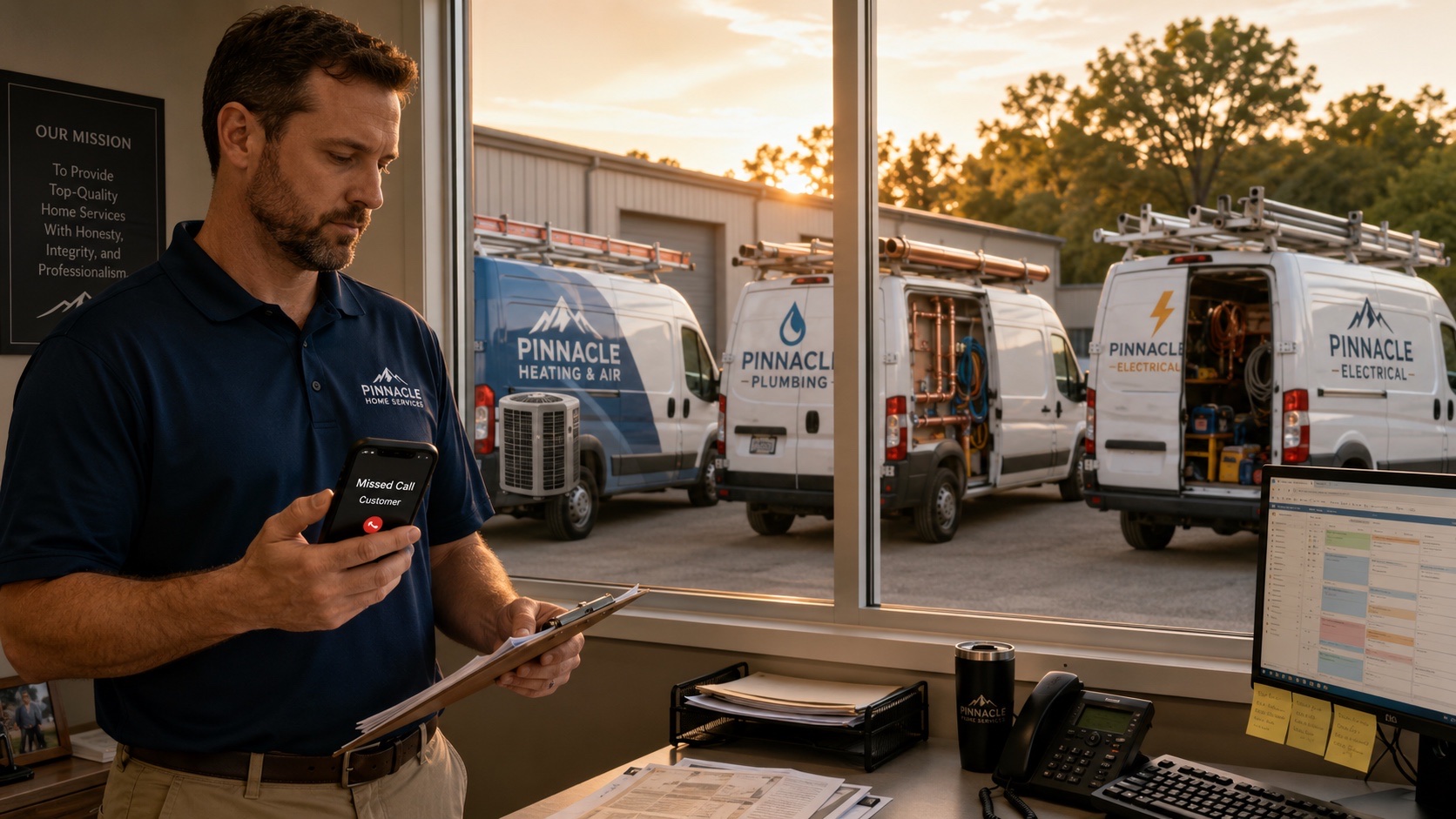
The short answer: a home services answering service picks up every call your crew can't, 24/7. A good one sorts emergencies from routine jobs, sends urgent calls to the right on-call tech for each trade, and books the rest. Live answering services cost roughly $300 to $1,000+ a month and bill by the minute. An AI answering service like Zinng starts at $49 a month for 300 minutes and answers every call at once, even during a cold snap.
Home services is one of the most call-driven industries that exists. A homeowner with no heat in February, no water on a Sunday morning, or a tripped breaker that won't reset doesn't email and doesn't fill out a contact form. They start dialing. They call three names off Google in the same fifteen-minute window. Whoever picks up first gets the job.
Your problem is that nobody can pick up. Your HVAC tech is up on a roof. Your plumber is under a sink. Your electrician is in a crawlspace pulling wire. Your dispatcher, if you even have one, is already on the phone with another customer. The next homeowner gets your voicemail, your competitor picks up, and a $400 service call or a $4,000 install becomes someone else's job.
This guide covers what a home services answering service actually does, why this trade loses more calls than almost any other, and the four real options for getting every call answered when your whole crew is in the field.
Why Home Services Businesses Need a 24/7 Answering Service
Every service trade loses revenue to missed calls. Home services loses more than almost any other for three reasons that are structural to how the work happens:
- The work is hands-on, dirty, and away from a phone. Crawlspaces, attics, roofs, behind appliances, under sinks. Your techs physically cannot answer a call mid-job without setting down a tool and washing their hands first. Calls that come in mid-job simply go unanswered. That's not a discipline problem. It's a physics problem.
- Calls hit at the worst possible times. No heat in winter at 6 AM before work. No AC in summer at 9 PM after a hot day. Burst pipes on holiday mornings. Power out during a storm. Garage door stuck before someone has to leave for work. Home services calls cluster in moments when your office is closed and your techs are sleeping, eating, or off the clock. Voicemail catches almost none of them.
- Homeowners are calling three companies, not one. Often the first company to pick up gets the job. Response speed matters a lot: in a Harvard Business Review study of 2,241 companies, firms that responded to leads within an hour were nearly 7 times as likely to qualify them as firms that waited longer (more in our speed to lead guide). Voicemail is the slowest response of all.
A home services answering service solves all three. Every call gets picked up instantly. Emergencies get triaged and texted to the right on-call tech. Maintenance and quote leads get qualified and routed to dispatch. You stop bleeding customers to whoever happened to be near a phone when yours rang out.
What a Home Services Answering Service Should Handle
Generic answering services treat every call the same: take a name, take a number, take a one-line message. That's barely above voicemail for a multi-trade home services operation. A real home services answering service should sort calls into the categories you actually deal with and handle each one differently:
- Active emergencies: No heat in cold weather, no AC in heat, no hot water, burst pipes, water leaks, electrical sparking, gas smells, garage door stuck open at night, sewer backup. The service should flag these as urgent and text or call your on-call tech for that trade with the full caller details.
- New service requests: Quote on a furnace replacement, AC tune-up booking, drain cleaning, water heater swap, electrical panel upgrade, garage door opener install. The service should collect the address, problem description, urgency, and preferred service window, then text the caller your calendar link or push the lead into your dispatch system.
- Maintenance contract calls: Existing customer needing a quarterly tune-up, annual service plan customer scheduling their visit. Recognize them, route to scheduling, log the conversation.
- Quote and estimate questions: "How much does a new AC cost?" "What's a panel upgrade run?" These rarely convert without a site visit. The service should capture the lead and book the visit, not try to quote on the call.
- Multi-trade routing: If you do HVAC, plumbing, electrical, and garage doors out of one office, the service has to identify which trade the call is for and route to the right on-call tech. This is the single most overlooked capability and the biggest single reason multi-trade shops miss after-hours work.
- Service area filtering: Out-of-area calls should get a polite decline or referral, not a callback promise you can't keep.
- Subcontractor and vendor calls: Supply house confirming a delivery, inspector calling to schedule a walk, parts dealer with a backorder update. These need to reach the right person, not get buried in your generic message inbox.
- Spam, telemarketers, and "we'd love to put you in our directory" calls: Filter these out so they don't show up in your message log or eat your minutes.
The best home services answering services are trained on your specific business: trades performed (HVAC only, plumbing + drain, full multi-trade), service area, minimum job sizes, on-call rotation, and what counts as urgent for each trade. A generic script produces a generic conversation that misses what makes the call worth taking.
The 4 Home Services Answering Options
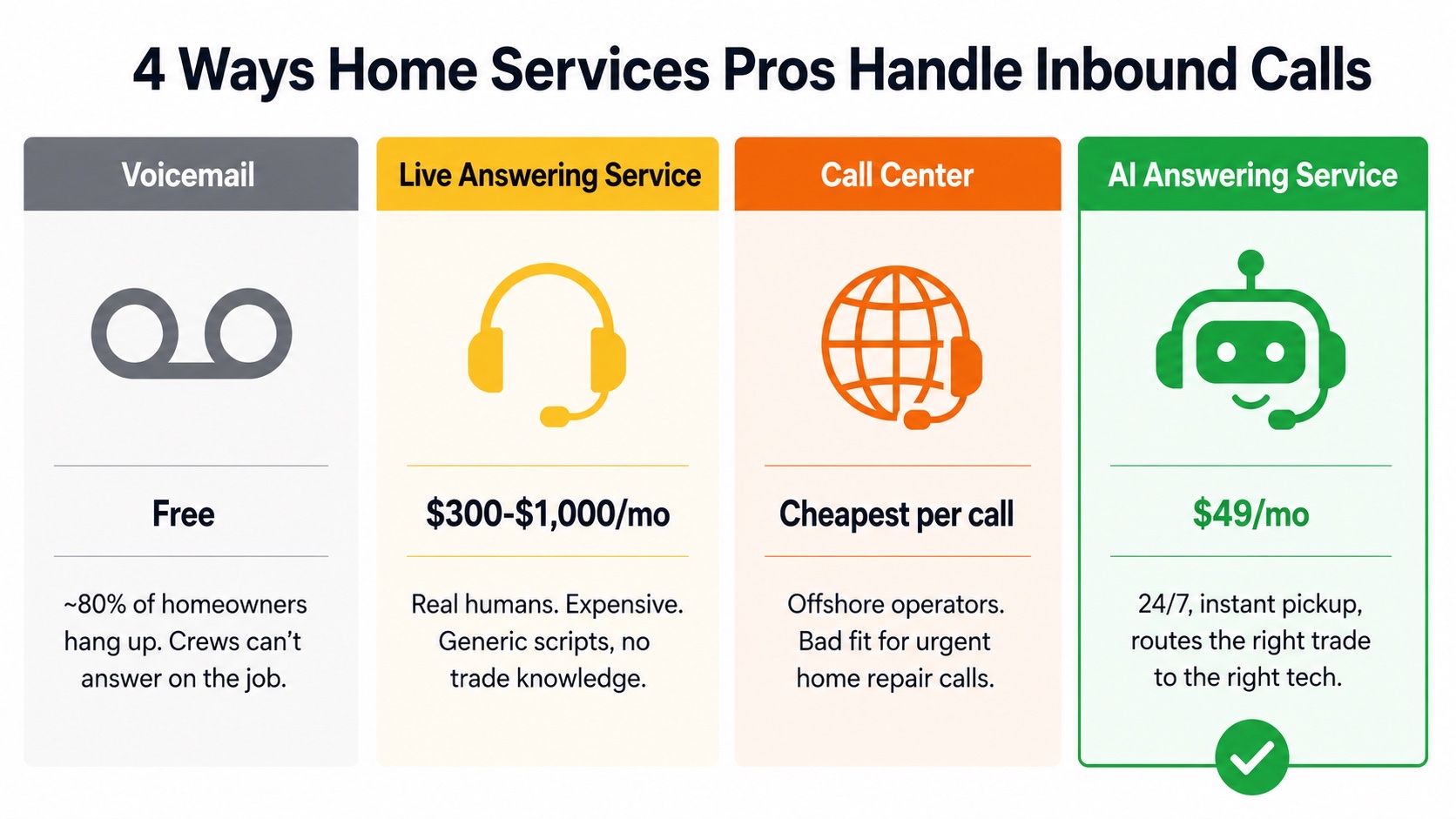
Home services owners have four real ways to handle calls when the crew is in the field. None of them are perfect, but the gap between the best and the worst is enormous.
Option 1: Voicemail (Free, and the reason you're reading this)
The default. Free, easy, and the silent killer of home services growth. The voicemail callback rate for home services is worse than the cross-industry average because homeowners with broken HVAC or burst pipes are actively dialing the next company in line. If your voicemail picks up and a competitor's office manager picks up, the lead is gone before you knew it existed.
Voicemail works for a one-person handyman operation running below capacity. For any multi-trade shop trying to fill a second or third truck, it caps the business hard.
Option 2: Live Answering Service ($300-$1,000/month)
Traditional services like Ruby, PATLive, AnswerConnect, and MAP Communications use human receptionists to answer your line, take messages, and follow whatever script you give them.
- Strengths: Warm human voice, naturally handles emotional callers (the homeowner whose basement just flooded), bilingual options on most plans.
- Weaknesses: Expensive ($1.30 to $5.40 per minute), the operator answering for your HVAC business is also answering for a law firm and a dentist that hour, inconsistent quality, you pay for spam minutes, hold times spike during weather events when you most need coverage.
- Cost reality: A multi-trade home services shop taking 300 minutes of calls per month is paying $390 to $1,620 monthly. Add overflow plans for storm events and many shops see $2,000+ in peak months.
Option 3: Call Center (Cheapest per call, lowest quality)
Larger franchise home services operations sometimes route calls to offshore call centers. Per-call cost is the lowest of any option, but operators have zero trade-specific training, accents can frustrate homeowners who already have a problem, and customization is bare bones.
Call centers can work for franchise shops with very high volume and a single national dispatch script. For an independent multi-trade shop, the quality drag costs more than the savings, and offshore operators almost never get the trade-routing logic right.
Option 4: AI Answering Service ($49-$99/month)
AI-powered services like Zinng, Rosie, and Smith.ai use voice AI to answer in a natural tone, route urgent calls to the right on-call tech by trade, and book service appointments via SMS scheduling links.
- Strengths: 24/7 coverage, instant pickup, unlimited concurrent calls (critical when a winter cold snap or a summer heat wave triggers 20 simultaneous calls), full call recordings and transcripts, 3-10x cheaper per minute than live services, spam calls that the AI ends in seconds (and blocked numbers that don't use your minutes), and an AI that actually knows which trade is which.
- Weaknesses: Cannot match the absolute top tier of human empathy on the most emotionally charged calls. Voice quality varies by provider; the bad ones still sound robotic.
- Cost reality: Zinng covers 300 minutes for $49/mo flat. Higher tiers scale to 2,000+ minutes for multi-truck shops with no per-minute billing on the included minutes.
For most home services businesses in 2026, an AI answering service is the right choice. The cost gap to live services is too wide to justify, and the multi-trade routing is something AI does noticeably better than rotating human operators.
Multi-Trade Dispatch: The Killer Feature
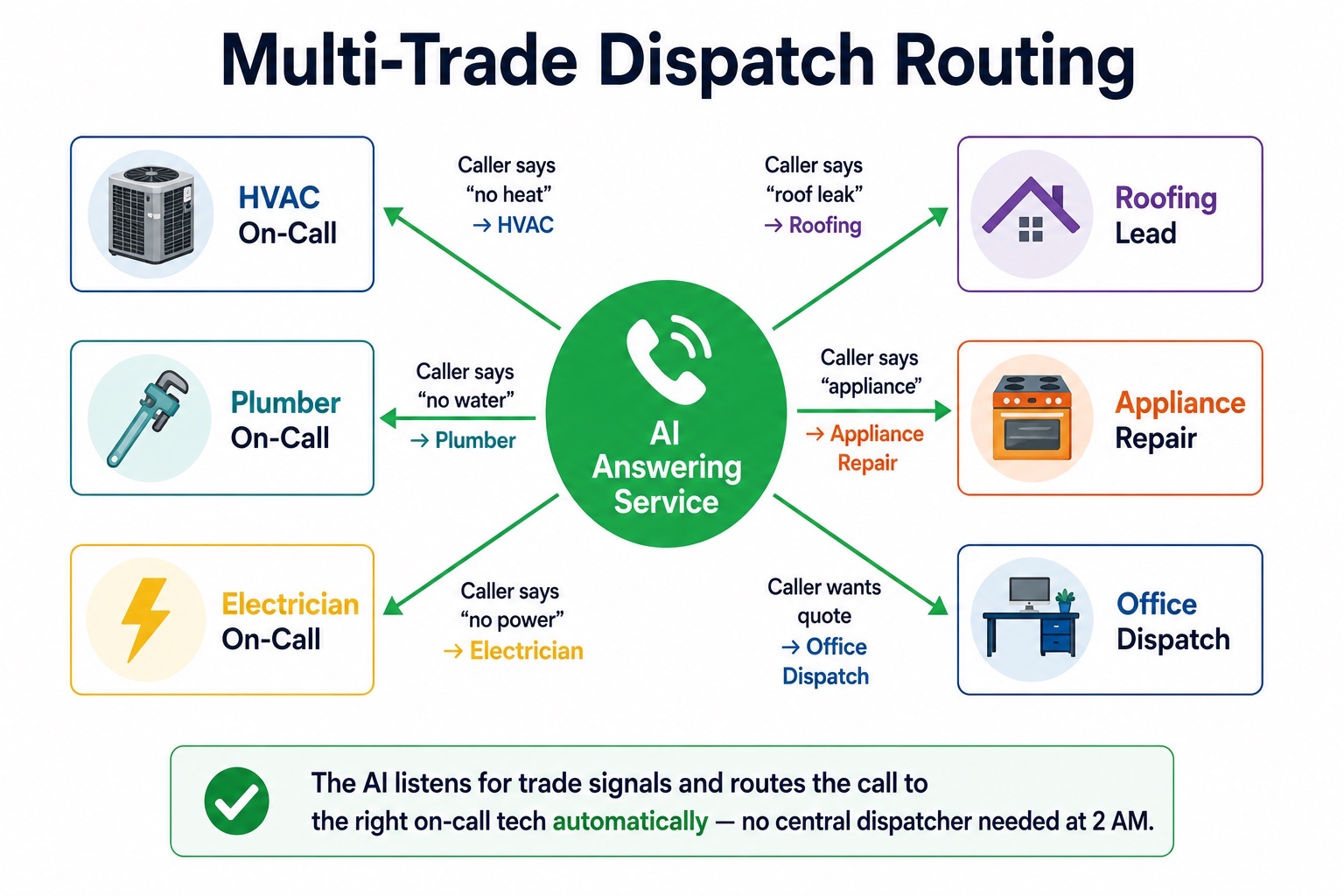
If you run a single-trade shop (just HVAC, just plumbing, just electrical), call routing is easy. The phone rings, you or your one on-call tech answers. If you run a multi-trade shop, routing is the hardest part of the day, and live answering services do it badly.
Multi-trade dispatch routing means the answering service listens to what the caller actually says, identifies which trade the job is for, and pages the right on-call tech for that trade. Done right, your HVAC guy doesn't get woken up at 2 AM for a sewer backup, your plumber doesn't get a no-power call, and your electrician doesn't get a quote request for a water heater.
What good multi-trade routing looks like in practice:
- The AI listens for trade signals early. "No heat" and "AC out" route to HVAC. "Water leak" and "no hot water" route to plumbing. "No power" and "burning smell" route to electrical. "Garage door stuck" routes to the door tech. "Stove not working" routes to appliance repair if you offer that.
- It confirms when the signal is ambiguous. A call about a "leak from the ceiling" could be a plumbing leak from an upstairs bathroom or a roof leak. The AI asks one clarifying question, then routes accordingly.
- It pulls the right on-call number for that trade. Your HVAC on-call rotation isn't your plumbing on-call rotation. The system knows which tech is up tonight for which trade and texts the right one.
- It respects service area by trade. Maybe your HVAC service area is wider than your plumbing service area because you only have one plumbing tech. The system handles that nuance.
- It logs everything. The morning dispatcher sees every call from overnight, who got routed, who responded, and which calls are still pending follow-up.
Live answering services almost never get this right because the operator answering your call also answers for a hundred other businesses and can't keep your on-call rotation in their head. AI services like Zinng configure it once and execute it correctly every time.
Emergency Triage Across Trades
Different trades have different emergency profiles. A good home services answering service uses a separate triage logic for each:
- HVAC: No heat in cold weather is urgent. No AC during a heat advisory is urgent. Carbon monoxide alarm sounding is a 911 call before it's an HVAC call. Routine "my unit is making a noise" is a next-day service.
- Plumbing: Active water leak, burst pipe, sewer backup, gas smell, no water at all in winter (frozen pipes possible). Routine "my faucet drips" is a next-week call.
- Electrical: No power to the house, sparking outlet, burning smell, breaker tripping repeatedly with no obvious cause. Routine "I need to add an outlet" is a quoted job.
- Garage door / appliance / other: Customer trapped (rare but real), door stuck open at night (security risk), refrigerator failure with no backup (food spoilage). Routine stuff waits for business hours.
The AI is configured during setup with these criteria for each trade you operate. It asks the right clarifying questions (Is the water actively flowing? Can you smell gas? Is anyone in immediate danger?), captures the essentials, and routes accordingly. Customers feel heard, on-call techs only get woken for real emergencies, and you stop missing the most profitable after-hours work.
Zinng configures multi-trade emergency triage during onboarding. The team builds your specific rules with you, or you can set them yourself by chatting with the AI in the app.
How to Set Up a Home Services Answering Service
Setup is faster than most owners expect. Four steps:
- Pick the service. Zinng is the best fit for most home services businesses; Rosie and Smith.ai are reasonable alternatives. Compare options in the 10 best auto call answering apps roundup.
- Define your trades, on-call rotation, and emergency rules. Which trades do you run? What's the service area for each? What counts as an emergency for each trade? Who's on call when for each trade? Spell these out so the AI handles each correctly from day one.
- Forward your business line. Most owners forward calls to the AI whenever they don't pick up within four rings. Some forward 24/7 and let the AI handle everything, especially overnight and on weekends. Either works.
- Test it. Call your own number a few times as different callers: HVAC emergency, plumbing leak, electrical no-power, quote on a new install, existing maintenance customer, telemarketer. Tune the AI until each call type routes the way you'd want your best dispatcher to handle it.
With Zinng, you can be live in minutes. Sign up, chat with the AI to set up your agent (it asks about your trades, service area, on-call rotation, and emergency criteria), and forward your business line. Prefer not to handle setup yourself? The Zinng team can build it for you instead.
Home Services Answering Service Pricing
Here is what each option actually costs for a home services shop taking 300 minutes of calls per month, a typical figure for a 2-4 truck multi-trade operation:
| Option | Monthly Cost (300 min) | Per-Minute Rate | 24/7? |
|---|---|---|---|
| Zinng AI | $49/mo | $0.16 effective | Yes |
| Rosie AI | $49/mo | $0.20 effective | Yes |
| Smith.ai (AI) | $95/mo (50 calls) | $1.90/call | Yes |
| MAP Communications (live) | ~$390-$510/mo | $1.28-$1.70/min | Yes |
| PATLive (live) | ~$690/mo | $2.30/min | Yes |
| Ruby Receptionists (live) | ~$1,080/mo | $3.60/min | Yes |
| Voicemail | $0 | N/A | No |
For a home services shop saving even one after-hours emergency per month, an AI answering service is a clear net positive. A single saved no-heat call in February at $800-$2,000 covers years of subscription cost. Live services need to save four or five times as many calls to break even on their per-minute rates.
Frequently Asked Questions
Can a home services answering service route calls to the right trade?
Yes, and this is one of the most important capabilities for multi-trade shops. Modern AI services like Zinng listen for trade signals on the call ("no heat" → HVAC, "no water" → plumbing, "no power" → electrical) and route to the right on-call tech for that trade. Live answering services struggle with this because the operator on duty handles many other businesses in the same hour.
Will the AI know home services terms like rough-in, condensate line, panel upgrade, or pilot light?
Yes. The setup process scans your website and uses your service list so the AI speaks your trade. It understands HVAC, plumbing, electrical, drain cleaning, water heaters, panel upgrades, garage doors, appliance repair, roofing, and anything else you offer. It won't promise services you don't perform.
Can it tell the difference between an emergency and a routine call for each trade?
Yes. You configure your emergency criteria for each trade during setup (no heat in winter, no AC in heat advisories, active water leaks, electrical sparks, gas smells, garage door stuck open at night). The AI runs the right triage questions and flags genuine emergencies for your on-call tech with the full caller details.
Does it integrate with ServiceTitan, Housecall Pro, Jobber, or FieldEdge?
Most modern AI answering services do, either via direct integration or webhooks. Zinng supports webhook-based integrations with ServiceTitan, Housecall Pro, Jobber, FieldEdge, and most other home services field management platforms. Lead capture, contact creation, and basic dispatch routing all flow through.
What happens during weather events when 20 calls come in at once?
AI answering services handle unlimited concurrent calls with zero hold time. During a cold snap when 30 homeowners call HVAC companies in the same hour, every one of those callers is answered at the same minute. Live answering services have hard concurrency limits, and your own dispatcher physically can't be on three calls at once. This is the single biggest practical advantage of AI for home services.
What about bilingual callers?
Bilingual English and Spanish coverage is included in most modern AI answering services at no extra cost. For home services businesses in Texas, California, Florida, Arizona, and many other markets, this is often a meaningful share of inbound calls. Confirm bilingual support before signing up.
Can the AI book service appointments directly?
Yes. The AI can either text the caller a scheduling link (most flexible, works with any calendar or dispatch tool) or book directly into your Google Calendar, ServiceTitan, Housecall Pro, or other field service management software. Setup depends on the provider.
How fast can I get a home services answering service set up?
Modern AI services are self-serve and live in minutes. With Zinng, you sign up, chat with the AI to configure your agent, and forward your business line. If you'd rather have the Zinng team build the multi-trade routing for you, that option is available too. Traditional live services usually take one to two weeks to onboard.
If you run a home services business and you're still relying on voicemail or paying $700+/month for a live answering service that doesn't know HVAC from plumbing, there's a better option in 2026. Zinng handles every call, routes the right trade to the right on-call tech, triages emergencies, and books service via SMS, all for $49/month. Sign up, chat with the AI to configure your agent, and you're live in minutes.
If you only run a single trade, we have deep-dive coverage for plumbing, pest control, landscaping, and construction too. Or compare every answering option side by side in the 10 best auto call answering apps roundup.