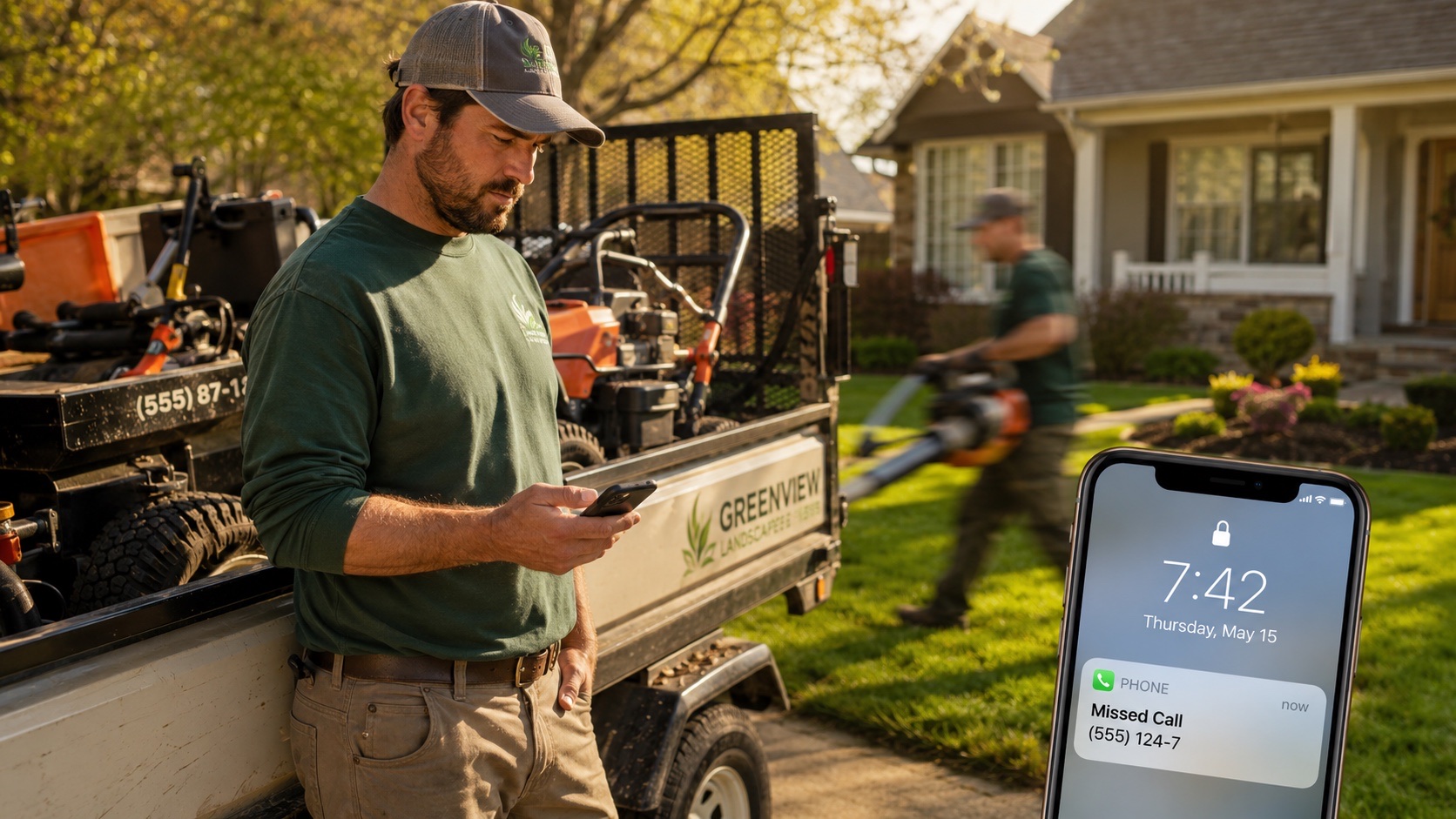
Landscaping is a phone-in-the-pocket business. You're on a riding mower with hearing protection on. Your foreman is forty feet up in a bucket trimming a hazard limb. Your install crew is elbow-deep in a French drain trench with a saw running. The phone rings, and nobody hears it. By the time you check it at lunch, the homeowner who needed a same-day mow has already booked someone else.
That call was a $80 weekly maintenance contract. Or a $4,200 patio job. Or a $300 storm cleanup that turns into the homeowner's go-to landscaper for the next decade. Either way, you didn't get it because nobody answered.
This guide walks through what a landscaping answering service actually is, why landscaping call patterns are uniquely brutal for missing calls, and the four real options for getting every call answered when you and the crew are in the field.
Why Landscaping Businesses Need a 24/7 Answering Service
Every service trade loses money to missed calls. Landscaping loses more than most for three reasons that are specific to how the work happens:
- You physically cannot answer the phone during work. Mowers, blowers, trimmers, chainsaws, stump grinders. The decibel level on a typical install or maintenance route makes hearing a ringtone impossible, and stopping a job to take a call costs your crew real productivity. Plumbers and electricians can step into a quiet hallway. Landscapers usually can't.
- Calls don't queue politely; they arrive in waves. Saturday mornings after a Friday storm. Sunday evenings as homeowners look at their yards. Monday mornings when commercial property managers walk the site. April when everyone simultaneously decides their grass needs cut. You either staff for the wave (overpaying nine months of the year) or miss the wave (underearning all year). Most landscapers do the second by accident.
- Customers shop fast and don't wait. Homeowners getting quotes for a paver patio call three or four contractors in the same hour. Industry callback data is consistent: the contractor who reaches the customer first wins the bid roughly 50% of the time, regardless of price. If your voicemail picks up and theirs doesn't, you lose the job before you knew it was available.
A landscaping answering service breaks all three problems. Calls get picked up while the crew keeps mowing. Spring rush waves get absorbed without hold times. Quote requests get logged and routed to you in real time so you can call back in minutes, not hours.
What a Landscaping Answering Service Should Handle
Generic answering services treat every call the same way: take a name, take a number, take a short message. That's barely better than voicemail for a landscaping business. A real landscaping answering service should sort calls into the categories you actually deal with and handle each one differently:
- New maintenance inquiries: Homeowner wants weekly mowing, biweekly mowing, or seasonal cleanup pricing. The service should collect the address, property size estimate, services requested, and preferred start date so you can quote without a second call.
- Design and install quotes: Caller wants a patio, retaining wall, sod install, irrigation system, or full landscape design. These are high-ticket leads. The service should capture the scope, timeline, and budget range and put a same-day callback on your dispatch.
- Storm damage and cleanup: Hail-broken limbs, downed trees, washed-out beds, leaf piles after the first big October wind. These are time-sensitive and often become regular customers if handled fast. Flag them as priority callbacks.
- Existing customer service requests: "Can you skip me this week?" "Can the guys hit the side yard next time?" "When are you coming for fall cleanup?" Recognize them, route them to scheduling, log the change.
- Irrigation and snow service calls: If you do irrigation or snow plowing, these have their own urgency profile. Broken sprinkler head spraying the driveway, snow lot needs plowing before 7 AM opening. Route to the right tech on call.
- Commercial property managers: Often the highest-value callers and they expect a callback within the hour during business hours. Tag commercial calls and bump them up the queue.
- Spam, telemarketers, and "we're a marketing agency": Filter these out so they don't show up in your message log or eat your minutes.
The best landscaping answering services are trained on the specific shape of your business: your service area, the services you actually offer (mow-and-blow, full-service maintenance, hardscape, irrigation, snow, tree work), your minimum job size, and how you want quotes captured. A generic script produces a generic conversation.
The 4 Landscaping Answering Service Options
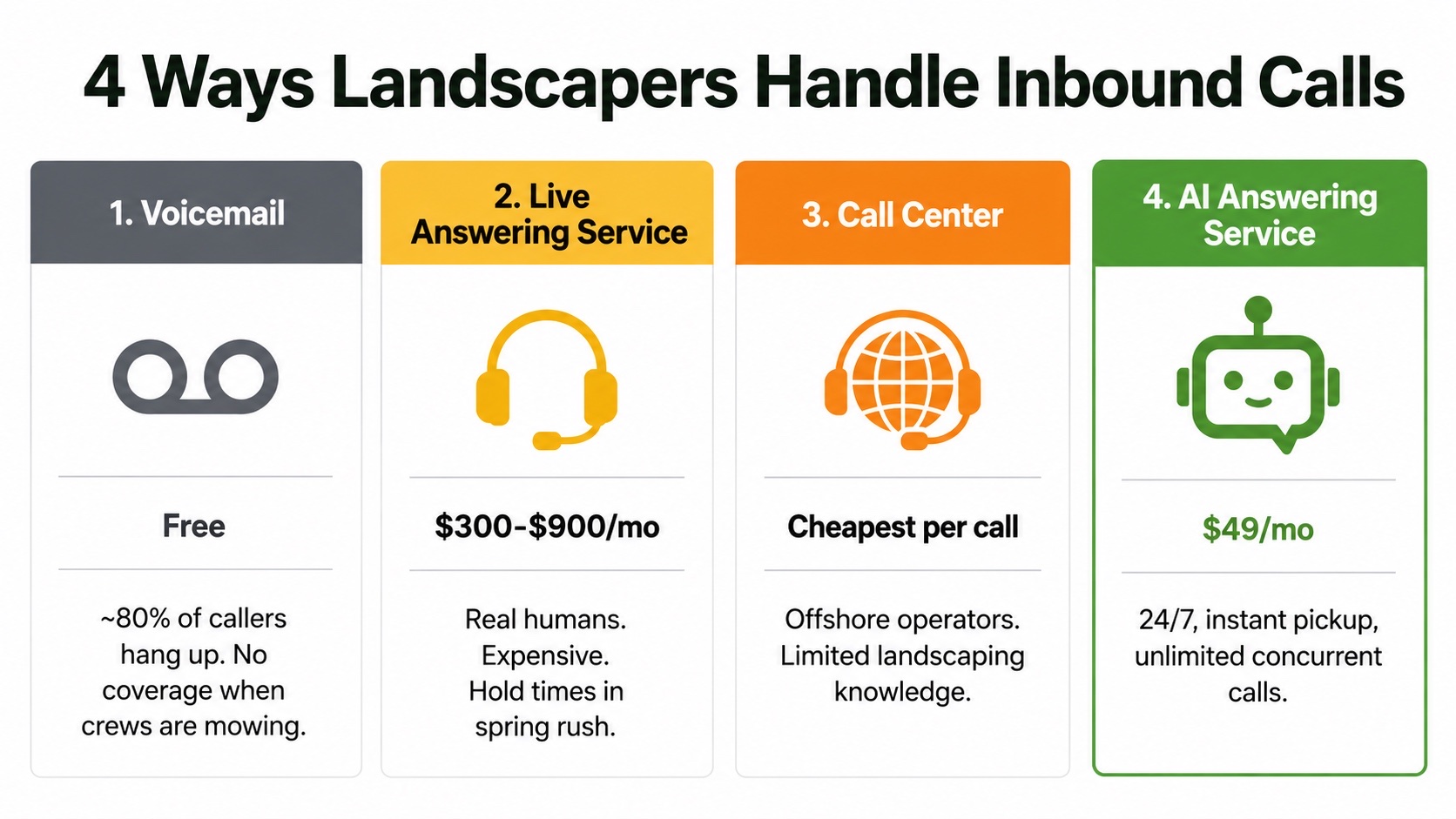
Landscaping owners have four real ways to handle calls when the crew is in the field. None of them are perfect, but the gap between the best and the worst is enormous.
Option 1: Voicemail (Free, but you'll feel it in May)
The default. Free, easy, and the reason most landscaping owners are reading this article. The data on voicemail callback rates is consistent: roughly 80% of business callers will not leave a voicemail. For landscaping specifically, the situation is worse because homeowners getting quotes are calling several contractors in the same fifteen-minute window. If they reach a competitor's receptionist before they reach your voicemail, that lead is gone.
Voicemail is a defensible choice for a one-person operation with very low call volume and no growth ambition. For anyone trying to grow past a single truck, it caps the business.
Option 2: Live Answering Service ($300-$900/month)
Traditional services like Ruby, PATLive, AnswerConnect, and MAP Communications use human receptionists to answer your line. They take messages, route urgent calls, and follow whatever script you build.
- Strengths: Warm human voice, naturally handles emotional callers (the homeowner whose oak tree just took out a fence), bilingual options on most plans, can occasionally handle nuanced situations better than AI.
- Weaknesses: Expensive ($1.30 to $5.40 per minute depending on provider), inconsistent quality across operators, the operator you get on a Tuesday afternoon is not the operator you get on a Saturday night, you pay for spam minutes, hold times spike right when you most need coverage (Monday mornings in April).
- Cost reality: A landscaping business taking 300 minutes of calls per month is paying somewhere between $390 and $1,620 monthly. Add spring surcharges and overflow plans and many landscapers see bills north of $2,000 in peak months.
Option 3: Call Center (Cheap, but the quality shows)
Some larger landscaping operations route inbound calls to offshore call centers. The per-call cost is the lowest of any option, but you trade away nearly everything else. Operators have minimal training on landscaping vocabulary, accents can frustrate homeowners who already have a problem, and customization is bare bones.
Call centers can work for very high-volume operations running simple dispatch scripts (think national chains with a single call type). For an independent landscaper, the quality drag usually costs more than the savings.
Option 4: AI Answering Service ($49-$99/month)
AI-powered services like Zinng, Rosie, and Smith.ai use voice AI to answer in a natural conversational tone, take detailed messages, route urgent calls, and book estimates via SMS scheduling links.
- Strengths: 24/7 coverage including weekends, instant pickup with zero hold time, unlimited concurrent calls (critical when ten homeowners call at 9 AM on the first warm Saturday in April), full call transcripts and recordings, 3-10x cheaper per minute than live services, no charge for spam.
- Weaknesses: Cannot match the absolute top tier of human empathy on the most emotionally charged calls. Voice quality varies by provider; the bad ones still sound robotic.
- Cost reality: Zinng covers 300 minutes for $49/mo flat. Higher tiers scale to 2,000+ minutes for multi-crew operations with no per-minute billing on the included minutes.
For most landscaping businesses in 2026, an AI answering service is the right choice. The pricing isn't comparable to live services, and the unlimited concurrent calls feature is uniquely valuable for a trade with seasonal call waves.
Spring Rush, Fall Cleanup, and Storm Surges
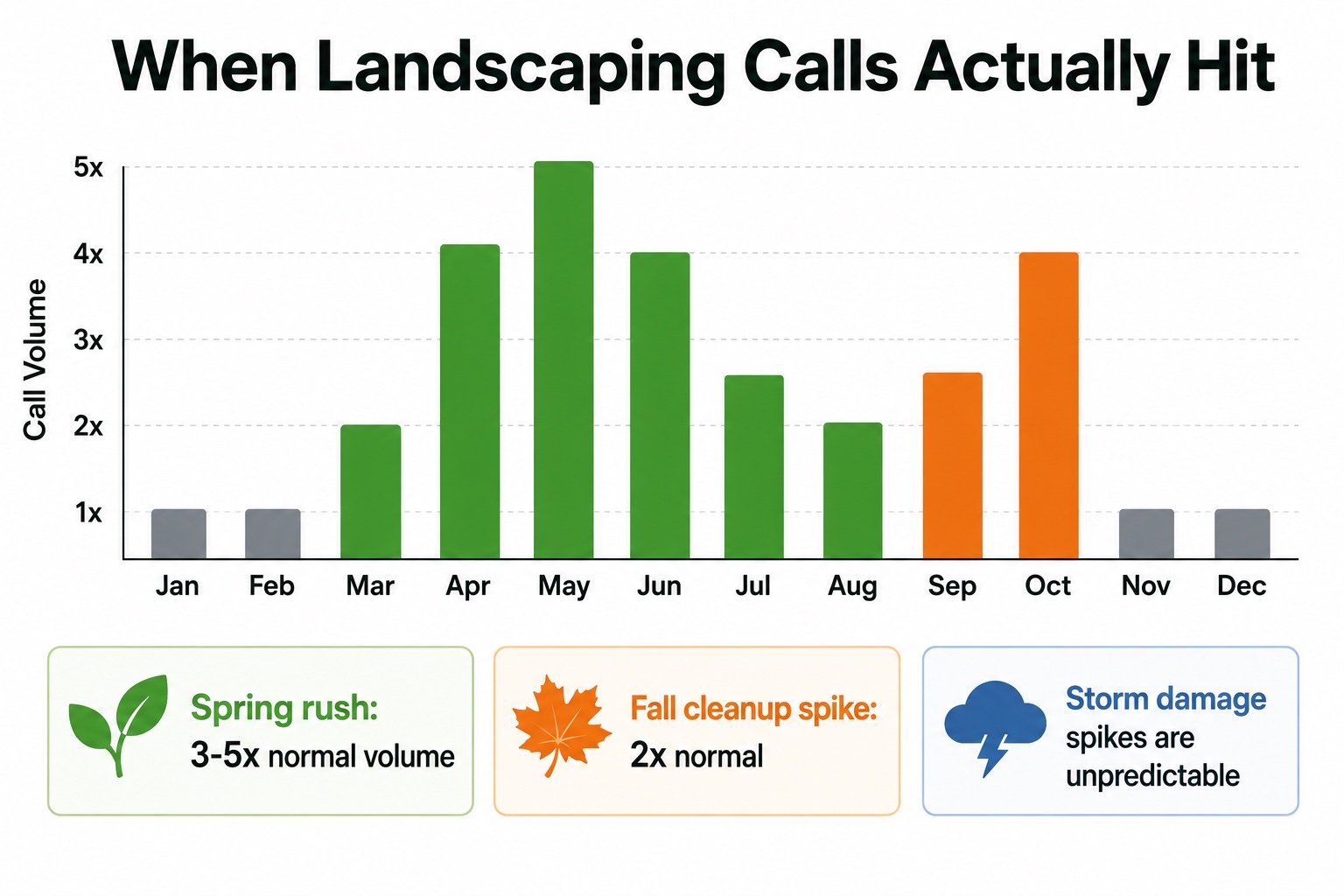
The seasonality of landscaping calls is the single biggest reason AI beats live answering services for this trade. A live answering service has a finite number of operators on shift. When a Saturday morning storm rolls through a metro area and 200 homeowners simultaneously call landscapers about downed limbs, the operators are slammed, your callers wait on hold, and many hang up.
An AI answering service has no hold queue. If 50 calls come in at the same minute, all 50 are answered at the same minute. For a landscaping business, this matters in three specific scenarios:
- The spring kickoff (March through May): Weekly call volume can triple or quadruple in the four weeks after the first warm Saturday. Every homeowner in your market is making the same decision in the same window. Voicemail and overloaded live services both fail here. AI absorbs the wave.
- Fall cleanup (September through October): A smaller but still real spike as leaves drop and homeowners book one-time cleanups, gutter clears, and bed mulching. Often a chance to convert a one-time cleanup customer into a year-round maintenance customer if the intake is good.
- Storm response (any month, no warning): Wind events, ice storms, late spring frosts, hurricane remnants. Call volume can 10x in a single morning. The landscapers who answer first get all the work. The ones whose phones ring out get crumbs.
For the cost of one or two saved storm-response jobs, an AI answering service pays for itself for the entire year.
Quotes, Estimates, and Booking Site Visits
Maintenance bookings can often be quoted on the call (square footage, frequency, basic add-ons). Design, install, and hardscape jobs almost always require a site visit. A good landscaping answering service handles both cases differently.
For maintenance-style calls, the AI collects the property details, services requested, and frequency, then either quotes from the rate sheet you provided during setup or texts the caller a "we'll confirm your quote within an hour" message and pushes the lead to your dispatch. For install and design calls, the AI captures the project scope, budget range, ideal timeline, and the caller's preferred days for a site visit, then texts them your calendar link to book an on-site estimate.
Specific routing rules that matter for landscapers:
- Service area: The AI should know which zip codes, towns, or radius you cover. Out-of-area calls get a polite decline or a referral, never a callback promise you can't keep.
- Minimum job size: If you don't take patio jobs under $5K or maintenance contracts under $60/visit, the AI should communicate that during the call so you don't waste a site visit.
- Crew assignment: If you have separate maintenance, install, and tree crews, the AI should route the call type to the right foreman or schedule the right estimate with the right person.
- Commercial vs residential: Commercial property managers expect a faster, more direct conversation. The AI should detect a commercial caller and adjust tone, pacing, and questions.
Zinng handles all of this in setup. If you use Jobber, ServiceTitan, Aspire, LMN, Yardbook, or another landscaping field service platform, the AI can also push captured leads and bookings directly into your system.
How to Set Up a Landscaping Answering Service
Setup is faster than most landscapers expect. Four steps:
- Pick the service. Zinng is the best fit for most landscaping businesses; Rosie and Smith.ai are reasonable alternatives. Compare options in the 10 best auto call answering apps roundup.
- Define your call types and priorities. What's a maintenance call? What's a design lead? What counts as urgent (storm damage, irrigation flood, snow service in winter)? Spell these out before setup so the AI routes correctly from day one.
- Forward your business line. Most landscapers forward calls to the AI whenever they don't pick up within four rings. Some forward 24/7 and let the AI handle everything; this is increasingly common during peak season. Either works.
- Test it. Call your own number a few times pretending to be different callers (new maintenance lead, install quote, storm cleanup, existing customer reschedule). Tune the AI's responses until each call type is handled exactly the way you'd want a great office manager to handle it.
With Zinng, you can be live in minutes. Sign up, chat with the AI to set up your agent (it asks about your service area, services offered, pricing rules, and how you want different call types handled), and forward your business line. Prefer not to handle setup yourself? The Zinng team can build it for you.
Landscaping Answering Service Pricing
Here is what each option actually costs for a landscaping business taking 300 minutes of calls per month, a typical figure for a 2-3 truck operation in growing season:
| Option | Monthly Cost (300 min) | Per-Minute Rate | 24/7? |
|---|---|---|---|
| Zinng AI | $49/mo | $0.16 effective | Yes |
| Rosie AI | $49/mo | $0.20 effective | Yes |
| Smith.ai (AI) | $95/mo (50 calls) | $1.90/call | Yes |
| MAP Communications (live) | ~$390-$510/mo | $1.28-$1.70/min | Yes |
| PATLive (live) | ~$690/mo | $2.30/min | Yes |
| Ruby Receptionists (live) | ~$1,080/mo | $3.60/min | Yes |
| Voicemail | $0 | N/A | No |
For a landscaping business saving even one new maintenance contract per month, an AI answering service is a clear net positive. A single saved install lead in the $3K-$8K range covers years of subscription cost. Live services need to save four or five times as many calls to break even on their per-minute rates.
Frequently Asked Questions
Can a landscaping answering service handle quotes and estimates?
Yes. Modern AI services like Zinng can quote simple maintenance work directly on the call using your rate sheet, and capture full project scope on design and install leads so you can call the customer back with a hot lead in hand. Site visits get booked via SMS scheduling link rather than over the phone, which is faster and more reliable for both sides.
Will the AI know landscaping terms like hardscape, drip irrigation, or sod installation?
Yes. The setup process scans your website and uses your service list so the AI speaks your trade. It understands edging, mulching, aeration, overseeding, dethatching, hardscape, retaining walls, drip irrigation, sod installation, tree pruning, snow removal, and whatever else you offer. It won't promise services you don't perform.
What happens during spring rush when calls come in waves?
This is where AI beats live services and human staff by the widest margin. AI answering services handle unlimited concurrent calls with zero hold time. If 30 homeowners call at the same minute on the first warm Saturday in April, all 30 are answered at the same minute. Live answering services have hard concurrency limits, and your own crew can't take calls on a mower.
Can it tell the difference between a maintenance lead and an install lead?
Yes. The AI asks the right qualifying questions early in the call and routes accordingly. Maintenance leads go to the schedule with the property details; install and design leads go to your dispatch as priority callbacks with the project scope and budget range captured. You stop sending your sales energy to mow-and-blow callers and stop missing high-ticket leads.
Does it integrate with Jobber, Aspire, LMN, or Yardbook?
Most modern AI answering services do, either via direct integration or webhooks. Zinng supports webhook-based integrations with Jobber, Yardbook, Aspire, LMN, and most other landscaping field service platforms. Lead capture, customer creation, and basic scheduling all flow through. For more complex workflows, ask the provider during onboarding.
What about bilingual callers?
Bilingual English and Spanish coverage is included in most modern AI answering services at no extra cost. For landscaping businesses in Texas, California, Florida, Arizona, and the Carolinas, this is often a meaningful share of inbound calls. Confirm bilingual support before signing up.
Can I use it just during peak season?
Yes. Most AI services bill month to month with no contract. Many landscapers turn the service on in March and off in November, or keep it year-round for snow service and storm response. Zinng has no minimum commitment, so you can match billing to your season.
How fast can I get a landscaping answering service set up?
Modern AI services are self-serve and live in minutes. With Zinng, you sign up, chat with the AI to configure your agent, and forward your business line. If you'd rather have the Zinng team build it for you, that option is available too. Traditional live services usually take one to two weeks to onboard.
If you run a landscaping business and you're still relying on voicemail or paying $700+/month for a live answering service, there's a better option in 2026. Zinng handles every call, qualifies maintenance and install leads, books estimates via SMS, and absorbs spring rush without hold times, all for $49/month. Sign up, chat with the AI to configure your agent, and you're live in minutes.
Other trades face the same problem. See our coverage for plumbing, pest control, and home services generally, or compare every option in the 10 best auto call answering apps roundup.