Pest control is a phone-driven business. When a homeowner discovers bed bugs at 9 PM, finds a wasp nest by the front door on a Sunday morning, or hears scratching in the attic at 2 AM, they pick up the phone. They are panicked, they want it gone now, and they are calling whoever picks up first.
If that's not you, it's your competitor.
This guide covers everything pest control business owners need to know about answering services in 2026: what they do, why they matter more for pest control than for almost any other trade, and the four main options for actually getting calls answered when you and your techs are in the field.
Why Pest Control Businesses Need a 24/7 Answering Service
Most service businesses lose money when they miss calls. Pest control loses more, faster, for three specific reasons:
- Pest calls are emotional and urgent. A homeowner with a roach problem is not patiently leaving a voicemail. They are panicking, calling 3-4 companies back to back, and signing with whoever answers first. Voicemail callback rates for pest control are below 15% in most surveys.
- Calls hit at the worst possible times. Bed bugs are discovered at night. Wasps swarm in mid-afternoon when techs are between jobs. Rodent activity spikes in early morning. Your business hours and the moments people call rarely overlap.
- Seasonal surges are extreme. Ant season, mosquito season, termite swarms, and rodent migrations create call volume spikes that can 3x your weekly average. Hiring enough staff for the peak weeks is impossible.
A pest control answering service solves all three. Calls get picked up instantly. Emergencies get triaged. Routine inquiries get logged. You stop losing customers to whichever competitor's phone happens to be in their hand when yours rings out.
What a Pest Control Answering Service Should Handle
Generic answering services treat every call the same. A pest control answering service should specifically handle the call types you actually get:
- Emergency calls: Active infestation, bed bugs found in a child's room, wasp nest blocking the front door, snake in the garage. These should trigger an immediate text or call to your on-call tech.
- New customer inquiries: Caller wants a quote. The service should collect name, address, pest type, severity, and preferred contact time. You follow up with a quote.
- Existing customer service requests: Need a retreat, scheduling a quarterly visit, asking about a previous treatment. The service should recognize them and route to scheduling.
- Pricing questions: "How much does termite treatment cost?" These rarely convert without a callback. The service should capture the lead, not try to quote on the call.
- Follow-up questions about active treatments: "Is it normal to still see ants two days after spraying?" Route these to the technician or office for a proper response.
- Spam and robocalls: Filter these so you do not pay for them and your team does not see them.
The best pest control answering services are trained on your specific business: your service area, your treatment types, your scheduling rules, and your emergency criteria. Generic scripts produce generic conversations.
The 4 Pest Control Answering Service Options
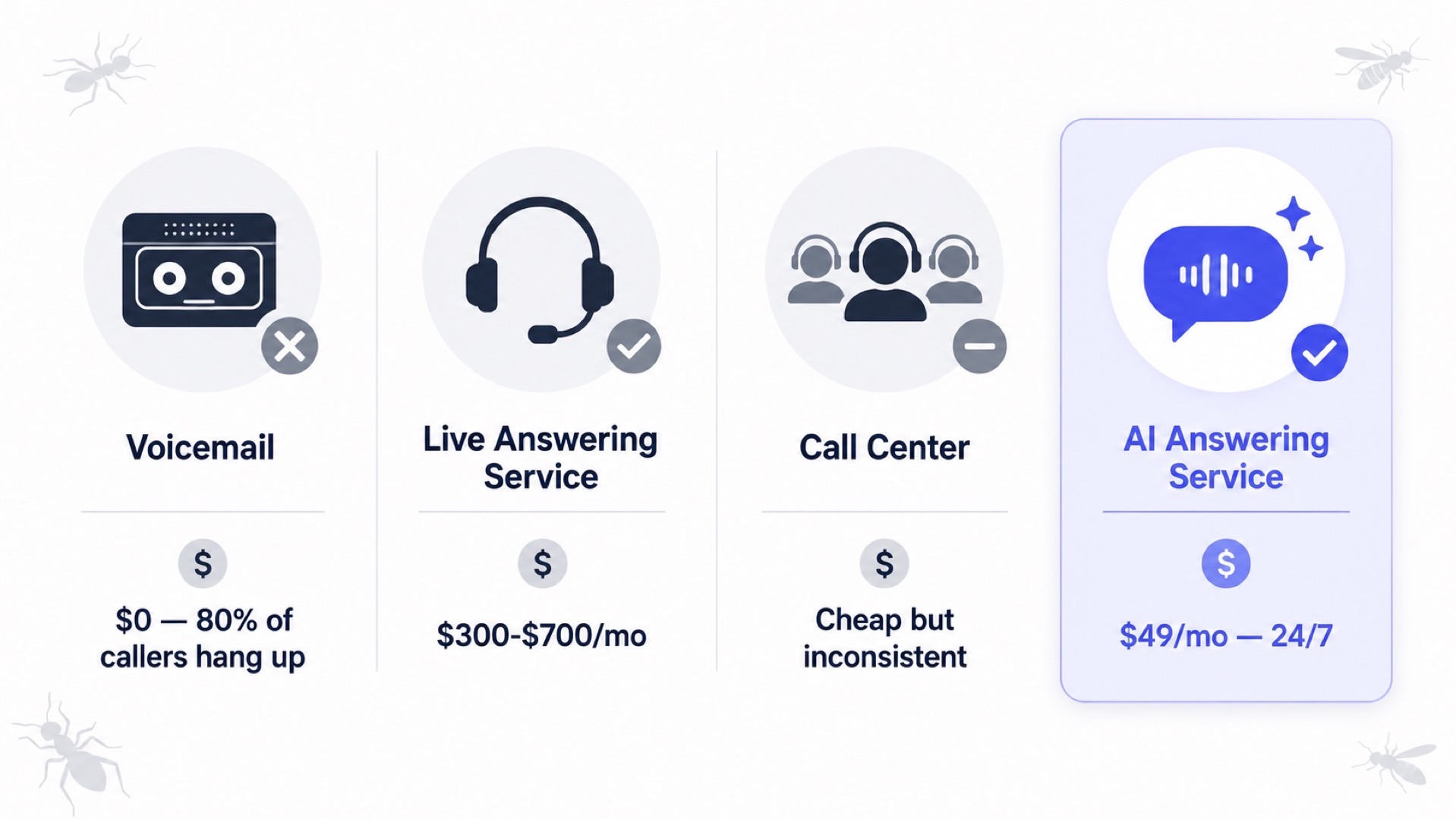
Pest control owners have four real options for handling calls when they cannot pick up. Each has tradeoffs.
Option 1: Voicemail (Free but Costs You Customers)
The default option. Cheap, easy, and the reason you are reading this article. Industry data is consistent: roughly 80% of callers will not leave a voicemail at all. For pest control specifically, the rate is even higher because customers want resolution immediately, not a callback hours later.
Voicemail is the right answer for businesses with very low call volume and tight margins. For anyone trying to grow, it is a slow leak.
Option 2: Live Answering Service ($300-$700/month)
Traditional services like Ruby, PATLive, AnswerConnect, and MAP Communications employ human receptionists who answer your calls. They take messages, schedule appointments, and route urgent calls per your script.
- Strengths: Real human voice, can handle emotionally charged calls, bilingual options available.
- Weaknesses: Expensive ($1.30 to $5.40 per minute), inconsistent quality across operators, you pay for spam calls, hold times during call spikes, no transcripts on most plans.
- Cost reality: A pest control business taking 200 minutes of calls per month is paying $260-$1,080 monthly. Add holiday surcharges and you can hit $1,500+.
Option 3: Call Center (Cheapest Per Call, Worst Quality)
Some pest control companies use offshore call centers to handle inbound calls. Lower per-call costs, but you sacrifice almost everything else. Operators have minimal training, accents can frustrate customers, and customization is limited.
Call centers occasionally make sense for very high-volume operations with simple scripts. For most pest control businesses, the quality issues cost more than the savings.
Option 4: AI Answering Service ($49-$99/month)
AI-powered services like Zinng, Rosie, and Smith.ai use voice AI to answer calls in a natural conversational tone, take detailed messages, route emergencies, and book inspections via SMS scheduling links.
- Strengths: 24/7 coverage, instant pickup, unlimited concurrent calls, full transcripts, 3-10x cheaper per minute than live services, no spam billing.
- Weaknesses: Cannot handle truly empathy-intensive calls as well as a top-tier human operator can. Voice quality varies by provider.
- Cost reality: Zinng covers 300 minutes for $49/mo flat. Higher tiers scale to 2,000+ minutes for high-volume operations. No per-minute billing on the included minutes.
For most pest control businesses in 2026, an AI answering service is the right call. The economics are not close.
Handling Pest Emergencies After Hours
The single most important capability of a pest control answering service is correctly triaging emergencies. A wasp nest blocking the door at 6 PM is different from a homeowner asking for a quarterly treatment quote. The system has to know the difference.
What a good emergency triage looks like:
- The AI or operator asks if it's an emergency. Direct question, no ambiguity.
- It collects the essentials: Caller's name, address, pest type, severity, and current phone number.
- It reassures the caller that the on-call tech will be notified immediately.
- It triggers a text or call to your on-call number with the full message and caller info.
- If the situation is truly life-threatening (severe allergic reaction to a sting, snake bite), it tells the caller to hang up and call 911.
This entire workflow takes under two minutes when done right. The on-call tech reads the message, decides whether it requires a same-day visit or a morning follow-up, and texts the customer back. Customer feels heard. You don't get woken up for non-emergencies.
Zinng handles this triage automatically. The team configures your emergency criteria during onboarding, and the AI follows your specific rules.
How to Set Up a Pest Control Answering Service
Setting up an answering service is simpler than most pest control owners expect. There are four steps:
- Pick the service. Zinng is the best fit for most pest control businesses; Rosie and Smith.ai are reasonable alternatives. See the 10 best auto call answering apps for a full comparison.
- Define your call types and emergency rules. What counts as an emergency for your business? Bed bugs? Wasps? Rodents? Get clear on it before setup.
- Forward your business line. Most pest control owners forward their business number to the AI when they cannot answer. Some forward 24/7 and let the AI handle everything. Either works.
- Test it. Call your own number a few times and pretend to be a customer with different needs (quote, emergency, existing customer, billing question). Adjust until the AI handles each correctly.
With Zinng specifically, you can be live in minutes. Sign up, chat with the AI to set up your agent (it asks about your service area, treatment types, emergency criteria, and scheduling rules), and forward your calls. Prefer not to handle setup yourself? The Zinng team can build it for you instead. Either way, you go back to spraying.
Pest Control Answering Service Pricing
Here is what each option actually costs for a pest control business taking 200 minutes of calls per month:
| Option | Monthly Cost (200 min) | Per-Minute Rate | 24/7? |
|---|---|---|---|
| Zinng AI | $49/mo | $0.16 effective | Yes |
| Rosie AI | $49/mo | $0.20 effective | Yes |
| Smith.ai (AI) | $95/mo (50 calls) | $1.90/call | Yes |
| MAP Communications (live) | ~$260-$340/mo | $1.28-$1.70/min | Yes |
| PATLive (live) | ~$460/mo | $2.30/min | Yes |
| Ruby Receptionists (live) | ~$720/mo | $3.60/min | Yes |
| Voicemail | $0 | N/A | No |
For a pest control business saving even one new customer per month with better call coverage, an AI answering service pays for itself in under a week. The math gets worse the higher you go with live services.
Frequently Asked Questions
Can a pest control answering service identify emergencies correctly?
Yes, when configured properly. AI services like Zinng are trained on your specific emergency criteria during setup. Bed bug discoveries, wasp nests near entry points, rodent sightings inside homes, and similar urgent situations get flagged and routed to your on-call tech. Live services follow scripts you define; quality depends on the operator.
Will the AI know what services my pest control business offers?
Yes. The setup process scans your website and uses your service list, pricing structure (if public), and treatment areas to inform what the AI knows. If a caller asks about termite treatment and you do not offer termite services, the AI handles it appropriately rather than promising a callback that creates a bad customer experience.
Can it book pest inspections directly?
Yes. The AI can either text the caller a scheduling link (most flexible, works with any calendar) or book directly on your Google Calendar, ServiceTitan, Housecall Pro, or other pest control software. Setup depends on the provider.
What about bilingual callers?
Bilingual English/Spanish coverage is included in most modern AI answering services at no extra cost. For pest control businesses in Texas, California, Florida, Arizona, and other markets with large Spanish-speaking populations, this matters significantly. Confirm bilingual support before signing up.
How fast can I get a pest control answering service set up?
Modern AI answering services are self-serve and can be live in minutes. With Zinng, you sign up, chat with the AI to set up your agent, and forward your business line. Same with Rosie. If you'd rather have the Zinng team build your agent for you, that option is available too. Traditional live answering services usually take 1-2 weeks to onboard.
What happens during pest control peak season?
AI answering services handle unlimited concurrent calls without hold times. If 10 customers call at once during termite swarm season, all 10 get answered instantly. Live answering services and your own staff have hard concurrency limits; AI does not. This is the biggest practical advantage of AI for seasonal businesses.
If you run a pest control business and you are still relying on voicemail or paying $700+/month for a live answering service, you have a better option in 2026. Zinng handles every call, prioritizes pest emergencies, and books inspections via SMS, all for $49/month. Sign up, chat with the AI to configure your agent, and you're live in minutes.
Other trades have the same problem. See our coverage for home services generally, or compare us against alternatives via the 10 best auto call answering apps roundup.