At a Glance
- •The best San Francisco answering service for most businesses is Zinng, an AI-powered service at $49/month with 100 minutes included and $0.12/minute overage.
- •Traditional live answering services in San Francisco range from $44/month (SAS, pay-as-you-go) to $259/month (AnswerForce, 200 minutes with live chat), with per-minute rates between $1.54 and $2.58.
- •San Francisco captures over 50% of global AI funding and 45% of all U.S. venture capital. The city's 90,000+ small businesses span tech startups, financial services, healthcare, legal, and tourism.
- •UCSF Health is California's #1 ranked hospital. Over 45% of SF residents speak a non-English language at home (Chinese 18.6%, Spanish 11.7%). HIPAA compliance and multilingual support are essential.
- •Zinng offers a 14-day free trial with no credit card required. Full call transcripts, bilingual support, spam filtering, and unlimited simultaneous calls included.
Why San Francisco Businesses Need an Answering Service
San Francisco packs roughly 90,000 small businesses and 828,000 residents into just 47 square miles. The city's GDP exceeds $268 billion, placing it ahead of most countries, and its businesses operate across every time zone: tech companies collaborating with Asia-Pacific partners, financial firms coordinating with New York and London, and tourism operators fielding inquiries from travelers worldwide. When a three-hour gap with the East Coast means missing morning calls from Manhattan clients until noon Pacific, and a 16-hour gap with Shanghai means late-night calls from manufacturing partners, San Francisco businesses face communication windows that stretch well beyond any standard workday.
The cost of missing those calls is amplified by San Francisco's operating economics. Office rent averages $65 per square foot, nearly double the national average. Hiring a full-time receptionist in San Francisco costs $55,000 to $70,000 per year before benefits, in a city where the average residential rent exceeds $3,500 per month. For the thousands of startups, solo practitioners, and small professional firms that make up the bulk of SF's business ecosystem, dedicating a full salary line to phone coverage is often the difference between staying lean and running out of runway.
An answering service solves both problems at once: around-the-clock coverage for a city that does business globally, at a cost that fits San Francisco's margin-conscious small business reality. The question is which service matches the speed, professionalism, and technical expectations that SF businesses demand.
What Drives San Francisco's Communication Needs
San Francisco's economy is unlike any other American city. Several overlapping sectors create distinct answering service requirements:
- AI and tech startups dominate the economy: San Francisco captured over 50% of global AI funding in 2025 and 45% of all U.S. venture capital. OpenAI, Anthropic, Databricks, Salesforce, Dropbox, Uber, Airbnb, and thousands of earlier-stage companies operate from the city. AI companies alone have leased over 6 million square feet of office space across the Financial District, SoMa, and Mission Bay. These companies, and the service providers surrounding them (legal, accounting, recruiting, marketing), handle sales inquiries, investor calls, partnership requests, and customer support that flows continuously. A Series A startup with three founders cannot afford to let a potential enterprise customer's call go to voicemail while the team is in a pitch meeting.
- Financial services anchor the downtown core: Wells Fargo and Visa are headquartered in San Francisco. The Federal Reserve's 12th District operates from the Financial District. The surrounding ecosystem of wealth management firms, fintech startups, insurance brokers, and investment advisors generates high-value calls where a missed connection can mean a lost client relationship worth hundreds of thousands in annual revenue. Compliance requirements in financial services add another layer: calls need professional handling and accurate documentation.
- Healthcare is a major employer: UCSF Health is ranked the #1 hospital in California by U.S. News. Zuckerberg San Francisco General is the city's only Level 1 trauma center, serving over 1.5 million people. Kaiser Permanente SF operates a 247-bed hospital with a regional cardiac referral center. California Pacific Medical Center (Sutter Health) and Chinese Hospital round out a dense healthcare cluster. The private practices, specialist offices, dental clinics, and telehealth startups connected to these institutions handle patient scheduling, after-hours triage inquiries, referral coordination, and billing questions at all hours. HIPAA-compliant call handling is a baseline requirement.
- Legal specialization in tech and IP: The Bar Association of San Francisco has over 7,000 members, with particular strength in technology law, intellectual property, venture capital transactions, and life sciences. Solo practitioners and small firms dominate the city's legal landscape numerically, and 69 legal tech startups operate from SF. For a two-partner IP litigation firm in the Financial District, every potential client call represents a case worth $50,000 to $500,000 in fees. An answering service that captures caller details and performs basic intake filtering pays for itself with a single converted lead.
- Tourism generates $9.4 billion annually: San Francisco welcomed 23.3 million visitors in 2025. The Moscone Center hosted over 30 major events generating 660,000+ hotel room nights. Dreamforce, RSAC, the Game Developers Conference, and dozens of other conventions bring waves of business travelers. Hotels, tour operators, restaurants, and event venues field reservation calls, group booking inquiries, and concierge requests around the clock. During Dreamforce week alone, hospitality businesses see call volumes spike by multiples that no fixed front-desk staff can absorb.
- Multilingual communication is essential: Over 45% of San Francisco residents speak a language other than English at home. Chinese languages (Cantonese and Mandarin) account for 18.6%, Spanish for 11.7%, and Tagalog for 3.4%. The city's Language Access Ordinance mandates services in Chinese, Spanish, and Filipino. For healthcare providers in the Sunset District, legal practices serving the Mission, and businesses in Chinatown, monolingual English answering fails a significant portion of their callers.
Top 5 Answering Services for San Francisco Businesses
We evaluated these services against San Francisco's specific demands: global time zone coverage for tech and finance, HIPAA compliance for the UCSF-anchored healthcare ecosystem, professional intake for the legal community, scalability for tourism surges, and multilingual capability for a city where nearly half of residents speak a non-English language at home.
1. Zinng: Best Overall (AI-Powered)
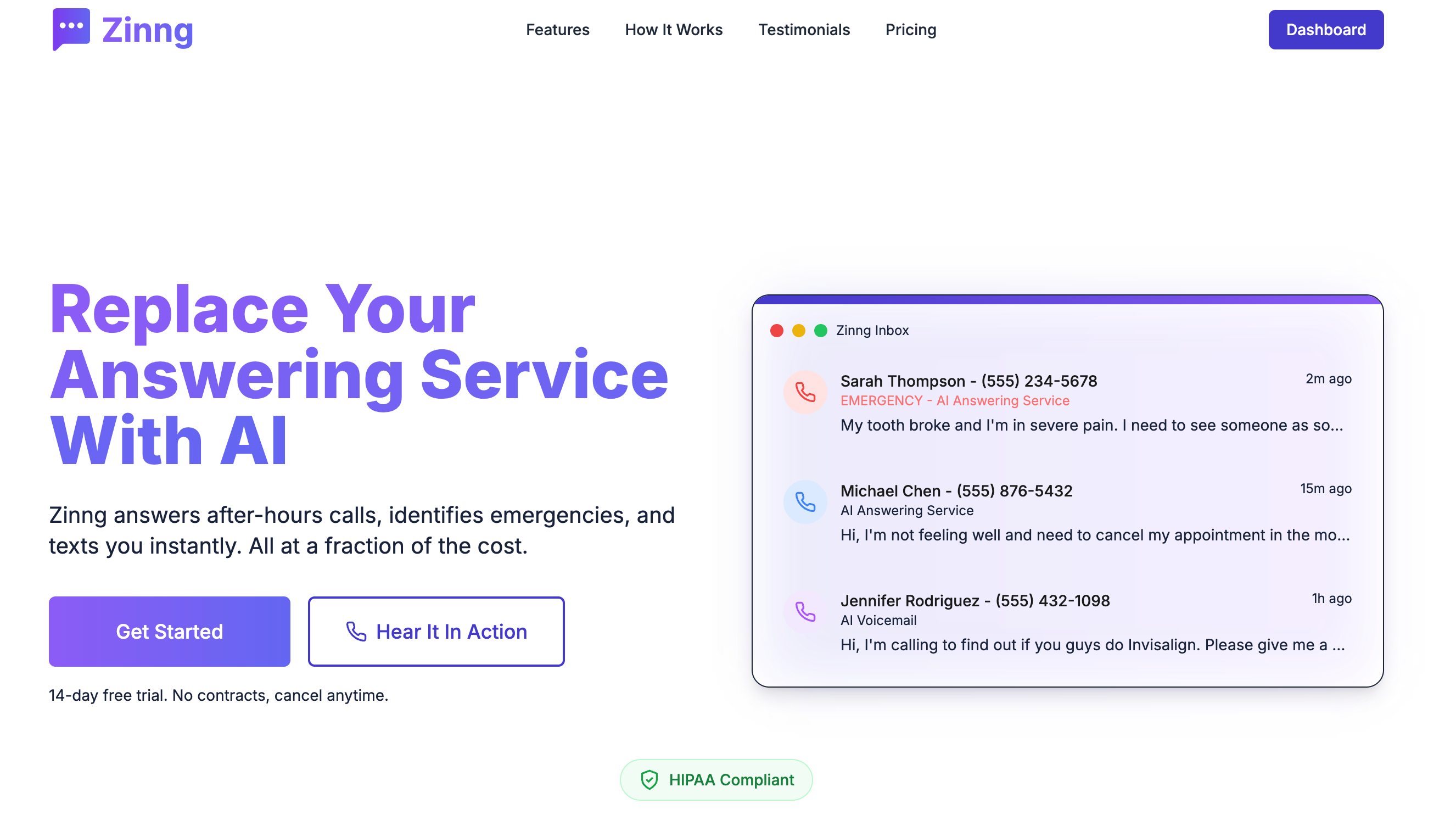
Zinng handles every call with AI that learns your business. There is no hold queue, no variability between a quiet Monday morning and the chaos of Dreamforce week, and no limit on simultaneous calls. For a SoMa startup fielding investor inquiries alongside customer support tickets, a Financial District wealth advisor whose clients call from Tokyo at 2am Pacific, or a Mission District medical practice whose patients need after-hours guidance in both English and Spanish, Zinng provides coverage that never degrades regardless of volume, hour, or complexity.
Each call produces a complete transcript delivered instantly by email with SMS alerts for urgent items. A venture-backed founder gets the exact name, company, deal size, and callback preference from a partner at Sequoia who called during a board meeting. A UCSF-affiliated dermatologist gets the precise symptoms, medication list, and insurance details from a patient who called at 10pm. In a city where a single missed call from the right investor or patient can represent six or seven figures in value, verbatim documentation replaces the abbreviated notes that human operators leave behind.
- Pricing: $49/month with 100 minutes included. Additional minutes at $0.12 each. Growth plan at $99/month with 250 minutes. Business plan at $199/month with 600 minutes.
- Best for: San Francisco startups, professional services firms, healthcare providers, and businesses of any size that need 24/7 global coverage with HIPAA compliance and unlimited call capacity at a price that fits SF operating margins.
- Key features: 24/7 AI answering, full call transcripts, SMS alerts for urgent calls, HIPAA compliant, custom call routing, spam blocking, appointment scheduling, bilingual support, 14-day free trial with no credit card.
- Standout: At $61/month for 200 minutes, Zinng costs less per month than one hour of a San Francisco receptionist's salary. The next most affordable option for the same volume is SAS at approximately $352 (100 minutes plus 100 overage minutes at $1.54/min). That is a $3,492 annual difference. For startups watching burn rate and solo practitioners managing overhead, those savings fund actual growth instead of phone coverage.
2. SAS (Specialty Answering Service): Best Pay-As-You-Go
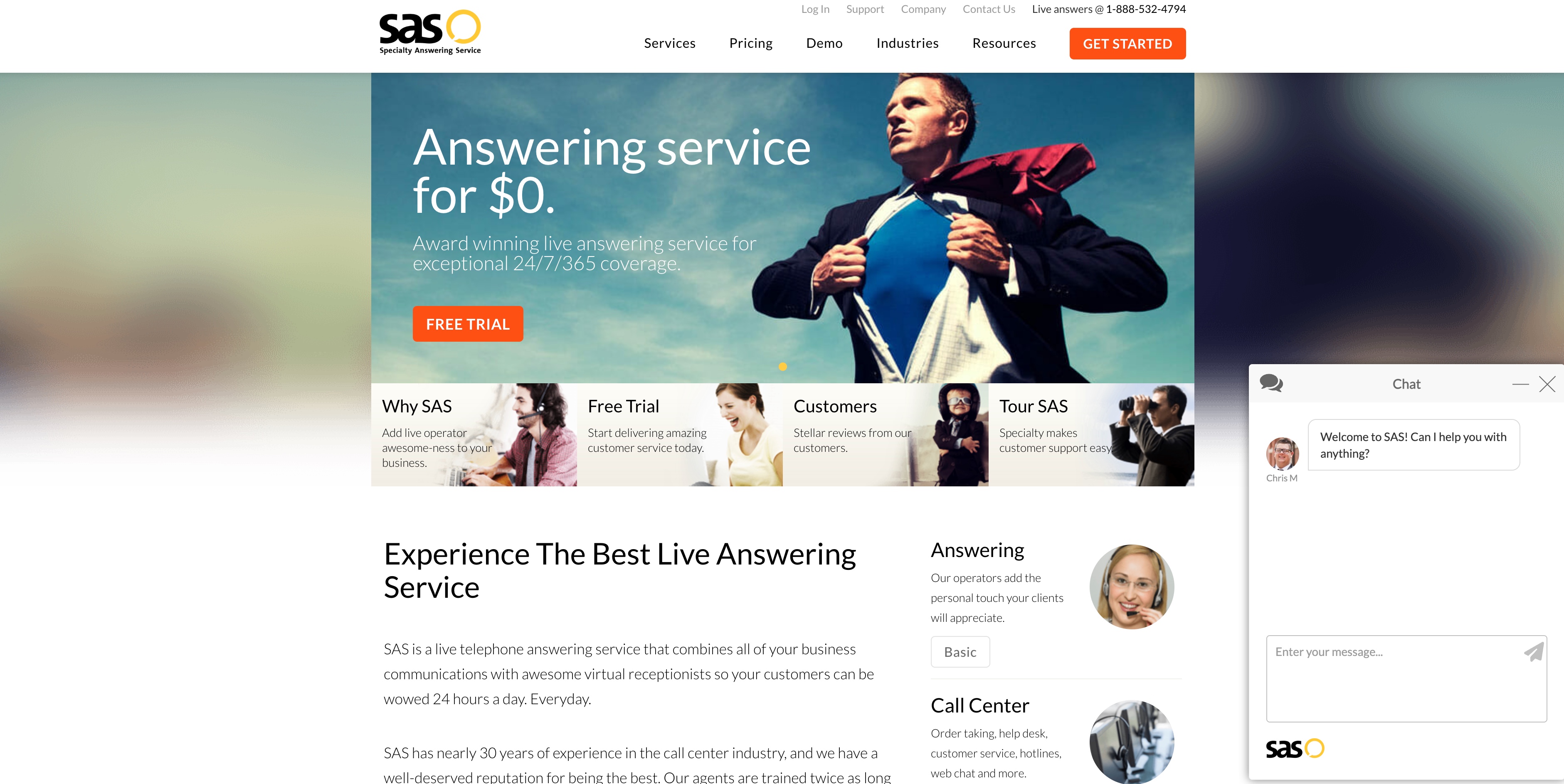
Specialty Answering Service, based in King of Prussia, Pennsylvania, offers the most flexible entry point of any traditional answering service. The pay-as-you-go plan starts at $44/month with no included minutes, charging $1.54 per minute of actual usage. For a San Francisco solo attorney who handles 30 minutes of calls per month during court days, or a Noe Valley therapist who only needs after-hours coverage for emergency calls, SAS lets you pay strictly for what you use without committing to a larger minute block.
SAS also provides a 2-week free trial with no credit card required, matching Zinng's risk-free evaluation period. Their HIPAA-compliant call handling makes them viable for the medical practices connected to UCSF and Kaiser, and their bilingual English/Spanish receptionists serve the 11.7% of San Francisco residents who speak Spanish at home. Flat-rate plans scale from $159/month for 100 minutes up to $10,599/month for 10,000 minutes, covering everything from a solo consultant to a high-volume hospitality business during convention season.
- Pricing: Pay-as-you-go at $44/month base + $1.54/min. Flat rate at $159/month for 100 minutes. Plans scale to $10,599/month for 10,000 minutes. 2-week free trial, no credit card.
- Best for: San Francisco solo practitioners, freelancers, and low-volume businesses that want pay-per-use flexibility without committing to a minute bundle.
- Key features: 24/7 live answering, bilingual English/Spanish, HIPAA compliant, message taking, order processing, appointment scheduling, 2-week free trial.
- Drawback: The pay-as-you-go model works at low volumes but gets expensive fast. A San Francisco property management company handling 200 minutes pays $44 + $308 (200 minutes at $1.54), totaling $352/month. Zinng handles the same volume for $61. At scale, SAS costs nearly six times more. The website also feels dated compared to the tech-forward tools that SF businesses are accustomed to, and quality can be inconsistent across different operators handling your calls.
3. AnswerForce: Best Phone + Chat Bundle
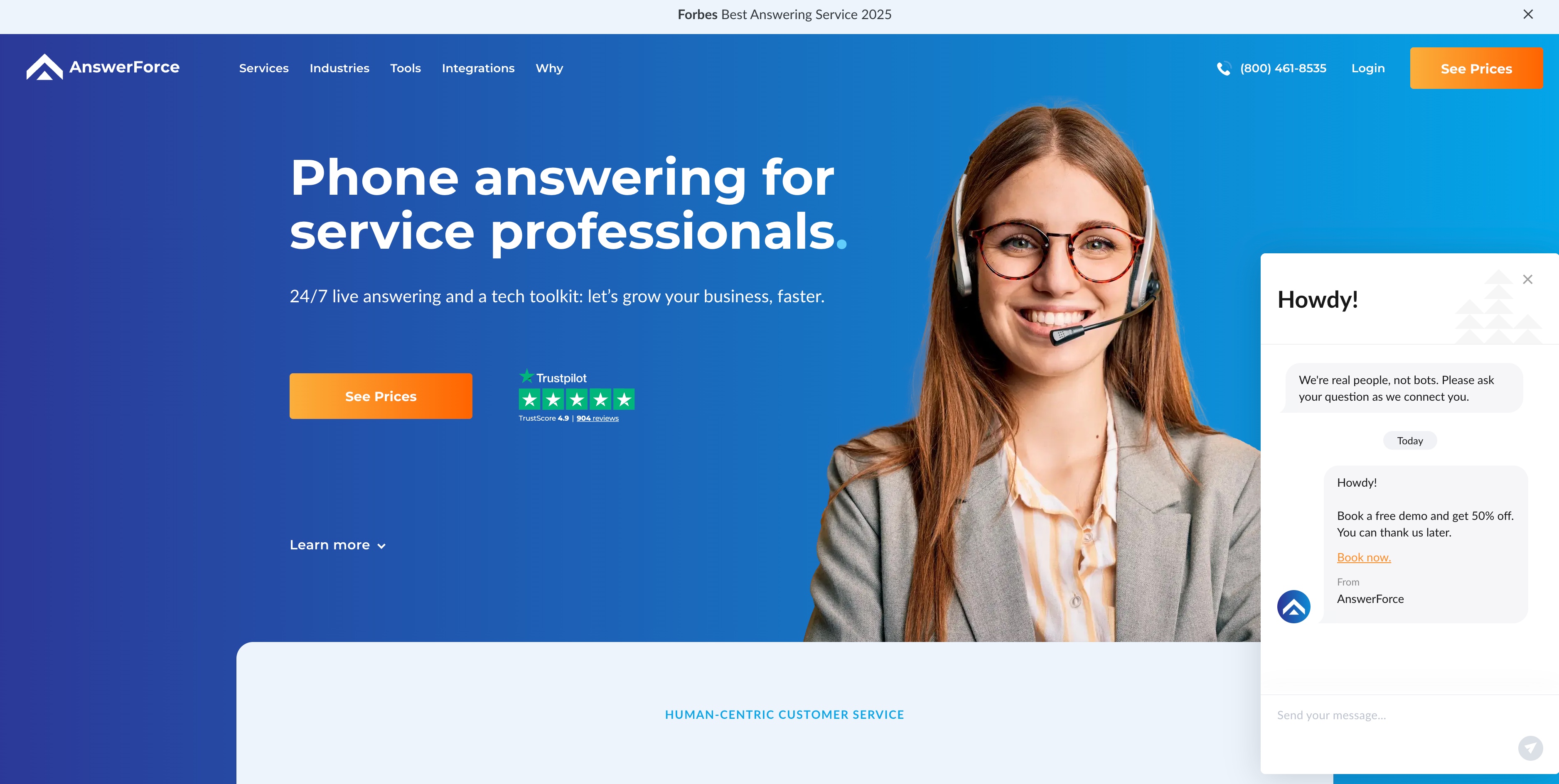
AnswerForce, headquartered in Portland, Oregon, bundles live phone answering with live chat support on every plan. For San Francisco's SaaS companies and e-commerce businesses, where customers expect both phone and chat as communication channels, AnswerForce provides a single vendor for both. The Intro plan includes 200 minutes of phone time plus 50 live chats, and the Best Value plan at $359/month adds 300 minutes with 100 chats and waives the setup fee.
The bundled chat capability is particularly relevant for SF's tech ecosystem. A Dogpatch-based SaaS startup running a product launch needs phone coverage for enterprise prospects and chat support for self-service users simultaneously. AnswerForce handles both channels with live agents rather than chatbots, giving callers and chatters a consistent human experience. The first 30 calls under 30 seconds each month are free, which benefits businesses that receive frequent quick inquiries alongside longer support calls.
- Pricing: Intro at $259/month for 200 minutes + 50 chats ($99 setup fee, $1.80/min overage). Best Value at $359/month for 300 minutes + 100 chats (no setup fee, $1.70/min overage). Standard at $649/month for 500 minutes + 150 chats. Premium at $959/month for 800 minutes + 250 chats.
- Best for: San Francisco SaaS companies, e-commerce businesses, and service providers that need both phone answering and live chat from a single vendor.
- Key features: 24/7 live answering, live chat included on all plans, bilingual English/Spanish, appointment scheduling, lead capture, first 30 short calls free monthly.
- Drawback: The $99 setup fee on the Intro plan is an unnecessary friction point for cost-conscious SF startups. For phone-only needs, AnswerForce is overpriced because you are paying for bundled chat whether you use it or not. A business using 200 minutes with no chat pays $259 at AnswerForce versus $61 at Zinng. The $198/month premium only makes sense if you actively use both channels. And even then, many SF businesses already have dedicated chat tools (Intercom, Drift, Zendesk) that outperform a general answering service's chat capability.
4. Davinci Virtual: Best for Solopreneurs and Virtual Offices
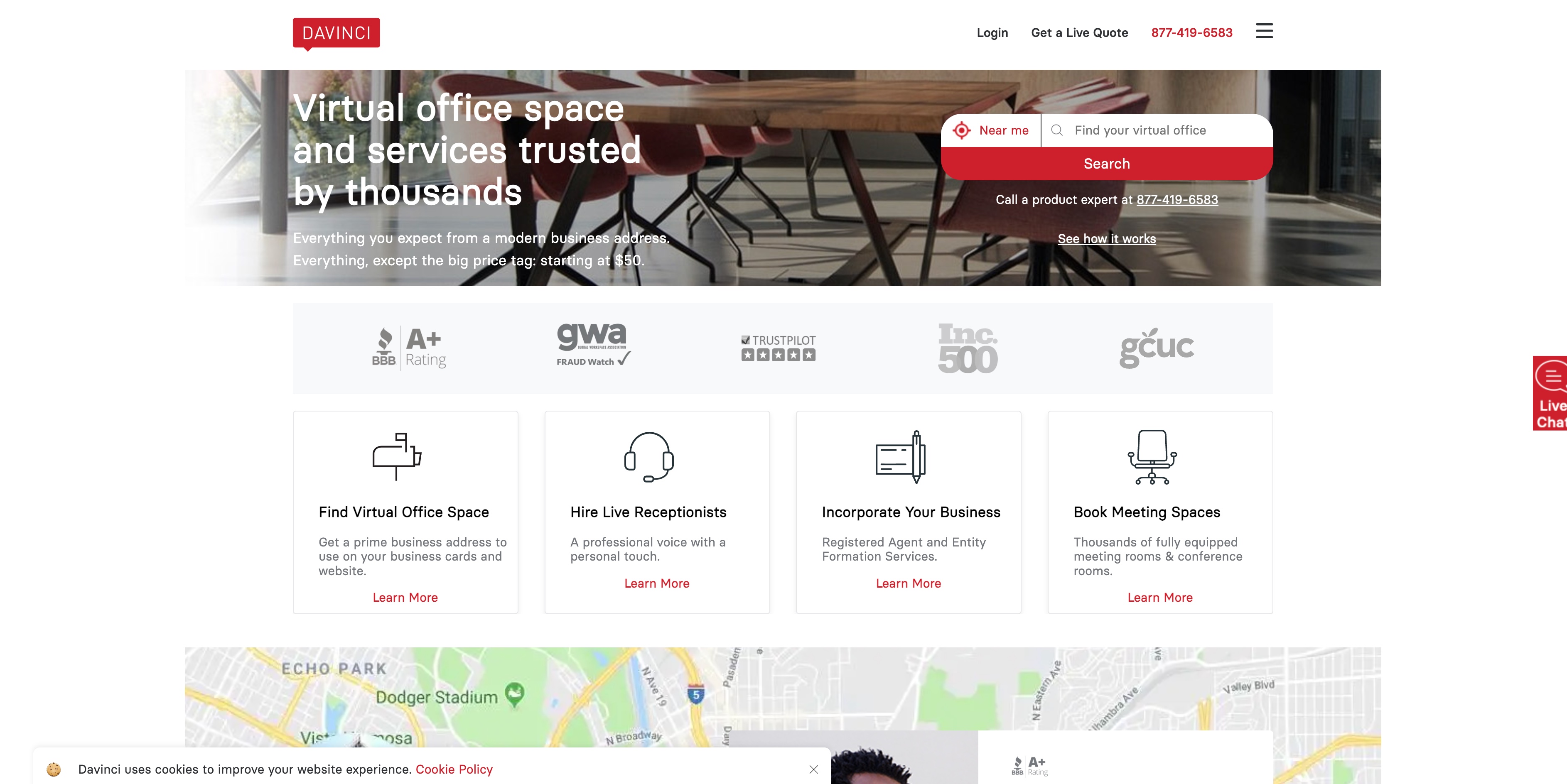
Davinci Virtual, based in Salt Lake City, packages live receptionist service with a complete virtual office solution. For San Francisco's large population of remote workers, freelance consultants, and early-stage founders who need a professional business address and phone presence without leasing a $65/sq ft office, Davinci bundles a local or toll-free number, live receptionists, call forwarding, and a business address into a single plan. A freelance UX designer working from a Haight-Ashbury apartment can present a Financial District business address and a professionally answered phone line to enterprise clients.
The virtual office model fits San Francisco's reality. With office vacancy rates at 30.1% and commercial rents still among the highest in the country, many SF professionals have abandoned traditional offices entirely. Davinci lets them maintain the polish of an established firm without the overhead. The receptionist service includes call screening, forwarding, and online faxing, handling the basic communication needs of a professional services business.
- Pricing: $129/month for 50 minutes. Plans up to $649/month for 300 minutes. $95 one-time setup fee. Overage at $1.75/min (Business plans) or $2.50/min (Premium plans).
- Best for: San Francisco solopreneurs, freelancers, and remote professionals who want a virtual office package with a professional business address and live receptionist in one plan.
- Key features: Live receptionists, free local or toll-free number, call forwarding and screening, online faxing, virtual office address packages available, professional voicemail.
- Drawback: No 24/7 coverage. Davinci receptionists are available weekdays 8am to 8pm Eastern only, which translates to 5am to 5pm Pacific. A San Francisco business misses all calls after 5pm local time and on weekends. For a city where tech companies operate around the clock and international business calls arrive at all hours, the limited coverage window is a serious gap. The $95 setup fee and $2.58/min effective rate on the base plan also make Davinci expensive per minute. Zinng provides true 24/7 coverage with no setup fee at $49/month, and its AI never clocks out at 5pm.
5. Nexa: Best for Legal and Medical Practices
Nexa, headquartered in Phoenix, trains its receptionists on industry-specific workflows for legal, medical, and home services businesses. In San Francisco, where the legal community specializes heavily in tech/IP law, venture capital transactions, and life sciences litigation, Nexa's legal intake training means receptionists understand how to qualify potential clients, collect case details, and route calls through platforms like Clio and Filevine. For the medical practices surrounding UCSF, Kaiser, and CPMC, Nexa provides HIPAA-compliant call handling with protocols designed for patient scheduling, triage routing, and referral coordination.
- Pricing: Plans start at approximately $239/month for 100 minutes. Custom pricing for higher volumes. Overage rates $1.59-$1.99/min. Bilingual support at $50/month extra.
- Best for: San Francisco law firms, medical practices, and professional services companies that need industry-trained receptionists with specialized legal and medical intake capabilities.
- Key features: 24/7/365 live answering, legal intake and medical call handling, CRM integrations (Clio, PracticePanther, Filevine), HIPAA compliant, emergency dispatch, 14-day free trial.
- Drawback: Pricing lacks transparency. Technology fees, holiday surcharges, and a 3.0% credit card processing surcharge inflate the advertised rate. Post-call work time (the time operators spend documenting your call after hanging up) counts against your minutes. For 200 minutes of actual call handling, the real cost can exceed $500 after all fees. The $50/month bilingual surcharge is a particular disadvantage in San Francisco, where over 45% of residents speak a non-English language at home. Zinng covers 200 minutes for $61 with bilingual support and HIPAA compliance included, with no hidden surcharges.
Pricing Comparison
Here is what each service costs for a San Francisco business handling approximately 200 minutes of calls per month.
| Service | Starting Price | Cost for 200 min | Per-Min Rate | 24/7? |
|---|---|---|---|---|
| Zinng | $49/mo | $61/mo* | $0.12/min overage | Yes |
| SAS | $44/mo | ~$352/mo** | $1.54/min | Yes |
| AnswerForce | $259/mo | $259/mo*** | $1.80/min overage | Yes |
| Davinci Virtual | $129/mo | ~$392/mo**** | $1.75/min overage | No***** |
| Nexa | ~$239/mo | ~$437/mo****** | $1.99/min overage | Yes |
*Zinng's $49 plan includes 100 minutes. 200 minutes = $49 + $12 overage (100 additional minutes at $0.12/min).
**SAS pay-as-you-go: $44 base + 200 minutes at $1.54/min = $352.
***AnswerForce Intro plan includes 200 minutes + 50 live chats. $99 setup fee applies on first month.
****Davinci's 50-minute plan ($129) + 150 overage minutes at $1.75/min = $391.50. $95 one-time setup fee not included.
*****Davinci operates weekdays 8am-8pm ET (5am-5pm PT). No weekend or evening coverage.
******Nexa's 100-minute plan (~$239) + 100 overage minutes at $1.99/min = ~$438. Additional technology fees not included.
Why AI Answering Fits San Francisco
San Francisco's business environment creates specific conditions where AI answering provides advantages that traditional services cannot match:
- Global operations require true 24/7 coverage. San Francisco businesses work across every time zone. A fintech startup in SoMa takes investor calls from London at 7am Pacific and partnership inquiries from Singapore at 11pm. A Hayes Valley e-commerce brand processes customer calls from New York at 6am and wholesale orders from Tokyo at midnight. Traditional answering services staff up for U.S. business hours and thin out overnight. AI does not have peak hours. It handles a 3am call from Seoul with the same precision as a 10am call from down the street. For Davinci Virtual, which shuts down at 5pm Pacific, more than half of San Francisco's global business communication falls outside their coverage window.
- High rents make in-house receptionists a luxury. At $65/sq ft average office rent and $55,000+ for entry-level front desk salaries, a dedicated receptionist costs a San Francisco business $80,000 to $100,000 annually when you include workspace, benefits, and payroll taxes. Zinng provides comparable call handling at $588 to $2,388 per year depending on volume. The math is stark: the annual cost of one human receptionist funds 15 to 20 years of AI answering service. For the thousands of startups managing burn rate and the solo practitioners watching overhead, this is not a marginal decision.
- Tech-savvy businesses expect instant, searchable documentation. San Francisco's workforce lives in Slack, Notion, and CRM dashboards. AI transcripts integrate into these workflows naturally, creating searchable records that can be tagged, shared, and referenced. A human operator's handwritten message slip or brief email summary cannot be searched, indexed, or automatically routed to the right Slack channel. For a legal team building a case file or a sales team tracking pipeline conversations, AI transcripts become part of the business system rather than a separate communication silo.
- Call volume spikes are unpredictable and extreme. When Dreamforce brings 170,000+ attendees to the Moscone Center, every hotel, restaurant, and car service in the city sees call volume double or triple. When a startup gets featured on TechCrunch or Product Hunt, inbound inquiries surge overnight. When UCSF announces a new clinical trial, the affiliated research coordinator's phone does not stop. Traditional services queue calls when volume exceeds their operator capacity. AI handles every call simultaneously. There is no "all operators are currently busy" with Zinng, regardless of whether your call volume is 10 per day or 100.
- Multilingual capability is a demographic requirement. With 18.6% of residents speaking Chinese languages and 11.7% speaking Spanish, monolingual English answering fails a major portion of San Francisco's population. AI-powered services can handle multilingual calls with consistent quality. Traditional services either charge extra for bilingual support (Nexa's $50/month surcharge) or limit multilingual capability to Spanish only, leaving the city's large Chinese-speaking community underserved.
Human answering services still serve a purpose for San Francisco's white-glove legal firms, high-net-worth wealth management practices, and luxury hospitality venues where callers expect a deeply personal touch. But for the daily call volume that 90,000+ small businesses handle, AI answering delivers better documentation, broader availability, and dramatically lower cost.
Frequently Asked Questions
What is the best answering service in San Francisco?
For most San Francisco businesses in 2026, Zinng is the best answering service. It provides 24/7 AI-powered call answering at $49/month with 100 minutes included, full call transcripts, HIPAA compliance, and unlimited simultaneous calls. For a city where office rents average $65/sq ft and startups need to project professionalism from day one, Zinng delivers enterprise-grade call handling at a fraction of traditional costs.
How much does a San Francisco answering service cost?
San Francisco answering service pricing ranges from $44/month (SAS, pay-as-you-go with no included minutes) to $259/month (AnswerForce, 200 minutes with live chat). For 200 minutes of monthly coverage, Zinng costs $61, while traditional live services range from $350 to over $500. Per-minute rates span $0.12 (Zinng AI) to $2.58 (Davinci Virtual).
Do San Francisco answering services offer multilingual support?
Most offer bilingual English/Spanish, but San Francisco's demographics demand broader language coverage. Over 45% of SF residents speak a language other than English at home, with Chinese languages (18.6%), Spanish (11.7%), and Tagalog (3.4%) being the most common. Zinng, SAS, and AnswerForce include bilingual English/Spanish support. For Mandarin, Cantonese, and other languages, businesses typically need specialized services or AI-powered solutions that can handle multilingual calls.
Are there HIPAA-compliant answering services for San Francisco medical practices?
Yes. San Francisco is home to UCSF Health (ranked #1 hospital in California), Zuckerberg SF General (the city's only Level 1 trauma center), Kaiser Permanente SF, and California Pacific Medical Center. Zinng, Nexa, and SAS all offer HIPAA-compliant call handling. For the thousands of medical practices, specialty clinics, and telehealth startups operating in the UCSF and broader SF healthcare ecosystem, HIPAA compliance is non-negotiable.
What types of San Francisco businesses use answering services?
San Francisco's answering service demand spans tech startups and AI companies (the city captures over 50% of global AI funding), law firms specializing in tech/IP and venture capital, healthcare providers connected to UCSF and Kaiser networks, financial services firms in the Financial District, and tourism/hospitality businesses serving 23 million annual visitors. The city's high commercial rents ($65/sq ft average) make outsourced call handling significantly cheaper than hiring in-house receptionists.
Final Verdict
Zinng is the best answering service for San Francisco businesses. At $61/month for 200 minutes of 24/7 coverage with HIPAA-compliant transcripts, bilingual support, and unlimited simultaneous calls, it matches the speed and precision that SF's tech-driven economy demands while costing less than a single hour of local office rent. The 14-day free trial with no credit card lets any San Francisco business evaluate the service at zero risk.
SAS offers the most flexible entry point with true pay-as-you-go pricing. The $44/month base with $1.54/min usage works well for San Francisco solo practitioners and freelancers handling fewer than 30 minutes of calls per month. The 2-week free trial and HIPAA compliance make it a viable option for low-volume medical and legal professionals. At higher volumes, the per-minute cost makes it significantly more expensive than AI alternatives.
AnswerForce stands out for San Francisco businesses that genuinely need both phone answering and live chat from one provider. The bundled approach saves the hassle of managing separate vendors, and the 200-minute Intro plan includes 50 chats. For SaaS companies and e-commerce businesses running both channels, the bundle delivers value. For phone-only needs, you are paying a premium for chat you will not use.
Davinci Virtual fills a specific niche for San Francisco's remote workers and solopreneurs who need a professional business address and phone presence without leasing office space. The virtual office package is genuinely useful in a city with 30.1% office vacancy and $65/sq ft rents. But the weekday-only coverage (ending at 5pm Pacific) is a dealbreaker for any business with evening, weekend, or international callers.
And Nexa provides specialized legal and medical intake training that generic services lack. For the IP law firms and UCSF-connected medical practices that need industry-specific call protocols, Nexa's training adds real value. The opaque pricing, hidden fees, and $50/month bilingual surcharge undercut the appeal for a city where transparent costs and multilingual capability are not optional.
San Francisco operates at the intersection of global technology, world-class healthcare, international finance, and massive tourism. From the AI labs in SoMa to the operating rooms at UCSF to the hotel desks along Fisherman's Wharf, the city's businesses handle calls that close funding rounds, coordinate patient care, execute trades, and book reservations across every time zone. The right answering service ensures that when the world calls San Francisco, every call gets answered.