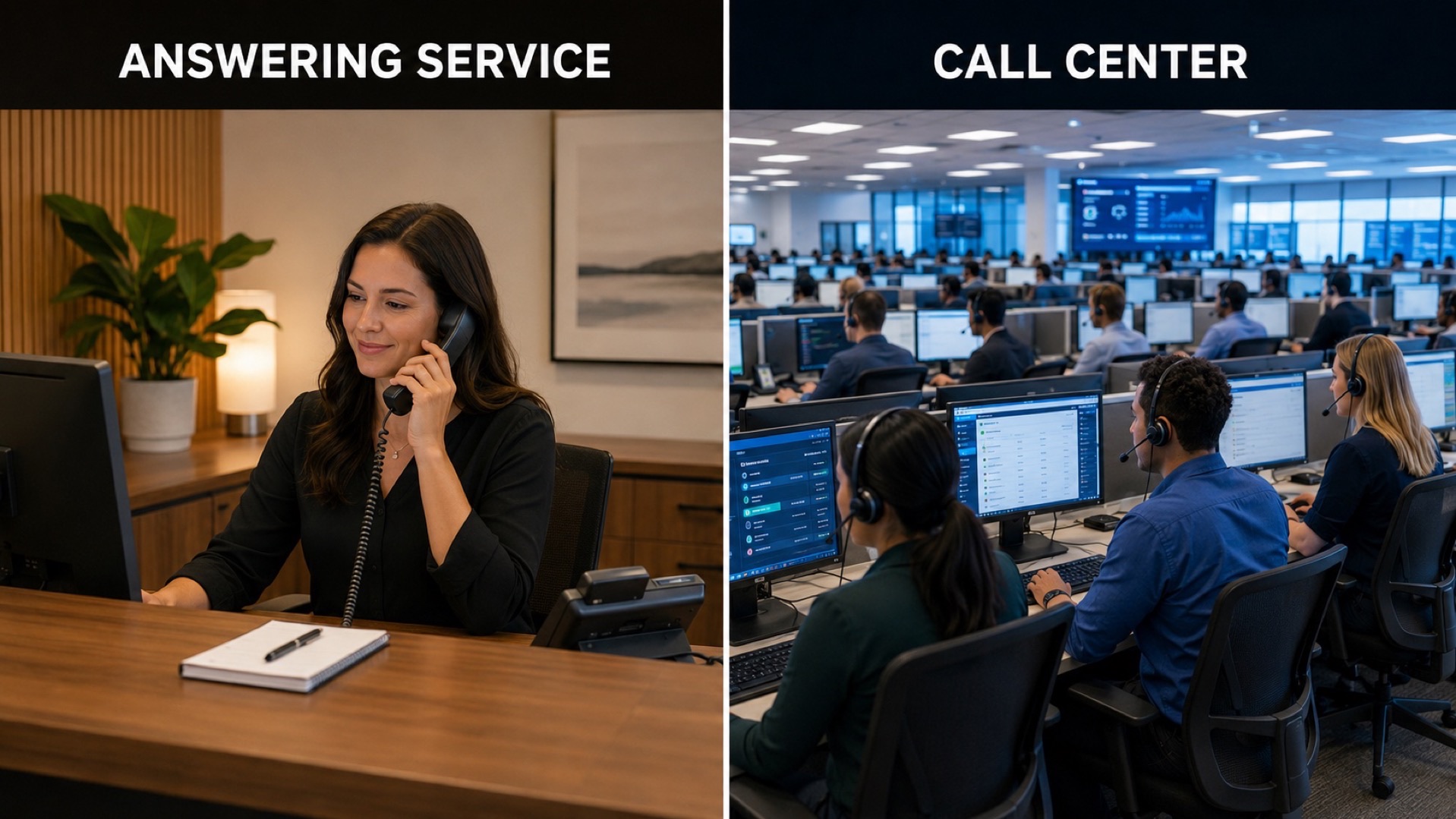
Answering service and call center sound similar, and people use the terms interchangeably all the time. But they are two genuinely different products built for different problems. If you pick the wrong one, you'll either overspend by 5-10x or you'll get a service that cannot handle what you actually need.
This guide explains what each one is, how they differ on cost, capacity, training, and use case, and which one fits your business. No sales pitch. Just the real comparison.
The Short Answer
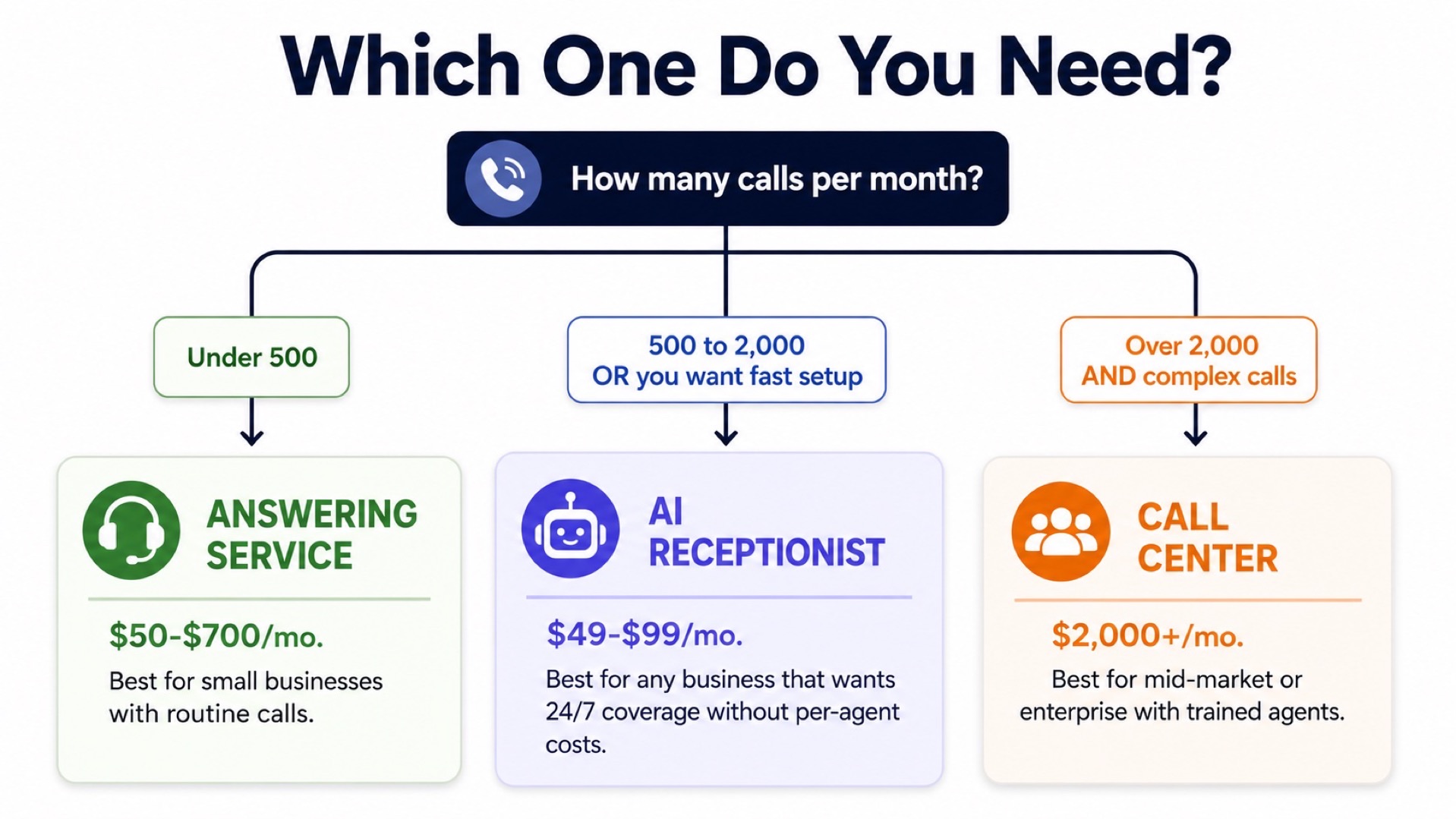
Pick an answering service if: You are a small business (1-50 people), most of your calls are routine (appointment booking, messages, basic inquiries), and you receive fewer than 500 calls per month. Expect to pay $50 to $700/month.
Pick a call center if: You are a mid-market or enterprise business, your calls require trained agents with product knowledge (technical support, sales, customer service), and you receive thousands of calls per month. Expect to pay $2,000 to $20,000+ per month, or $20-$50 per hour of agent time.
Pick neither if: You are open to AI. A modern AI receptionist handles the answering service use case at $49-$99/month and can scale into lower-tier call center work without per-agent costs.
What Is an Answering Service?
An answering service is a third-party service that picks up your business calls when you cannot, takes messages, and handles routine call types: appointment scheduling, after-hours coverage, message taking, urgent call routing, and basic FAQ responses.
Most answering services are staffed by trained receptionists who follow a custom script for your business. You provide the script during onboarding (what's your business name, what services you offer, what counts as an emergency, who to route urgent calls to). The receptionists then handle calls according to that script and send you messages by text, email, or directly into your CRM.
Common answering service providers include Ruby Receptionists, PATLive, AnswerConnect, MAP Communications, Smith.ai, and dozens of regional options. Pricing typically ranges from $50/month for a basic plan up to $700+/month for higher-volume needs. Most charge per minute ($1.30 to $5.40 per minute is the typical range) or per call.
What an answering service does well
- Picks up calls when your office is closed or busy
- Takes messages and routes them to the right person
- Books appointments using your scheduling system
- Routes urgent calls to on-call staff
- Filters out spam and wrong numbers
- Provides bilingual support (English/Spanish, sometimes more)
Where answering services fall short
- Cannot resolve complex technical issues — the receptionist isn't trained on your product
- Quality varies by operator and shift
- Most plans have a per-minute or per-call ceiling that gets expensive quickly above a few hundred calls/month
- You pay for spam and wrong-number calls on per-minute pricing
What Is a Call Center?
A call center is a much larger operation built to handle high-volume call traffic with agents who are trained on your specific products, services, and processes. Call centers handle inbound (customer support, technical help, sales calls) and outbound (sales prospecting, surveys, collections).
The agents work in dedicated workstations, often in a large facility with hundreds of seats. They have access to your CRM, knowledge base, and product documentation. They go through weeks of training before they take a single live call.
Call centers come in two flavors:
- Outsourced (BPO) call centers like TaskUs, Teleperformance, Concentrix, Sitel, and hundreds of smaller providers. You contract with them and they staff agents on your behalf. Pricing is typically per-hour ($20-$50/hour of agent time) or per-call.
- In-house call centers built and operated by you. Same model but you own the people, the facility, and the systems. Best when call volume justifies the fixed cost.
Mid-market and enterprise companies often combine both: an in-house core team for complex issues plus outsourced overflow for peak volume.
What call centers do well
- Handle thousands or tens of thousands of calls per day
- Resolve complex issues with trained agents
- Run sales scripts with measurable conversion targets
- Integrate deeply with your CRM, ticketing, and ERP systems
- Provide detailed reporting on call patterns, agent performance, and customer outcomes
- Support multiple languages with dedicated language queues
Where call centers fall short
- Expensive — minimum monthly spend is often $2,000+ even for outsourced setups
- Long onboarding (4-12 weeks for offshore BPOs, 2-4 weeks for domestic)
- Quality varies by agent and shift
- Most setups require minimum hour commitments per month
- Overkill for businesses with fewer than ~2,000 calls/month
Answering Service vs Call Center: Side-by-Side
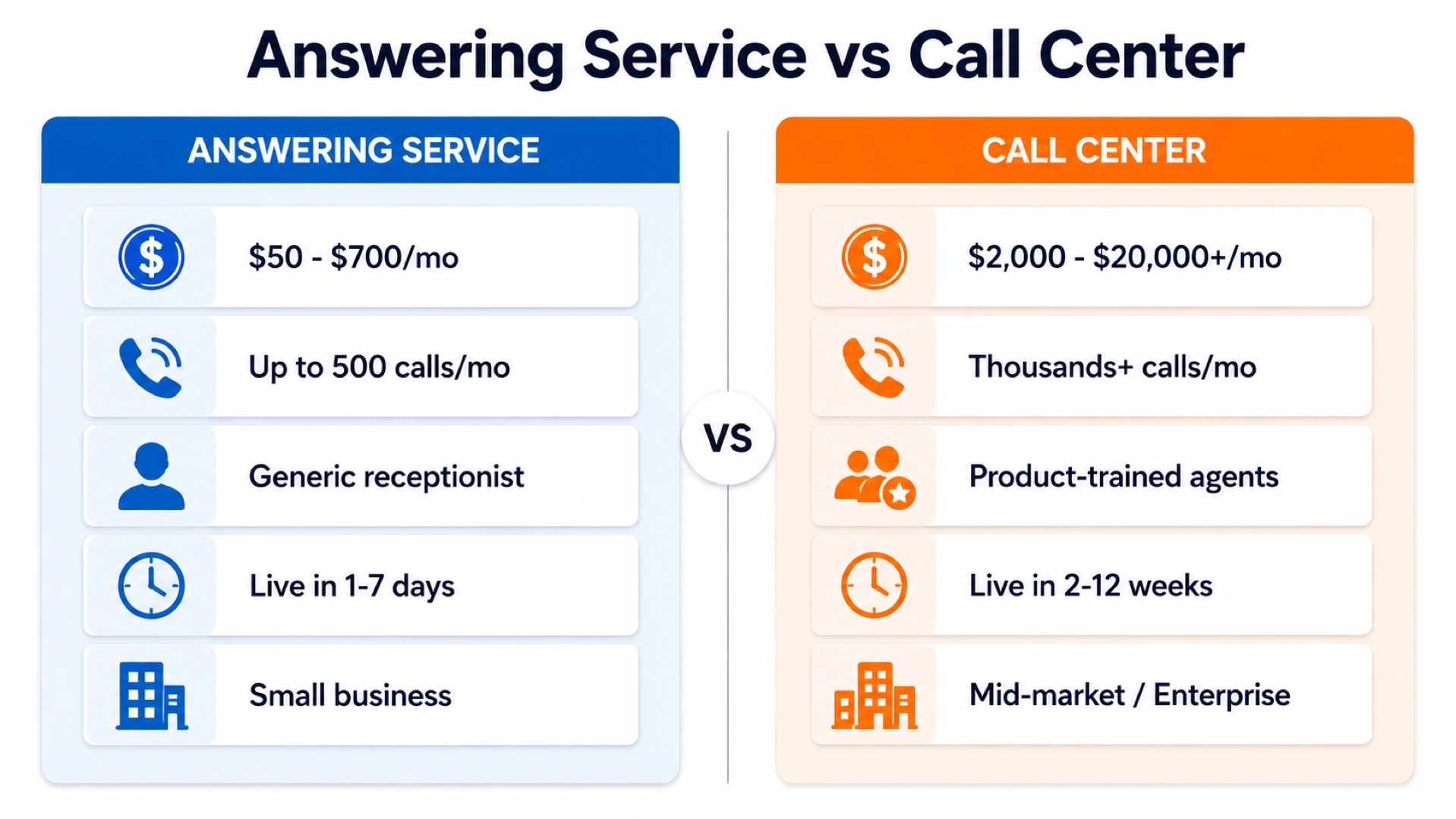
| Answering Service | Call Center | |
|---|---|---|
| Typical monthly cost | $50 - $700 | $2,000 - $20,000+ |
| Pricing model | Per minute or per call | Per agent hour or per call |
| Call capacity | Up to ~500 calls/month | Thousands to tens of thousands/month |
| Agent training | Generic receptionist + your script | Weeks of product-specific training |
| Best for | Routine calls, messages, scheduling | Technical support, complex sales, high-volume customer service |
| Onboarding time | 1-7 days | 2-12 weeks |
| CRM integration | Basic (Salesforce, HubSpot, Zapier) | Deep, often custom |
| Reporting | Basic message logs | Full agent + call analytics |
| Typical customer | Small business (1-50 people) | Mid-market or enterprise |
| Contracts | Month-to-month common | Annual or multi-year typical |
When to Pick an Answering Service
An answering service is the right choice when most of these apply:
- You are a small business with 1-50 employees.
- You receive fewer than 500 inbound calls per month.
- Most of your calls are routine: messages, scheduling, basic FAQ, after-hours coverage.
- You want a setup that can be live within a week.
- You do not need agents to resolve complex product or technical issues.
- You want predictable per-minute or per-call costs.
Specific business types where answering services tend to fit well: dental and medical offices, law firms, contractors and home services (HVAC, plumbing, electrical), real estate agents, accountants, consultants, veterinary clinics, and small e-commerce operations.
See our review of the best answering services for specific provider picks.
When to Pick a Call Center
A call center is the right choice when most of these apply:
- You are a mid-market or enterprise business.
- You receive thousands of inbound calls per month, or you run outbound campaigns at scale.
- Your calls require deep product knowledge to resolve (technical support, software, complex sales).
- You have a multi-week onboarding budget and can afford agent training time.
- You need full reporting and analytics across your call operation.
- You can commit to a minimum monthly spend of $2,000+ and an annual contract.
Specific business types where call centers fit well: SaaS companies with paid support tiers, telecom and ISP providers, financial services, healthcare insurance, large e-commerce operations, B2B sales teams with measured outbound campaigns, and any business where the agent needs to know your product cold.
A Third Option: AI Receptionist
The category that has emerged most recently is AI-powered receptionists like Zinng, Rosie, Smith.ai (AI tier), and others. These are not answering services and they are not call centers, but they handle a lot of what both do, at a fraction of the cost.
An AI receptionist sits between the two traditional options:
- Like an answering service: Picks up routine calls, takes messages, books appointments, routes urgent calls, handles after-hours coverage.
- Like a call center: Handles unlimited concurrent calls without hold times, scales with your business, provides full transcripts and reporting.
- Unlike both: Costs $49-$99/month with no per-minute or per-agent pricing. Can be set up in minutes, not days or weeks. Same quality at 2am as at 2pm.
For small businesses considering an answering service, an AI receptionist is almost always cheaper and faster to deploy. For mid-market businesses considering a call center, AI does not yet replace trained agents on complex calls, but it can handle the routine 60-70% of call volume, freeing your call center for the cases that actually need a human.
See our 10 best auto call answering apps for picks. Most businesses end up using a hybrid: AI for routine calls, humans (either in-house, answering service, or call center) for the complex cases.
Frequently Asked Questions
What's the main difference between an answering service and a call center?
Scale and depth. Answering services are smaller, cheaper, faster to set up, and handle routine calls with generic receptionists following your script. Call centers are bigger, more expensive, slower to set up, and handle complex calls with agents trained on your products. Answering services serve small businesses; call centers serve mid-market and enterprise.
Can I use an answering service for technical support?
Only for the simplest tier. Answering service receptionists can do basic password reset scripts or "I'll route you to our support team" workflows, but they are not trained on your product and cannot troubleshoot deeply. For real technical support, you need a call center or in-house support team.
How much does a call center cost?
Outsourced call centers typically charge $20-$50 per hour of agent time, with monthly minimums starting around $2,000. Specialized providers (healthcare, finance, technical support) charge more. Fully in-house call centers cost $40k-$80k per agent per year in salary alone, before facility and technology overhead.
Is an answering service cheaper than a call center?
Yes, by 5-50x for the same call volume. The tradeoff is depth. Answering services handle routine calls efficiently and cheaply. Call centers handle complex calls with trained agents, which costs more but is necessary when your calls require real product knowledge.
Can an AI receptionist replace either one?
For small businesses, an AI receptionist can fully replace an answering service at a fraction of the cost. For call centers, AI can handle the routine portion of call volume (often 60-70%) but does not yet replace trained agents on complex calls. Most mid-market operations use a hybrid: AI for routine, humans for complex.
Do answering services and call centers handle outbound calls?
Most answering services are inbound-only. Some offer limited outbound (appointment reminders, basic follow-ups). Call centers handle both inbound and outbound at scale, including sales prospecting, surveys, and collections. If outbound is a significant part of your need, you almost certainly need a call center.
Ready to get started?
Set up your AI phone agent in minutes. Try it free for 7 days.
Try Zinng Free for 7 Days
About the Author
Timothy Bramlett
Co-Founder & CEO, Zinng
Timothy Bramlett is an American entrepreneur, software engineer, and product strategist. He is the founder of Zinng, an AI-powered phone agent platform that helps businesses never miss a customer call with intelligent call handling, real-time transcripts, and instant summaries.