Answering service pricing is genuinely confusing. One provider quotes you $49/month. Another quotes you $1,725/month. They both say "answering service." Which one is the real price for what you actually need?
This guide breaks down exactly what an answering service costs in 2026 across every common pricing model, every major provider, and every reasonable call-volume scenario. Real numbers from real pricing pages, plus the hidden fees nobody mentions on the marketing site. By the end, you'll know what you should be paying and which providers are quietly overcharging.
The Short Answer
If you're a small business owner with under 300 minutes of calls per month and you just want a number to plan around, here it is:
- AI answering services: $49 to $149/month flat rate. No per-minute charges in most cases.
- Live answering services (traditional human receptionists): $180 to $720/month for 100 to 300 minutes. Heavy overage charges past your included minutes.
- Per-call hybrid services (AI + human): $95 to $300/month for 30 to 60 calls. Add-on fees for scheduling, payments, and notifications.
- Pay-as-you-go services: $44/month base plus $1.50 to $5.00 per minute used.
The headline number does not tell the full story. A $250/month plan with $5.40/minute overage on a busy month can balloon to $800. A $49/month flat rate AI plan stays $49 even when you 5x your call volume. The pricing model matters more than the sticker price.
The 4 Pricing Models You'll See
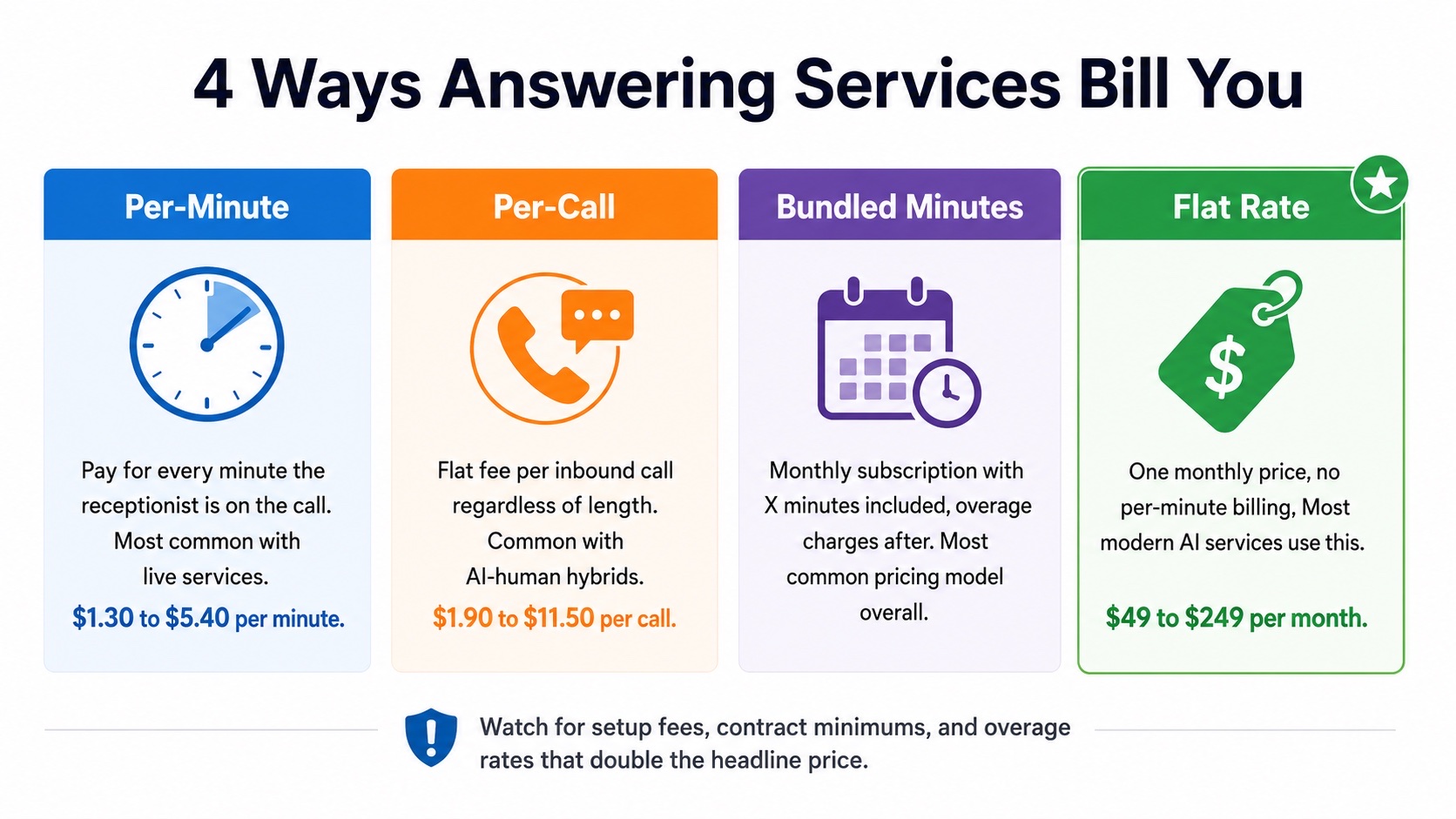
Every answering service uses one of these four billing models. Knowing which one a provider uses tells you most of what you need to know about whether the price is fair for your call volume.
1. Per-Minute Billing
You pay for every minute a receptionist is on the call, rounded up to the nearest minute (or sometimes 30 seconds). This is the most common model for traditional live answering services. Headline rates run from $1.30/minute on the cheapest tiers up to $5.40/minute on premium services like Ruby Receptionists.
Per-minute billing is brutal during busy months. Your monthly cost is directly tied to how chatty your callers are. A two-minute hold-and-transfer call costs the same as ten minutes of intake. There's no incentive for the operator to be efficient because longer calls mean more revenue for the provider.
2. Per-Call Billing
You pay a flat fee for each inbound call regardless of length. Most common with AI-human hybrid services like Smith.ai. Rates run from $1.60 per call on AI-only tiers up to $11.50 per call on premium live tiers.
Per-call billing is more predictable than per-minute. But it punishes you for spam calls and short hang-ups that still count as a billed call. Some providers also count voicemails and connection failures as billable events.
3. Bundled Minutes with Overage
You pay a flat monthly subscription that includes X minutes. Anything over your bundle is billed at a per-minute overage rate. This is the most common model overall and most live services use it.
The trap with bundled-minute plans is that the overage rate is almost always significantly higher than the effective in-bundle rate. PATLive's 75-minute Starter plan works out to $3.13/minute effective in the bundle, then charges $2.25/minute on overage. Going over your bundle by even 30 minutes can add $60 to $150 to your bill.
4. Flat-Rate Subscriptions
You pay a fixed monthly price with no per-minute or per-call charges within a generous usage allotment. Modern AI services like Zinng use this model. The headline price is the actual bill. There's no Monday-morning surprise after a busy weekend.
Flat-rate is the most owner-friendly model. You can budget exactly what you'll spend. You don't get punished for a viral moment or a seasonal call surge. The tradeoff is that flat-rate is generally only available from AI services. Most live services need to charge per-minute to cover their staffing costs.
Real Prices from Real Providers
Here is the actual starting price and per-minute economics for the major answering services in 2026. Prices verified against each provider's published pricing page (or confirmed quote where pricing isn't public).
| Provider | Type | Entry Price | Effective Per-Minute Rate |
|---|---|---|---|
| Zinng | AI, flat rate | $49/mo (300 min) | $0.16 effective; extra minutes ~$0.17 in buckets |
| Rosie | AI, flat rate | $49/mo (250 min) | $0.20 effective, $0.25 overage |
| Smith.ai (AI plan) | AI, per-call | $95/mo (50 calls) | ~$1.90 per call |
| Smith.ai (Live plan) | Hybrid, per-call | $300/mo (30 calls) | $10.00 per call, $11.50 overage |
| MAP Communications | Live, bundled | $179/mo (125 min) | $1.43 effective, $1.30 overage |
| Specialty Answering Service | Live, pay-as-go | $44/mo base + $1.54/min | $1.54 per minute |
| AnswerForce | Live, bundled | $259/mo (200 min + 50 chats) | $1.30 effective, $1.80 overage |
| VoiceNation / Moneypenny | Hybrid, bundled | $99/mo (30 min) | $3.30 effective, $2.99 overage |
| Davinci Virtual | Live, bundled | $129/mo (50 min) | $2.58 effective, $1.75 overage |
| AnswerConnect | Live, bundled | $350/mo (200 min) | $1.75 effective, $2.50 overage |
| PATLive | Live, bundled | $235/mo (75 min) | $3.13 effective, $2.25 overage |
| Abby Connect | Live, bundled | $329/mo (100 min) | $3.29 effective |
| Ruby Receptionists | Live, bundled | $395/mo (100 min) | $3.95 effective, $4.50 overage |
A few things jump out from the table. AI services have effective per-minute rates 10x to 25x lower than live services. The "Live, bundled" category is the most expensive across the board because you're paying both for the bundle and for risk of overage. Per-call services (Smith.ai) look reasonable until you realize a single 60-second call costs you what 10 minutes of AI minutes would cost.
What You'll Actually Pay by Call Volume
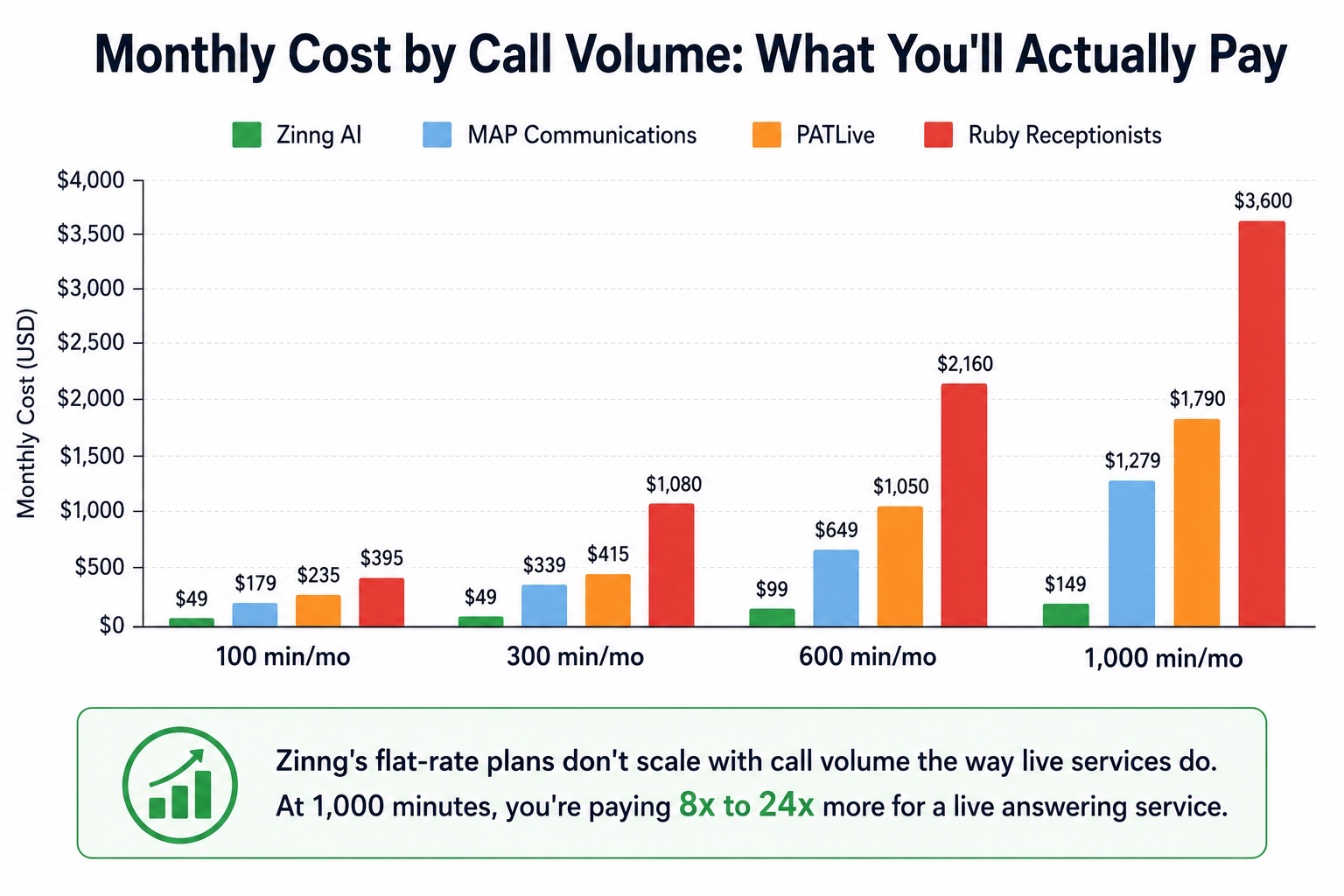
The starting price tells you almost nothing. What matters is what you pay when you actually use the service. Here's the real monthly bill at four common call-volume scenarios across the major providers.
| Provider | 100 min/mo | 300 min/mo | 600 min/mo | 1,000 min/mo |
|---|---|---|---|---|
| Zinng | $49 | $49 | $99 | $149 |
| Rosie AI | $49 | $62 | $149 | $149 |
| MAP Communications | $179 | $339 | $649 | ~$1,279 |
| Specialty Answering Service | $198 | $506 | $968 | ~$1,584 |
| AnswerConnect | $350 | $395 | $945 | ~$1,685 |
| PATLive | $235 | $415 | $1,050 | ~$1,790 |
| AnswerForce | $259 | $359 | $649 | $1,179 |
| Abby Connect | $329 | $599 | $1,380 | ~$2,260 |
| Ruby Receptionists | $395 | $1,080 | $2,160 | $3,605 |
Notes on the numbers above: Where a provider's plan tier doesn't exactly match the call volume, the closest published tier is used with overage added. Higher volumes ($600+/month) often qualify for custom enterprise pricing that may come in lower than these published rates.
The cost spread is enormous. At 300 minutes per month, the cheapest live service costs almost 7x what Zinng costs. At 1,000 minutes per month, Ruby Receptionists costs 24x what Zinng costs. The math doesn't reward loyalty to the traditional answering service model unless you have a very specific reason to use a live operator.
Hidden Costs Nobody Talks About
The headline monthly price is rarely the whole story. Watch for these:
- Setup fees ($49 to $200): AnswerConnect charges $49.99 on most plans. Abby Connect charges $95. AnswerForce charges $99 on lower tiers. Davinci charges $95. Most AI services charge $0.
- Overage rates that are higher than effective in-bundle rates: If your bundle works out to $1.30/minute effective and overage is $1.80/minute, every minute you go over your bundle costs almost 40% more than budgeted. PATLive, AnswerForce, AnswerConnect, and Davinci all do this.
- Per-message fees: Some live services charge $0.25 to $0.75 per text message sent on your behalf. Add up over a month and it's another $50-$150.
- Bilingual add-on: PATLive charges $20/month for bilingual answering. Most services include it now, but check.
- Holiday surcharges: Live services frequently charge 1.5x to 2x rates on major US holidays. AI services don't.
- Per-call action fees: Smith.ai charges $1.50 to book an appointment on top of the per-call rate, $1.00 to take a payment, $0.50 for Microsoft Teams notifications. A "simple" booking call can cost $13.50 by the time everything's added.
- Annual contract minimums: Some live services discount monthly billing only with a 12-month commitment. Going month-to-month adds 10-25% to the bill.
- Per-message email/SMS notifications: A few providers charge by the notification when you want a text every time someone calls.
By the time you stack three or four of these onto a "$259/month" plan, you're often paying $400-$500/month. Always run the math with everything you'll actually use turned on.
AI vs Live Pricing, Side by Side
The single biggest cost decision is AI vs live. Here's how the two compare on a per-minute basis for a typical 300-minute month:
| Metric | AI Answering (Zinng) | Typical Live Service |
|---|---|---|
| Monthly cost at 300 min | $49 | $339 to $1,080 |
| Effective per-minute rate | $0.16 | $1.30 to $3.60 |
| Extra minutes | ~$0.17/min in buckets (150 for $25) | $1.80 to $5.40 |
| Setup fee | $0 | $0 to $200 |
| After-hours coverage | Included, 24/7 | Included on most, surcharges on some |
| Holiday rates | No change | Often 1.5x to 2x |
| Concurrent calls handled | Unlimited | Hard limit (hold queue past it) |
| Bilingual | Included | Usually included, $20/mo add-on at some |
| Cancel anytime? | Yes, month to month | Often requires 30-day notice |
The cost gap isn't subtle. AI services run 8x to 24x cheaper at the same call volume. The argument for paying more for a live service is that a human can navigate emotionally complex or genuinely unusual calls better than the AI can. That's still true for a specific subset of calls (a frantic homeowner whose basement is flooding, a grieving family member calling a funeral home), but the gap is closing fast as voice AI gets better, and for the 95% of calls that are routine intake, booking, or message-taking, AI handles them more consistently than a human staff that rotates operators.
Is an Answering Service Worth the Money?
The standard ROI math for an answering service is straightforward: how much revenue do you currently miss to unanswered calls? If even a small fraction of those missed calls would have converted into a customer, the service pays for itself.
Some quick reference numbers from industry research:
- Roughly 80% of business callers will not leave a voicemail.
- The average small business misses 25-60% of inbound calls during business hours.
- Callers who reach a live answer instead of voicemail are 4x more likely to convert.
- For service trades (plumbing, HVAC, roofing, contractors), callers typically call 3-5 competitors in the same window. Whoever answers first wins roughly 50% of the time.
If your average customer is worth $200 (lawn care, salon, small repair), an answering service that captures even one extra customer per month covers itself at almost any price tier. If your average customer is worth $2,000 (legal, dental, contractor remodels), it covers itself in the first saved call.
The harder question is which service to use. The math overwhelmingly favors AI for small businesses below 1,000 minutes per month: the cost is low enough that the break-even is one or two saved calls per month, and the 24/7 coverage means you save calls your competitors miss in the middle of the night. Live services start to make sense at higher volumes or for industries where the conversational quality of a top-tier human operator genuinely matters (high-touch professional services, complex sales, premium hospitality).
Frequently Asked Questions
What's the cheapest answering service?
For an actual flat-rate price, Zinng and Rosie are tied at $49/month for the starter plan. For pay-as-you-go, Specialty Answering Service starts at $44/month base plus $1.54/minute used. For traditional bundled live answering, MAP Communications is the cheapest at $179/month for 125 minutes.
Is per-minute or flat-rate pricing better?
Flat-rate is better for almost every small business. Per-minute billing is predictable only if your call volume is predictable, and most small businesses see significant month-to-month variance. A flat rate insulates you from spike months, seasonal surges, and the kind of viral or storm-driven call waves that blow up per-minute bills.
What's an "answering minute" anyway? When does the clock start?
For most live services, the minute clock starts when the receptionist picks up and ends when the call disconnects (caller hangs up or gets transferred). Hold time, transfer time, and outbound message-relay calls usually count. Time spent at the IVR menu before reaching a receptionist usually doesn't. For per-call services, you pay the same fee whether the call is 10 seconds or 10 minutes. Read your provider's billing terms carefully because the definitions vary.
Are there free answering services?
Not in any meaningful sense. Some AI services offer 7 to 7-day free trials (Zinng, Rosie, SAS), but no paid answering service is fully free. The truly free options are voicemail and call forwarding to your cell phone, both of which don't deliver the answering service value. Don't trust any service that promises "free 24/7 answering" — there's always a catch (capped at a tiny call volume, sells your call data, or charges for any actual feature).
Do answering services charge for spam and robocalls?
Live answering services almost always charge for spam calls because the operator still picks up and listens long enough to identify it. AI services like Zinng filter most spam before it touches your billed minutes. This alone is worth $20-$50/month in saved minutes for a typical small business.
How much does Ruby Receptionists actually cost in practice?
Ruby's lowest plan is $395/month for 100 included minutes. Most Ruby customers run on a 200-minute ($720/mo) or 500-minute ($1,725/mo) plan because the per-minute economics get noticeably better at higher tiers. Overage rates run from $5.40/minute on the smallest plan down to $3.30/minute on the largest. A typical small business owner using Ruby pays $700 to $1,200/month all in.
Is Smith.ai's per-call pricing better than per-minute?
For very short calls, per-call pricing is worse than per-minute. A 30-second hang-up call on Smith.ai's Live plan costs $10.00, the same as a 5-minute appointment booking. For very long calls, per-call is better. Net-net, per-call pricing tends to favor the provider, not the customer, because most business calls run under 90 seconds and you pay the same as if they ran 5 minutes.
How does AI answering service pricing stay so low?
AI doesn't need a 40-hour-per-week salary, doesn't take breaks, and handles unlimited concurrent calls on the same infrastructure. The economics are fundamentally different from live answering services. The marginal cost of a Zinng call is the cost of a few cents of voice AI compute. The marginal cost of a Ruby call is a fraction of a real human's hourly wage plus overhead, which is why Ruby has to charge $4-$5 per minute to stay profitable.
Can I switch from a live answering service to AI without losing quality?
For routine intake, message-taking, appointment booking, and after-hours coverage, AI handles the calls indistinguishably from a top-tier live receptionist in most cases (and more consistently than the bottom 80% of live operators). For emotionally complex calls, AI still doesn't match the best human operators, though the gap is closing fast. Most small business owners who switch from live to AI find the AI does as well or better for 95% of their calls, at 5-10% of the cost.
The pricing varies enormously, but the math overwhelmingly favors AI answering services for small businesses in 2026. If you're currently paying $400+/month for a live answering service that's just taking messages and booking appointments, switching to a flat-rate AI service like Zinng typically saves $3,000 to $10,000 per year without losing the calls you used to capture.
Want to dig deeper? Compare the actual AI options in our 10 best auto call answering apps roundup, see how an answering service stacks up against a full call center in answering service vs call center, or browse all answering service reviews by state.
Ready to get started?
Set up your AI phone agent in minutes. Try it free for 7 days.
Try Zinng Free for 7 Days
About the Author
Timothy Bramlett
Co-Founder & CEO, Zinng
Timothy Bramlett is an American entrepreneur, software engineer, and product strategist. He is the founder of Zinng, an AI-powered phone agent platform that helps businesses never miss a customer call with intelligent call handling, real-time transcripts, and instant summaries.