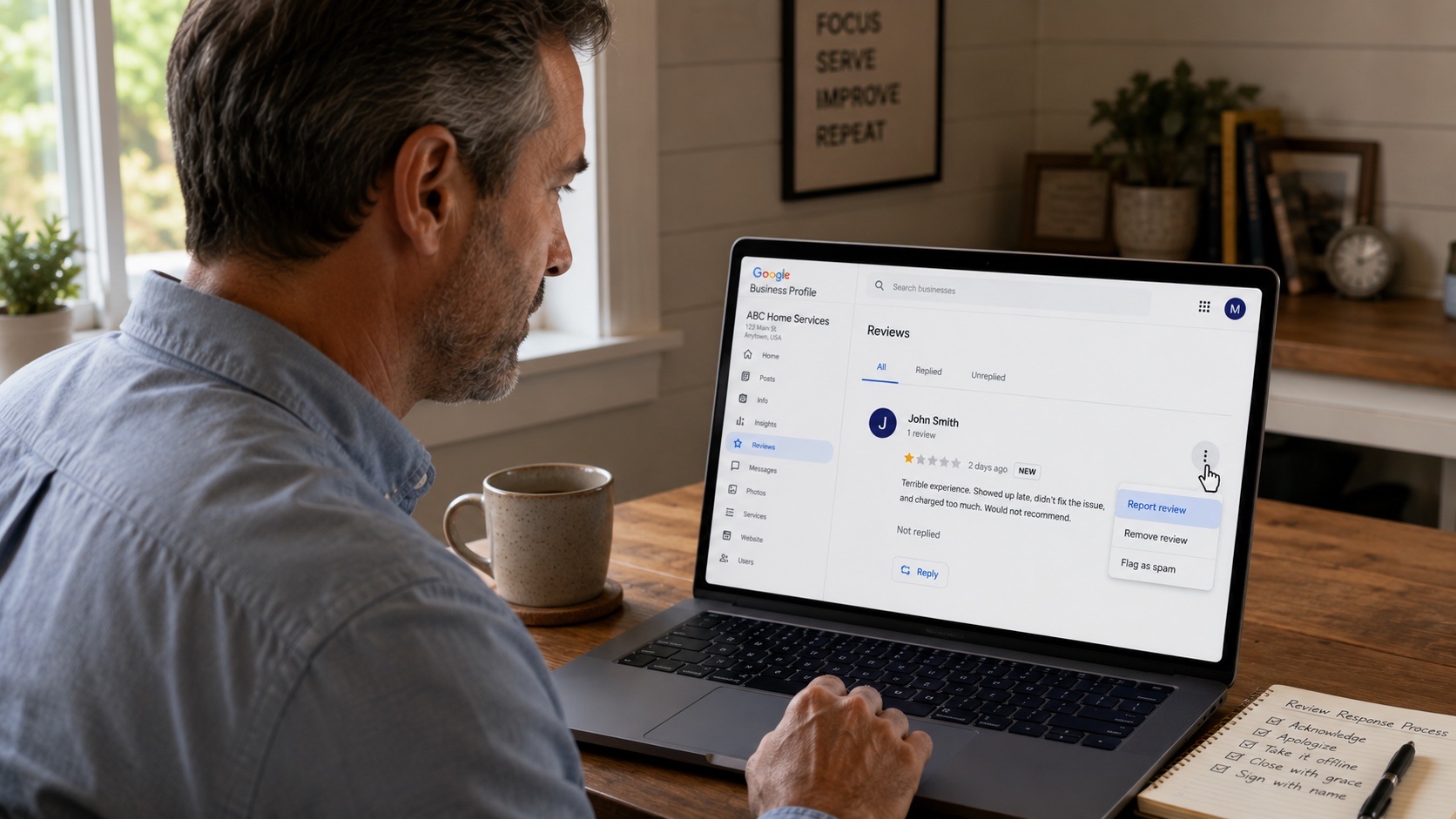
You're here because a fake or unfair Google review is sitting on your business profile and you want it gone. The good news: there is a real process for getting reviews removed. The bad news: most reviews you want removed will not be removed.
This guide is the honest version. It covers exactly what Google will and won't remove, the four paths you can pursue (free, paid, legal, and "respond and move on"), how to actually file a removal request, and the strategies that maximize your chances. By the end you'll know which battles are worth fighting and which ones to skip.
The Honest Truth About Google Review Removal
Three things you need to accept before we go further:
- Google removes a minority of flagged reviews. Industry estimates put the removal rate around 10-25% of flags. The biggest variable is whether the review actually violates Google's content policies, not how unfair you think it is.
- Google removes content, not opinions. A review can be brutally unfair, factually wrong, and obviously written by someone with an axe to grind, and Google will still leave it up because it's a legitimate opinion. Removal isn't about merit; it's about policy violation.
- Almost every business has a few of these. One unfair 1-star isn't going to sink your business. Your overall rating, response strategy, and review velocity matter more than any single review. Don't burn 40 hours trying to remove a review when the same time spent on getting 10 more 5-stars would have produced a better business outcome.
With that out of the way: let's get into what Google will actually remove, and how to file the request.
What Google Will (and Won't) Remove
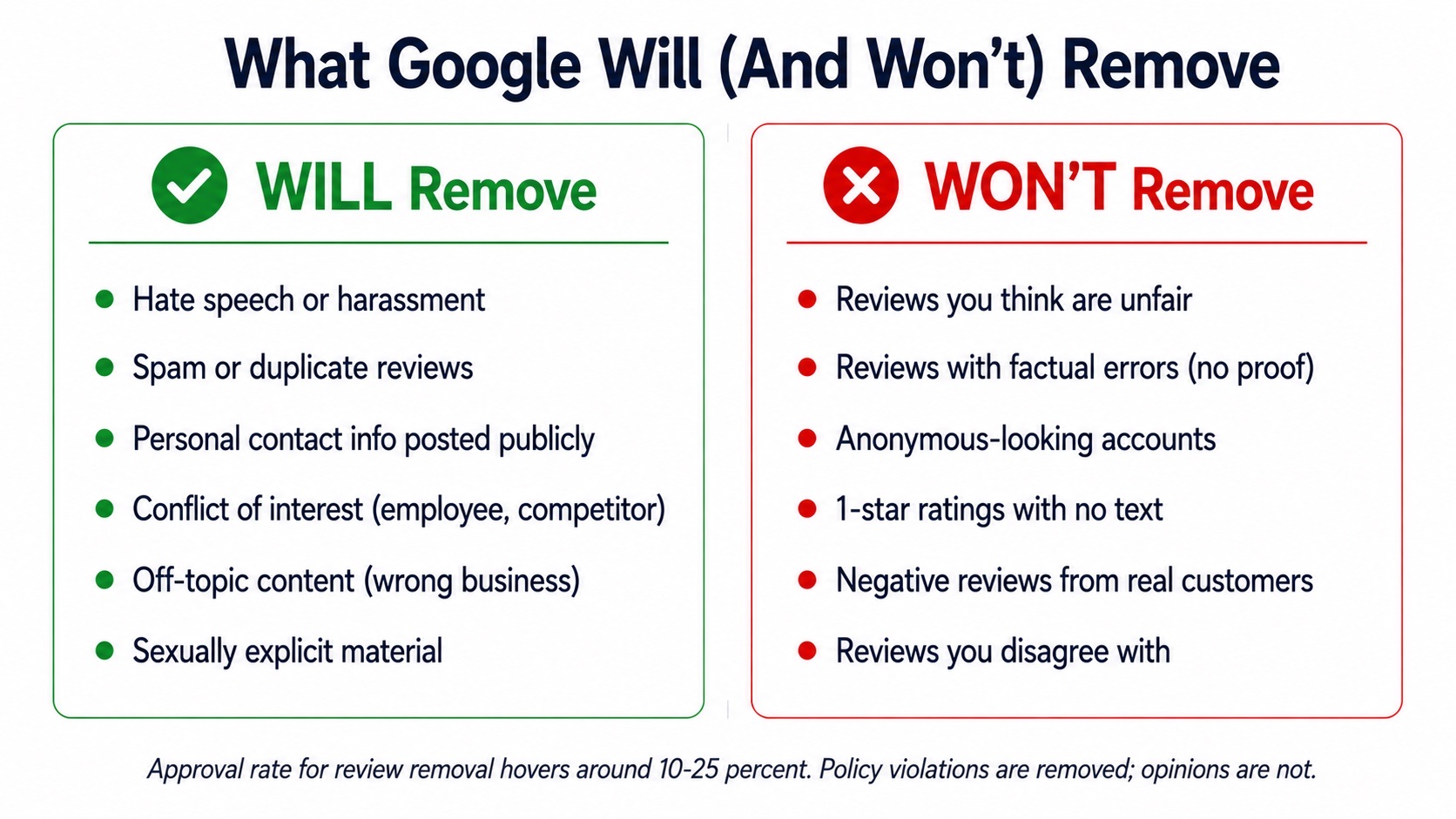
Google publishes its content policies. A review only gets removed when it violates one of them.
Google WILL Remove Reviews That Are:
- Spam or duplicate content. Multiple reviews from the same account, automated content, irrelevant promotional material.
- Off-topic. A review of a different business posted on yours. A political rant unrelated to your services. A review that's actually about a product you don't sell.
- Hate speech or harassment. Slurs, threats, or harassment directed at any individual or group.
- Conflict of interest. Reviews from current or former employees, owners, family members of competitors, or someone with a clear personal vendetta you can document.
- Personal information. Phone numbers, home addresses, email addresses, or other identifying info posted publicly without consent.
- Sexually explicit content. Self-explanatory.
- Impersonation. Reviews pretending to be from someone they're not, especially if used to mislead.
- Promotion of illegal activity. Reviews promoting illegal services, dangerous activities, or regulated content.
Google WON'T Remove Reviews That Are:
- Unfair in your opinion. Real customer leaves a brutal review for something you don't think was your fault. It stays.
- Factually wrong (without proof of policy violation). Customer misremembers the date, the price, or what they ordered. It stays unless you can prove it's spam or conflict of interest.
- From anonymous-looking accounts. Just because the account has one review and no profile photo doesn't mean it's fake. Google won't remove on suspicion alone.
- 1-star with no written content. A standalone star rating is allowed even with no review text.
- From real customers complaining about real things. Even if the complaint is petty or one-sided.
- Negative opinions you disagree with. Google explicitly allows critical reviews. That's the whole point of a review system.
The mental shift: stop asking "is this review fair?" and start asking "does this review break a specific Google policy?" If the answer is no, you're better off responding well than fighting to remove it.
The 4 Paths When You Want a Review Gone
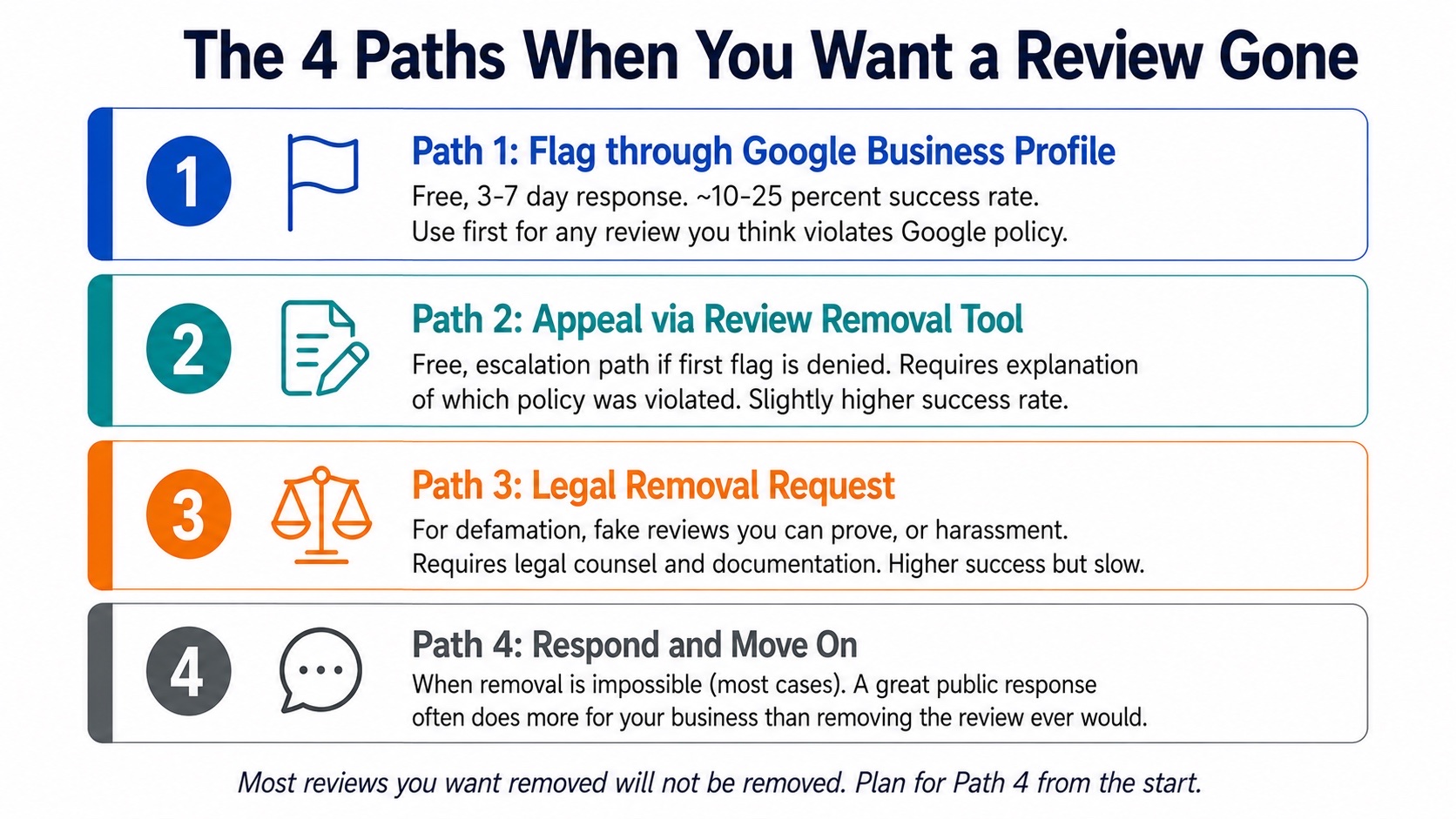
You have four real options. The first three try to make the review go away. The fourth accepts that it isn't going anywhere and turns the situation into a marketing win.
Path 1: Flag the Review Through Google Business Profile
This is the free, first-pass option. You click the three dots next to the review, hit "Report review," and pick the relevant policy violation. Google's automated and human review teams evaluate the flag in 3-7 days. Success rate: roughly 10-25%, higher if the violation is clear-cut (hate speech, off-topic, conflict of interest you can document) and lower if you're just claiming unfairness.
Always start here. It costs nothing and takes 60 seconds.
Path 2: Appeal via Google's Review Removal Tool
If your initial flag is denied, you can escalate via Google's dedicated review removal tool. This is essentially a more formal version of the flag where you explain in writing which policy was violated and why. The success rate ticks up slightly because a human reviewer reads your reasoning instead of an automated triage. Response time: another 5-10 days.
The escalation works best when the original flag was a borderline case where your written explanation can tip the decision.
Path 3: Legal Removal Request (for Defamation or Verified Fake Reviews)
For reviews that constitute legal defamation (provably false statements of fact that cause damage) or verified fake reviews where you have evidence, you can file a legal removal request through Google's Legal Help page. This requires substantially more effort: documentation, often a cease-and-desist letter to the reviewer first, and ideally a lawyer's involvement.
Success rate is higher than the regular flag (probably 30-50% for genuinely actionable cases) but the process takes weeks to months and the bar for what counts as legal defamation is high. Save this for cases where the review is genuinely defamatory and the damage to your business is significant.
Path 4: Respond Well and Let It Stay
The fourth path is "you can't remove it, but you can make it work for you." A great public response to a bad review often does more for your business than removing the review would have. Future customers who read a thoughtful, accountable response often convert at higher rates than customers who see a profile with only 5-stars (which can look suspicious).
For most reviews you want removed, this is the realistic outcome. See our guide on how to respond to negative Google reviews for the framework and 10 copy-paste templates by review type.
How to Flag a Review (Step-by-Step)
The actual flagging process is straightforward. Here's exactly what to do:
- Sign in to your Google Business Profile. Go to business.google.com and sign in with the account that owns the profile. You can also do this from Google Maps or Google Search if you're already signed in as the business owner.
- Find the review. Navigate to your profile's reviews section. Locate the specific review you want to report.
- Click the three-dot menu next to the review. On desktop it appears to the right of the review. On mobile, tap the small icon at the bottom of the review card.
- Select "Report review." A list of policy violation categories will appear.
- Pick the most specific applicable category. Common options: "Spam," "Off-topic," "Conflict of interest," "Hate speech," "Sexually explicit content," etc. Picking the most specific (and most clearly applicable) policy gives you the best shot at removal.
- Submit and wait. Google's response time is typically 3-7 days. You may receive an email confirming the decision; you may not.
- If denied, escalate via the review removal tool. Don't take the denial as the end. The escalation to the formal review removal tool reads your written explanation, which sometimes changes the outcome.
Tip: Document everything. Screenshot the review before flagging in case it gets edited later. Note the date you filed the flag and any reference numbers Google provides. If you escalate, you'll need this paper trail.
How to Improve Your Removal Odds
Most flags fail because the reviewer's complaint is technically allowed under Google's policies, even when it feels unfair. A few approaches that genuinely move the needle:
- Match the violation to the policy precisely. Don't pick "Spam" if the review isn't actually spam. The reviewer used to work for you? "Conflict of interest." The review names a competitor and recommends them? "Conflict of interest." The reviewer's account has 30 reviews all of similar businesses in random cities? "Spam." Specificity wins flags.
- Document the conflict of interest before flagging. If you suspect the reviewer is a former employee, a competitor, or a personal vendetta, gather evidence first: their LinkedIn, screenshots of their other reviews showing the pattern, any past communications. Include this when you escalate to the removal tool.
- Flag fast. Newer reviews seem to get more reviewer attention than older ones. Flagging within 24-48 hours of the review going live has anecdotally higher success rates than flagging weeks later.
- Use the appeal explanation well. When you escalate to the review removal tool, you get to write an explanation. Be specific, professional, and policy-focused. "This review violates Google's conflict of interest policy because the reviewer is a former employee, as documented in [linked LinkedIn profile] and the negative reviews they've left for our former coworkers." Not "this review is unfair."
- Respond to the review first. A public response that frames the review as a misunderstanding or addresses obvious factual errors signals to Google's reviewers that you're acting in good faith. Don't acknowledge specific claims you'll later deny.
- Don't mass-flag. Flagging every negative review you receive looks suspicious to Google. Flag only the ones that have a real policy basis.
Paid Removal Services: Worth It?
Several services advertise paid Google review removal, often using "no win, no fee" pricing. Removify, Reputation Defender, and similar firms charge anywhere from $300 to $2,500 per review attempt, depending on complexity. They will tell you their success rates are high. They are not Google insiders. They use the same flag-and-escalate process you can use yourself, plus aggressive escalation tactics and sometimes legal letters.
When paid services make sense:
- The review is genuinely defamatory and causing real revenue loss.
- You've already tried the free flag and escalation paths and been denied.
- You have the budget to absorb the cost even if removal fails.
- The service operates on "no win, no fee" terms so your downside is limited.
When paid services don't make sense:
- The review is fair (even if unflattering). No amount of money will get a fair review removed.
- The review is a single 1-star complaint without text. The juice isn't worth the squeeze.
- You haven't tried the free paths yet.
- The service requires upfront payment regardless of outcome.
If you spend $1,500 trying to remove a single review, the same budget invested in a steady review-velocity campaign (SMS automation, QR codes at point of service) would likely produce 30-50 new positive reviews and meaningfully shift your overall rating. Run the math both ways before signing a contract.
Legal Options for Truly Defamatory Reviews
For reviews that cross the line into legal defamation, you have additional options. The bar for legal defamation in the United States is high: the statement must be (a) a false statement of fact (not opinion), (b) communicated to a third party, (c) made with at least negligence as to truth, and (d) cause actual damages.
"Their service was terrible" is opinion. Cannot be defamation. "They stole money from me" (when they didn't) is a false statement of fact. Potentially defamation.
Legal Path 1: Cease-and-Desist Letter to the Reviewer
If you can identify the reviewer, a lawyer-drafted cease-and-desist letter outlining the false statements and demanding removal often produces voluntary takedowns. Cost: typically $300-$800 for the letter. Success rate: surprisingly high (60%+) when the reviewer is a real person with something to lose.
Legal Path 2: Court Order via Defamation Lawsuit
Filing an actual defamation lawsuit is the nuclear option. You'd need to identify the reviewer (often requires subpoenaing Google for account info), prove the elements of defamation, and obtain a court order. Cost: $5,000-$30,000+ in legal fees. Timeline: 6-18 months. Recommended only for genuinely catastrophic defamation cases where the dollar damage justifies the cost.
Legal Path 3: Google Legal Removal Request
If you obtain a court order ruling that specific review content is defamatory, Google will remove it via their Legal Help page. This is the only way to get Google to override their content policies. A court order is essentially the ultimate proof.
For 99% of business owners reading this, legal options are overkill. They're worth mentioning because they exist and they work when used appropriately. They're not worth pursuing for a regular unflattering review.
When You Can't Remove It (The Realistic Outcome)
For most reviews you want gone, the realistic outcome is: it stays. Here's how to turn that into a non-disaster.
- Respond well, publicly, within 24 hours. Use the 5-step framework from our negative review response guide: acknowledge, apologize for the experience, take it offline, close with grace, sign with a real name and title. A thoughtful response can convert future readers more effectively than the original review pushes them away.
- Bury it with positive reviews. The single best counterweight to a bad review is 10 new good ones. Use SMS review requests, QR codes at point of service, and personalized email follow-ups. See our how to get more Google reviews guide for the prioritized playbook.
- Accept the math. A single 1-star drops your average rating by about 0.05 stars when you have 50 reviews, and by about 0.01 when you have 200. The fastest way to make a bad review effectively invisible is to grow your overall review count.
- Don't obsess. Owners who spend 20 hours a week stewing over a bad review produce worse business outcomes than owners who spend that same time on review velocity, customer experience, or marketing. The bad review will fade in relevance whether you obsess over it or not.
Frequently Asked Questions
Can I get a Google review removed just because it's unfair?
No. Google removes reviews that violate their content policies (spam, conflicts of interest, hate speech, off-topic content, personal information, etc.), not reviews that are unflattering or one-sided. Even a brutally unfair review from a real customer about a real interaction is allowed under Google's policies and will not be removed.
How long does Google take to respond to a review flag?
Typically 3-7 days for the initial flag. If you escalate to the formal review removal tool, expect another 5-10 days. Legal removal requests take weeks to months. Plan accordingly: you cannot rush a Google review removal.
What percentage of flagged reviews actually get removed?
Industry estimates put the removal rate around 10-25% of flagged reviews. Clear-cut policy violations (off-topic, hate speech, documented conflicts of interest) have higher success rates. Vague "this is unfair" flags rarely succeed.
Can I tell who left an anonymous Google review?
Not directly. Google does not share reviewer identity with businesses. You can sometimes infer from context (specific details only certain customers would know), from clicking the reviewer's profile and looking at their other reviews, or from a pattern of timing relative to a known incident. If you need to legally identify a reviewer for defamation purposes, you can subpoena Google through a lawsuit, but that's expensive and slow.
Are paid removal services like Removify worth the cost?
Sometimes. They charge $300-$2,500 per review attempt and typically operate on no-win-no-fee terms. They make sense for genuinely defamatory reviews causing real revenue loss, but they use the same flag-and-escalate process you can run yourself for free. For most business owners, investing the same money in a review velocity program produces more impact than paying to remove a single review.
What if a former employee left a fake review?
This is one of the few cases where flag success rates are higher than average. Document the conflict of interest (LinkedIn, employment records, any communications between you), flag the review citing "conflict of interest," and provide the documentation in your appeal. Google takes employee conflict-of-interest reviews seriously when the evidence is clear.
Can I sue someone for a bad Google review?
You can sue for defamation if the review contains false statements of fact (not opinions) that cause provable damages. The bar is high and US courts have generally protected online reviewers. Most "bad review" lawsuits are bad ideas: expensive, slow, and likely to draw Streisand-effect attention to the very review you wanted buried. Reserve litigation for genuinely catastrophic defamation cases.
Should I respond to a negative review even while I'm trying to get it removed?
Yes. A thoughtful public response actually helps your removal chances (it signals good-faith effort to Google's reviewers) and protects your business in the meantime. If the review eventually gets removed, the response goes with it. If it doesn't, you've already done the marketing work.
Does flagging a review hurt my business with Google somehow?
No. Filing flags is a normal part of running a Google Business Profile, and there's no evidence that Google penalizes businesses for flagging. What you should avoid is flagging every negative review you receive (it looks suspicious) or trying to remove reviews that are clearly legitimate but unflattering. Be judicious.
Most of the time, you can't remove a bad Google review. Most of the time, you don't actually need to. A great response, a steady review velocity strategy, and a focus on the customer experience will do more for your business than any successful removal would. Flag what genuinely violates policy. Respond well to everything else. Move on.
Related reading: our guide to responding to negative Google reviews (10 templates by review type), the how to get more Google reviews playbook (15 tactics ranked by effectiveness), and the free Google review QR code generator. If you also want to make sure every happy customer is one you can ask for a review (because every inbound call actually got answered), see how Zinng's AI phone agents handle every call 24/7.
Ready to get started?
Set up your AI phone agent in minutes. No credit card required.
Try Zinng Free for 7 Days
About the Author
Timothy Bramlett
Co-Founder & CEO, Zinng
Timothy Bramlett is an American entrepreneur, software engineer, and product strategist. He is the founder of Zinng, an AI-powered phone agent platform that helps businesses never miss a customer call with intelligent call handling, real-time transcripts, and instant summaries.