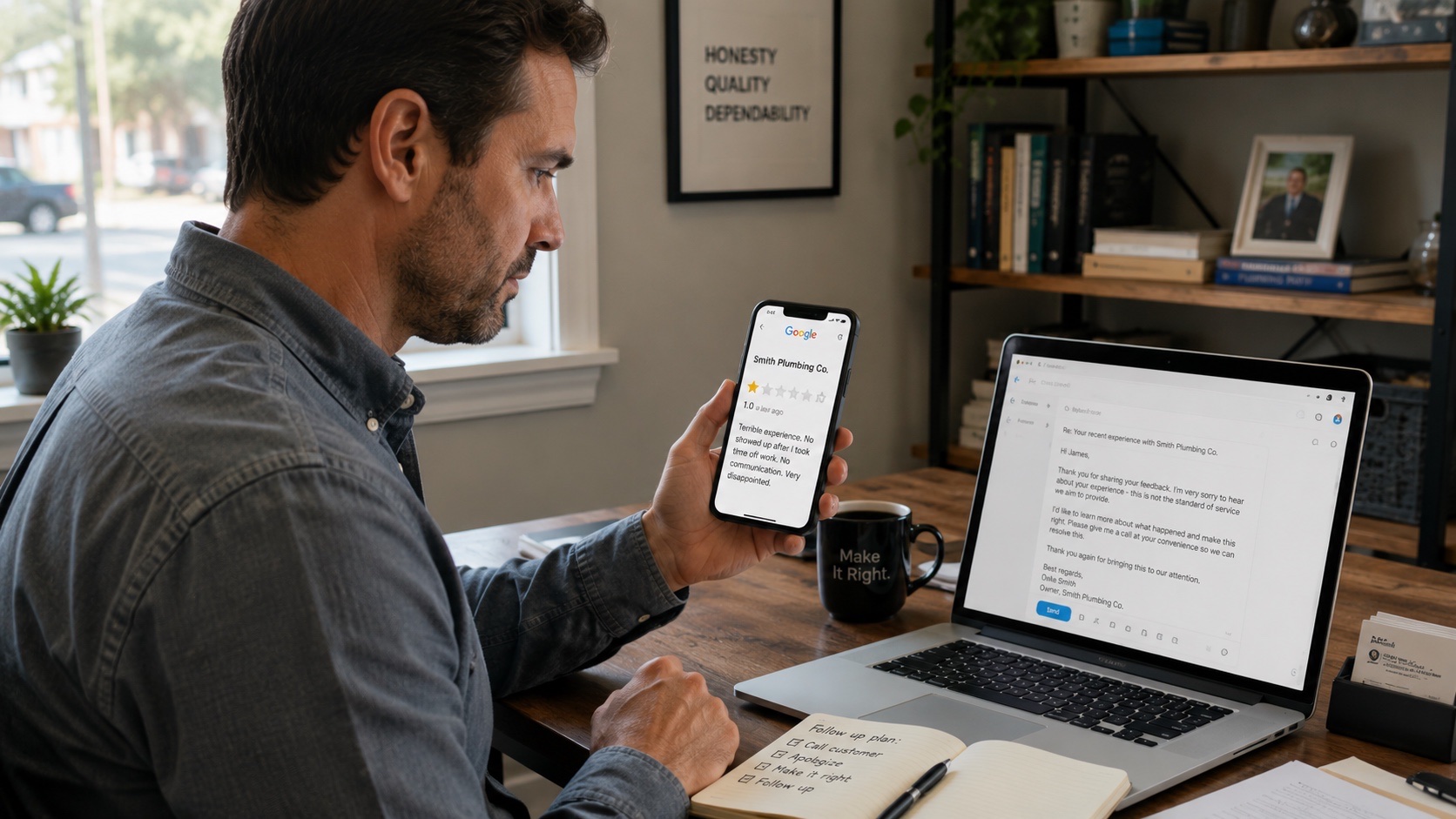
You just got a 1-star review. Your stomach dropped. Your first instinct is either to fire back defensively or to ignore it and hope it goes away. Both are wrong, and both will cost you business.
The reality: future customers read your responses to negative reviews more carefully than they read the reviews themselves. A well-handled 1-star is often more persuasive than another 5-star, because it shows you're a real business with real accountability. A botched response to a 1-star, on the other hand, can sink an otherwise great review profile.
This guide gives you the 5-step framework, 10 copy-and-paste templates organized by review type (legitimately bad, unfair, factually wrong, fake-but-you-can't-prove-it, and lukewarm 3-stars), a side-by-side comparison of a bad response versus a good one, and the short list of what you should never write. By the end you'll be able to draft a great response in under 90 seconds.
Why You Must Respond to Every Negative Review
Three reasons, in order of importance:
- Future customers read your reply. Roughly 89% of consumers read business responses to reviews before making a purchase decision. They use the response to gauge how you treat unhappy customers, which is what they really want to know. A thoughtful, accountable reply to a 1-star can convert a skeptical reader into a paying customer.
- Google rewards engagement. Google has confirmed that businesses responding to reviews are seen as more trustworthy and engaged, which feeds the local search ranking algorithm. Not responding is leaving a free ranking signal on the table.
- The original reviewer often updates their rating. Roughly 1 in 5 negative reviewers will edit or even remove their review if the business responds thoughtfully and resolves the issue. This is the single most underused tool small businesses have.
The cost of responding well is 90 seconds of your time. The cost of responding badly (or not at all) is real money. The math is not subtle.
The 5-Step Framework for Any Negative Review
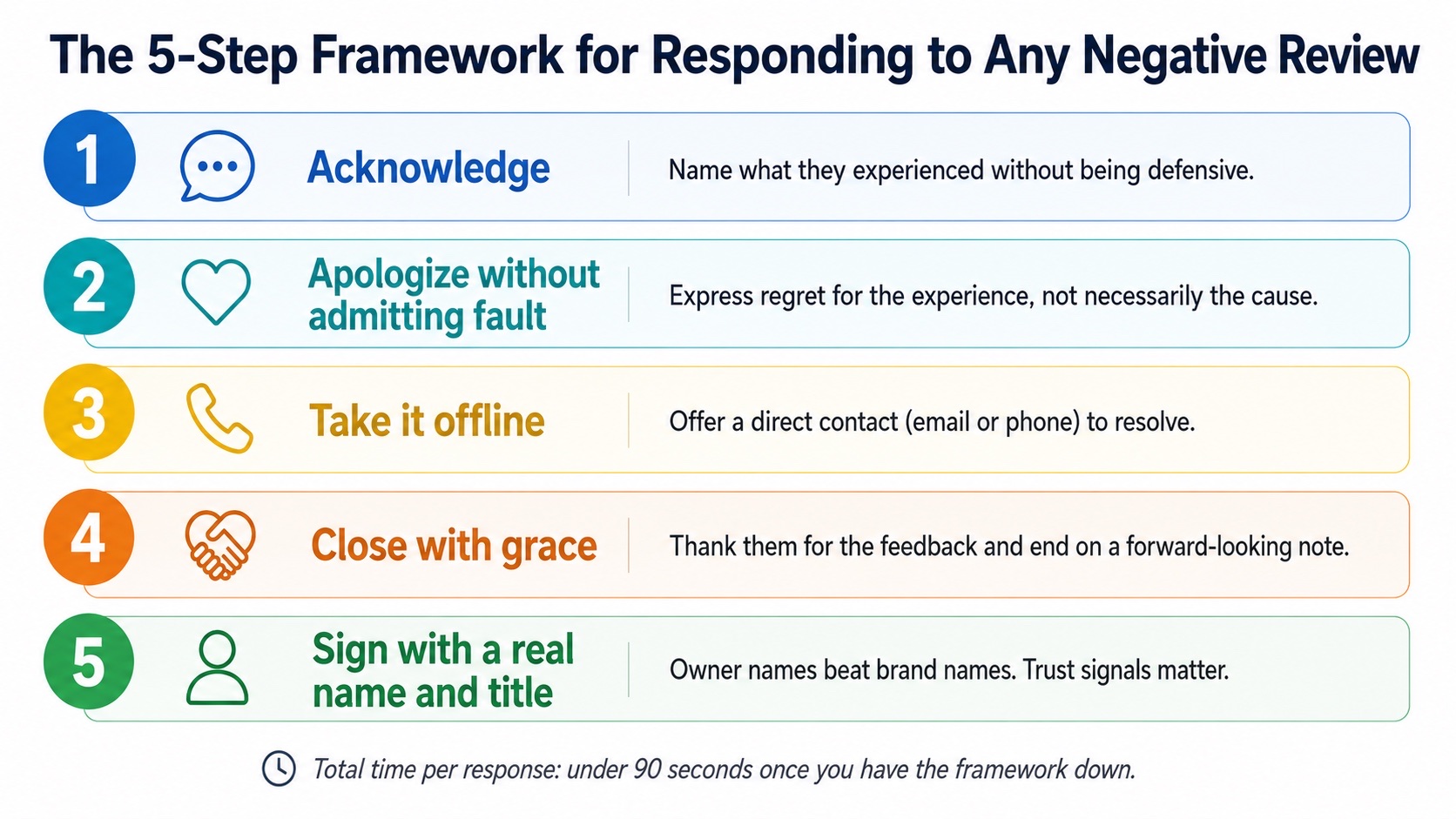
Every effective response to a negative review hits these five steps. Once you have the framework, the writing becomes mechanical.
1. Acknowledge what they experienced
Name the issue they raised without being defensive. "I'm sorry your installation took longer than expected" or "Running 45 minutes late is genuinely frustrating, and I understand why that affected your impression of us." Acknowledgement doesn't mean agreement. It means the reader (the reviewer and every future customer) knows you read the review and took it seriously.
2. Apologize for the experience, not necessarily the cause
You can apologize that someone had a bad experience without admitting fault for something you didn't do or admitting legal liability. "I'm sorry your visit didn't reflect the standard we hold ourselves to" works whether the issue was your fault, a misunderstanding, or partially the customer's fault. It puts the focus on the experience, not the blame.
3. Offer to take it offline
Give them a specific way to reach you directly: "Please email me at [email protected] and I'll personally look into this." Two reasons. First, it gets the dispute out of public view. Second, it shows future readers that you offered resolution, which is more persuasive than the original complaint. Use a real email or phone number, not a generic contact form.
4. Close with grace, not closure
Don't write "we hope to see you again soon" if they're never coming back. Write something forward-looking and grounded: "Thank you for taking the time to share this. We use this kind of feedback to keep improving." Don't grovel. Don't argue. Don't make promises you can't keep.
5. Sign with a real name and title
Always sign as a person, not as the brand. "Mark, Owner" or "Sarah, General Manager" beats "The Team at XYZ Business" every time. Personal signatures signal accountability to readers and to Google. If you're the owner, sign as the owner. People give owner responses more weight than brand responses.
Bad Response vs. Good Response (Same Review)
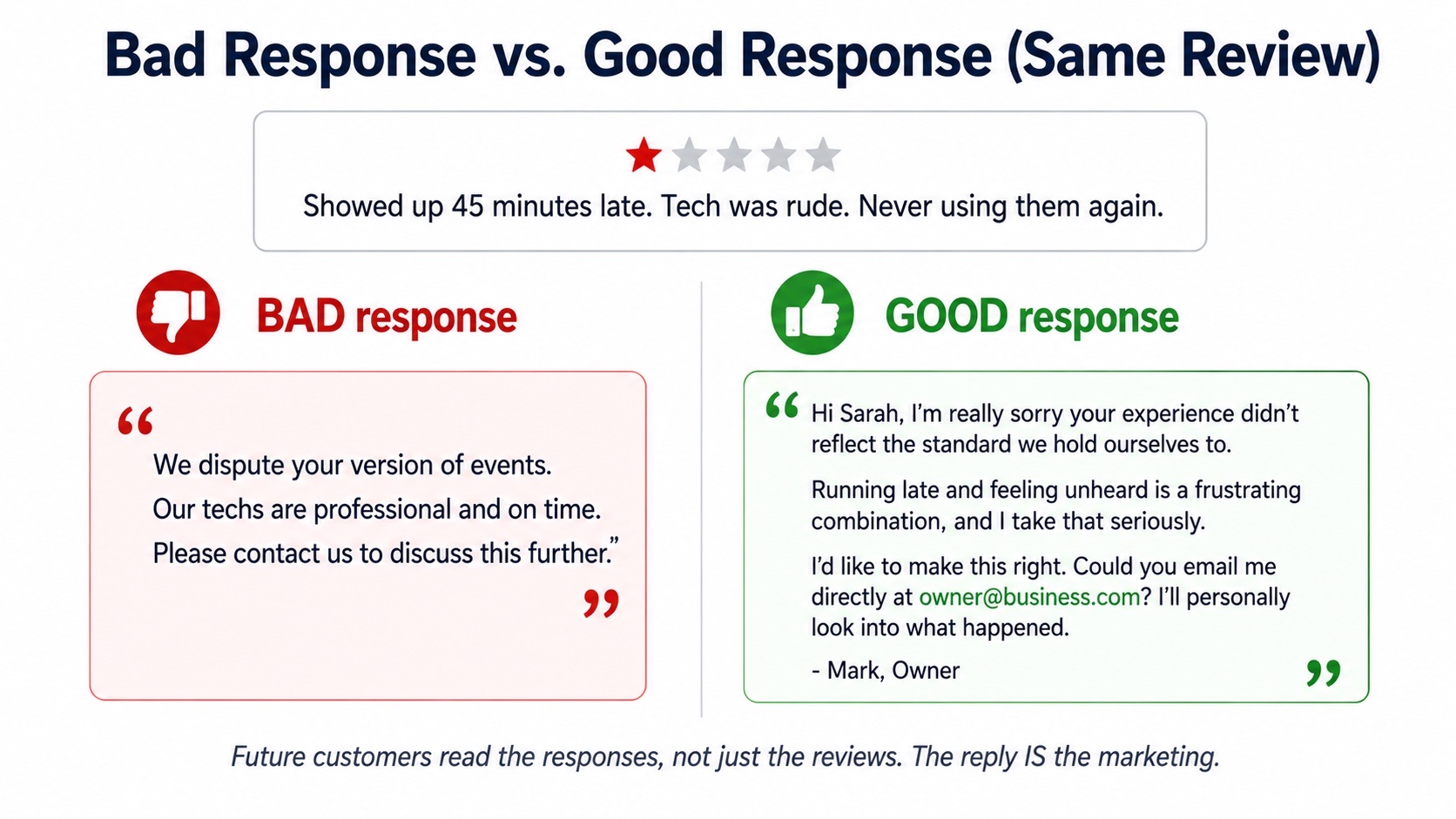
Here's a real-world example. Same review, two responses.
The review: "Showed up 45 minutes late. Tech was rude. Never using them again." (1 star)
Bad response:
"We dispute your version of events. Our techs are professional and on time. Please contact us to discuss this further."
What's wrong with it: defensive, calls the reviewer a liar, no real apology, generic close. A reader sees this and thinks "this business will fight me if something goes wrong." You've damaged your conversion rate with future customers more than the original 1-star did.
Good response:
"Hi Sarah, I'm really sorry your experience didn't reflect the standard we hold ourselves to. Running late and feeling unheard is a frustrating combination, and I take that seriously. I'd like to make this right. Could you email me directly at [email protected]? I'll personally look into what happened.
— Mark, Owner"
What's right with it: acknowledges the specific complaint (late + felt unheard), apologizes without admitting fault, offers a direct line to the owner, signs with a real name and title. A reader sees this and thinks "this business handles problems like a grown-up." That confidence is what closes the sale.
10 Templates by Review Type
Not every negative review is the same. Trying to use one template for all of them produces robotic-sounding responses. Use the right template for the type of review you're dealing with.
Type 1: The Legitimate Complaint (You Messed Up)
The customer's complaint is fair. Something genuinely went wrong on your end. Your job is to own it.
"Hi [Name], you're right and I'm sorry. [Specific issue they raised] should never happen, and the fact that it did is on us. I'd like to make it right. Please email me directly at [direct contact] so I can [specific remedy: refund, redo the work, etc.]. Thank you for telling us. The only way we get better is by hearing where we fell short.
— [Your Name], [Title]"
When to use: Anytime the complaint is clearly valid and a reasonable person would side with the customer. Don't try to spin it. Own it.
Type 2: The Partial Fault (Misunderstanding or Mixed Blame)
Something went wrong, but it's not 100% your fault. Maybe there was a miscommunication or both sides played a role.
"Hi [Name], I'm sorry your experience with us didn't go the way either of us wanted. Looking at our records, it sounds like there was a miscommunication about [specific item]. I'd like to talk it through with you directly so I can understand where we missed the mark. Please email me at [direct contact] and I'll personally follow up. Thank you for the feedback. It helps us catch breakdowns like this before they happen again.
— [Your Name], [Title]"
When to use: When you'd want a chance to explain in person but don't want to argue publicly. Take it offline immediately.
Type 3: The Factually Wrong Review (Their Facts Are Off)
They're not lying, but they got something wrong. They mixed you up with another business, misremember the date, or are upset about a service you don't even offer.
"Hi [Name], thanks for reaching out and I'm sorry for the frustration. Looking at our records I don't see a visit matching [specific detail they mentioned]. It's possible we have you confused with another customer or another business. Could you email me at [direct contact] with any details (date, who you spoke with, invoice number)? I want to get to the bottom of this and make it right if it was us.
— [Your Name], [Title]"
When to use: When their facts are clearly wrong but you want to be respectful, not combative. Never call them a liar publicly. State the discrepancy gently and ask for details.
Type 4: The Unfair Review (Outside Your Control)
The complaint is real but the cause was outside your control. A shipping carrier lost their package. The weather killed the lawn you installed. The manufacturer recalled the product.
"Hi [Name], I completely understand the frustration. [Specific external cause] is genuinely outside our control, but it doesn't change the fact that the experience wasn't what you expected when you chose us. I'd like to talk about what we can do. Please email me at [direct contact] and I'll personally see what options we have. Thank you for letting us know.
— [Your Name], [Title]"
When to use: When the situation was real but not your fault. You can name the external cause briefly without sounding like you're making excuses, as long as you still offer to help.
Type 5: The Suspicious / Likely Fake Review
The review is from someone who you have no record of being a customer, names a competitor, or has classic fake-review tells (generic complaint, no specifics, account with one review on it). Don't accuse publicly. Respond like you would to a real customer, then flag it through Google.
"Hi [Name], thanks for reaching out. I checked our records and I'm not finding a visit or order matching this description. We want to make sure every customer leaves happy, so I'd love to get the details and figure out what happened. Please email me at [direct contact] with the date and any other information you can share. I'll personally look into it.
— [Your Name], [Title]"
When to use: When the review doesn't match any real interaction. The polite "let's verify" tone signals to future readers that the review may not be legitimate without you having to say it. See the "When to Flag for Removal" section below for the next step.
Type 6: The Lukewarm 3-Star (Not Bad, Not Great)
Often the most actionable category. The customer wasn't angry, just underwhelmed. Often willing to revise upward if you respond well.
"Hi [Name], thank you for the honest feedback. Reading between the lines, it sounds like [specific thing they mentioned] kept this from being a 5-star experience. I'd love to learn more so we can do better next time. If you have a minute, email me at [direct contact] with what we could have done differently. We genuinely use this kind of feedback to improve.
— [Your Name], [Title]"
When to use: Every 3-star review. These convert to 4 or 5 stars at higher rates than 1-star reviews do, and the writer is usually still reasonable.
Type 7: The Emotional / Angry Review (All Caps, Strong Language)
The reviewer is heated. Don't match their energy. Stay calm, respond like an adult to a child having a tantrum, and don't escalate.
"Hi [Name], I can hear how upset you are and I'm sorry your experience left you this frustrated. I want to understand what happened. Please email me directly at [direct contact] and I'll personally take the time to talk this through. Thank you for the feedback.
— [Your Name], [Title]"
When to use: When the review is angry or emotional. Short, calm, and offer to take it offline. Don't engage with the substance publicly.
Type 8: The Pricing Complaint (Quoted High, Felt Overcharged)
Customer feels you overcharged. Defensive replies look bad. Acknowledge that pricing felt off to them without conceding your prices are wrong.
"Hi [Name], I appreciate you sharing this. Our pricing is set the way it is because [one-sentence reason: certified techs, parts quality, warranty, etc.], but I understand it didn't feel like the right value to you, and that's important feedback. I'd be glad to walk through the breakdown of your specific invoice if it would help. Please email me at [direct contact].
— [Your Name], [Title]"
When to use: When the complaint is specifically about price or perceived value. You can defend your pricing without being defensive.
Type 9: The Service-Industry Complaint (Tech, Server, Stylist Was Rude)
An employee allegedly behaved badly. Don't throw the employee under the bus publicly. Acknowledge and investigate.
"Hi [Name], I'm sorry our team didn't represent us the way we expect. I take this seriously and want to look into what happened on your visit. Please email me at [direct contact] with any details (date, time, name of the person you worked with if you remember). I'll personally follow up with the team. Thank you for telling us.
— [Your Name], [Title]"
When to use: When the complaint is about a specific person. Investigate privately. Don't promise to fire anyone publicly.
Type 10: The Old / Resolved Issue Coming Back
You already worked with this customer and thought it was handled, but they're now leaving a review reopening the issue.
"Hi [Name], thanks for reaching out again. I remember we worked through [issue] and I thought we'd landed in a good place. Clearly there's more to discuss. Please email me at [direct contact] and I'll personally take another look. I'd rather we make this right than leave it where it is.
— [Your Name], [Title]"
When to use: When you recognize the customer and have history. Acknowledge the prior interaction without rehashing it publicly.
What NOT to Write (Six Mistakes That Make It Worse)
Some phrasings reliably make negative-review situations worse. Avoid these even when you really want to use them:
- "We dispute your version of events" / "That's not what happened": Tells future customers you'll argue with them when they have a problem.
- "Our records show that..." followed by a contradiction: Sounds bureaucratic and combative. Use a softer version: "I checked our records and want to make sure I have the right details."
- "We're sorry you feel that way" / "I'm sorry you had this experience": Non-apologies. Reviewers and future readers see through them instantly. Apologize for something specific, even if it's just the experience.
- "This is not the X we know": Throws an unnamed employee under the bus or dismisses a real complaint. Don't.
- Naming the customer's gender, age, or appearance. Sometimes business owners write "the customer was angry and unreasonable" or similar. This is a one-way ticket to a viral screenshot. Stay neutral about the person.
- Asking them to remove the review. Don't do this in the public reply. If you resolve the issue offline, you can ask them privately to consider updating. But never in the public response.
If you find yourself wanting to write any of these, walk away from the keyboard for an hour. Come back when you can write a response you'd be comfortable seeing on the front page of your local newspaper.
When to Flag a Review for Removal
Google removes a small percentage of flagged reviews. They will only remove reviews that violate their content policies. Knowing what qualifies (and what doesn't) saves you from wasting energy on lost causes.
Google WILL remove reviews that:
- Contain hate speech, profanity, or harassment directed at a person.
- Contain personal contact information (phone numbers, addresses, emails) without consent.
- Are spam or duplicate posts.
- Are clearly from someone with a conflict of interest (a current or former employee, a competitor, etc.).
- Are off-topic for the business listed (a review of a different business or completely unrelated content).
- Contain sexually explicit material.
- Promote illegal activity or impersonate someone.
Google will NOT remove reviews that:
- You think are unfair.
- You believe are factually wrong (unless you can prove they're spam).
- Are from people you suspect are not customers (unless you have evidence).
- Are anonymous (negative reviews from anonymous-looking accounts are still policy-compliant).
- Have a low rating with no written content.
How to flag: In your Google Business Profile, click the three dots next to the review and select "Report review." Choose the relevant policy violation. Expect a response in 3-7 days. If denied, you can request escalation through Google Business Profile support, but the success rate stays low.
For the full deep-dive on the removal process, the appeals workflow, when to consider paid services, and when to consider legal options for defamatory content, see our dedicated guide on how to remove a fake Google review (and what to do when you can't).
Frequently Asked Questions
How quickly should I respond to a negative Google review?
Within 24 hours, ideally within 4 hours during business days. Quick responses signal to future readers that you take feedback seriously. Sitting on a 1-star review for a week makes you look either disorganized or like you're hoping it goes away.
Should I respond to every negative review?
Yes, every one. Even if you're confident the review is unfair or fake. The response is more for future customers than for the original reviewer. A pattern of thoughtful responses across all your reviews (positive and negative) builds more trust than any single 5-star.
Can I get a fake Google review removed?
Maybe. Google removes reviews that violate their content policies (spam, conflicts of interest, off-topic, hate speech, etc.) but they won't remove a review just because you say it's fake. You need to show evidence of policy violation. Flag the review, document the reasons, and expect a 3-7 day response. The removal success rate hovers around 10-20%.
Should I ask the customer to update or remove their review?
Never in your public response. After you've resolved the issue offline, it's reasonable to mention "if you have a chance to update your review, we'd appreciate it." Roughly 1 in 5 negative reviewers will revise upward after a positive resolution. But the ask only works after you've genuinely fixed the problem, not as part of the resolution conversation.
What if the negative review is from a competitor or someone with a vendetta?
Respond like you would to a real customer (calm, offer to take it offline) and then flag it through Google with documentation. Don't accuse anyone publicly, even if you're 99% sure. Public accusations almost always make you look worse and rarely succeed at getting the review removed. Let your professional response do the talking; future customers will draw their own conclusions.
Can AI help me write responses to negative reviews?
Yes, carefully. AI is great for drafting a first version that you polish in 20-30 seconds. The trap is letting AI auto-publish responses unsupervised, which produces generic-sounding replies that all read the same. Use AI to overcome the blank-page problem; always edit before you post. A response that sounds like you (or like a real person at your company) converts better than a polished but obviously-AI response.
Do responses to negative reviews actually affect my Google ranking?
Indirectly, yes. Google has confirmed that responding to reviews signals engagement and trustworthiness, which feeds into local search ranking. The bigger effect is on conversion: future customers who read your responses to negative reviews convert at meaningfully higher rates than customers who only see the reviews themselves.
What if I'm too angry to write a calm response right now?
Walk away. Take 24 hours. Come back when you can write something you'd be comfortable seeing as a headline tomorrow. The Google review will still be there. Responding while emotional almost always produces a worse outcome than waiting one day.
Should the owner or a team member respond?
For 1 and 2-star reviews: ideally the owner or general manager. The personal accountability of an owner signature carries weight that a brand response can't match. For 3+ star reviews, a team member can handle it. Always sign with a real name and title, not "the team at XYZ."
Negative reviews are not the disaster they feel like in the moment. Handled well, they often help your business more than they hurt it. Print the framework, save the templates, train your team, and respond within 24 hours every time.
Related reading: the full guide to getting more Google reviews (where responses fit into the broader strategy), our QR code playbook, and the free Google review QR code generator. If you also want to make sure every happy customer is one you can ask for a review (because they actually got through to you), see how Zinng's AI phone agents answer every call 24/7.
Ready to get started?
Set up your AI phone agent in minutes. No credit card required.
Try Zinng Free for 7 Days
About the Author
Timothy Bramlett
Co-Founder & CEO, Zinng
Timothy Bramlett is an American entrepreneur, software engineer, and product strategist. He is the founder of Zinng, an AI-powered phone agent platform that helps businesses never miss a customer call with intelligent call handling, real-time transcripts, and instant summaries.