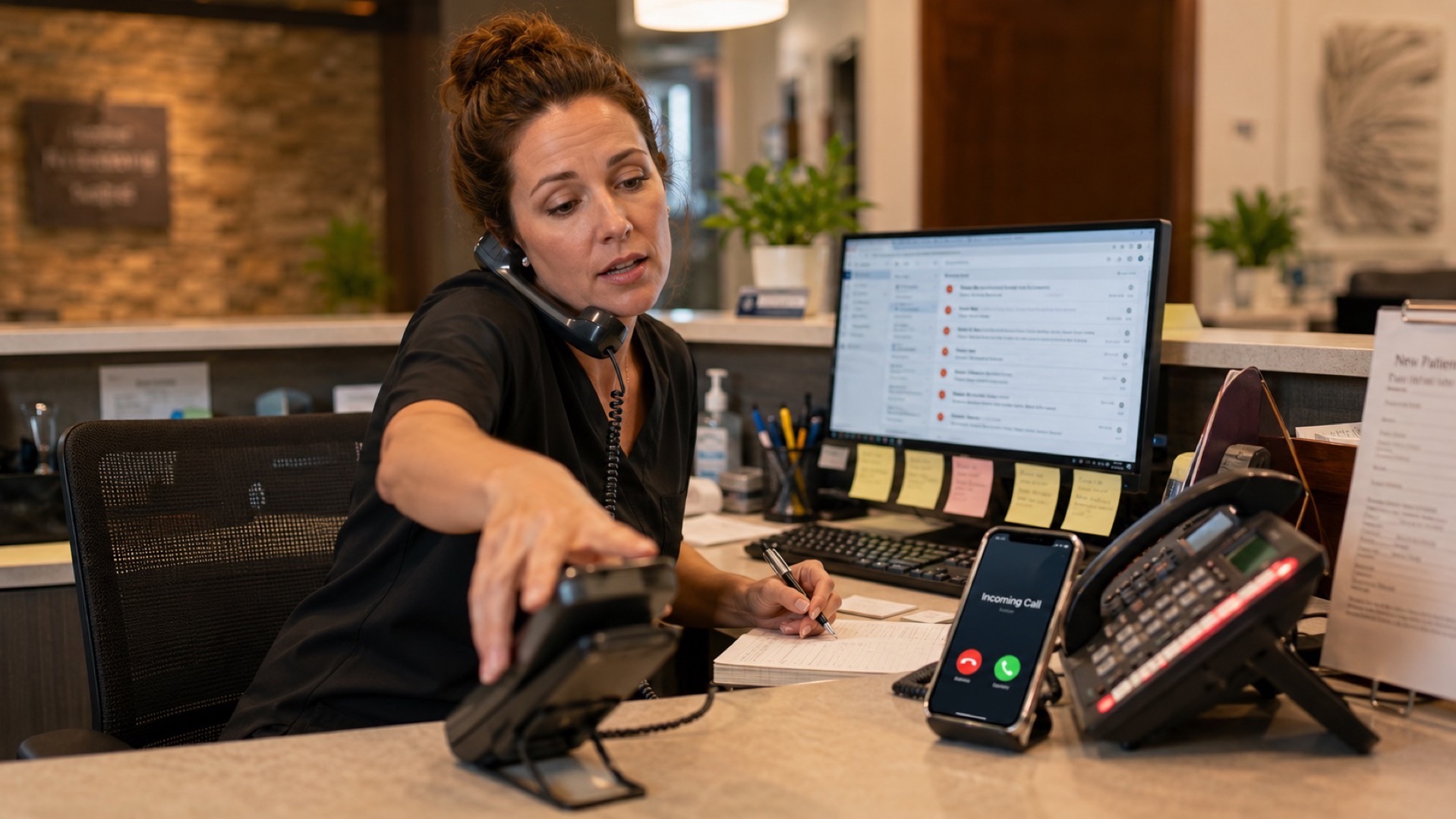
The phone won't stop ringing. Your team is double-booked. Half the calls go to voicemail and never get returned. Customers who do reach you complain about hold times. Meanwhile, the calls you actually want to take, the high-value leads and the existing customers with real problems, are getting lost in the noise.
This is high call volume. Every small business that's growing hits it at some point. The question is what you do about it before it starts costing you revenue, customers, and sanity.
This guide covers the definition, what causes it, the real cost of ignoring it, and 12 specific strategies to handle it. Several of them are free.
What Is High Call Volume?
High call volume is when your business receives more inbound calls than your current staffing and processes can handle within a reasonable response time. There's no universal number that defines it because the threshold depends on your business size, your team, and your industry.
A rough framework for small businesses:
- Solo operator: More than 15-20 inbound calls per day starts to interfere with billable work.
- 2-5 person team: 50-100 calls per day starts pushing wait times above 60 seconds.
- Larger SMB or contact center: Any consistent pattern where call volume exceeds the staffed capacity to answer within 30 seconds.
The real test is not raw call count. It's whether your customers are routinely waiting on hold, hitting voicemail, or hanging up before reaching anyone. If they are, you have high call volume.
Why Call Volume Spikes Happen
High call volume is rarely random. It usually comes from one or more of these specific causes:
- Seasonality. HVAC companies in summer. Pest control during ant or mosquito season. Tax accountants in March. Roofing after a storm. Many small businesses have predictable annual call surges.
- Marketing campaigns. A direct mail piece, a TV spot, a sponsored Google search campaign, or a viral social post can 5x your call volume for a week.
- Outages or product issues. Something breaks. Customers call. Volume spikes immediately and stays elevated until the issue is resolved.
- Staffing shortages. Your call volume stayed the same, but your team shrunk. Same effect as a volume spike.
- News cycles and trends. A news story mentions your industry. A TikTok goes viral. Calls start coming in from people who would never have called otherwise.
- Compliance or regulatory deadlines. Tax filing deadlines, ACA enrollment, regulatory changes that affect your industry, all trigger call surges.
- Word of mouth growth. The good kind. You're getting referrals faster than you're staffing for them.
Knowing which cause applies to you matters because the right strategy depends on it. A one-week marketing spike calls for overflow handling. A persistent staffing gap calls for hiring or automation.
Signs You Have a High Call Volume Problem
Not every busy day means you have a high call volume problem. These are the actual warning signs:
- Voicemail box stays full. If callers regularly get "this voicemail box is full," you're not just busy, you're overrun.
- Hold times routinely exceed 2 minutes. Industry data shows customer satisfaction drops sharply after the 60-second mark.
- Repeat callers. Customers calling 2-3 times in the same day because they could not get through the first time.
- Team members skipping breaks. If your front desk has not had lunch in three weeks, you have a problem.
- Negative reviews mentioning the phone. "Tried calling 4 times, no one ever picked up." This is the most public signal.
- Lost leads at the same volume as your inbound marketing. If your marketing is generating 100 inbound calls and 30 sales, but you're only fielding 60 of the calls, you've left 40 leads on the table.
- You forgot to call someone back. The classic. The message slip got buried, the customer never heard back, and they signed with a competitor.
What High Call Volume Is Actually Costing You
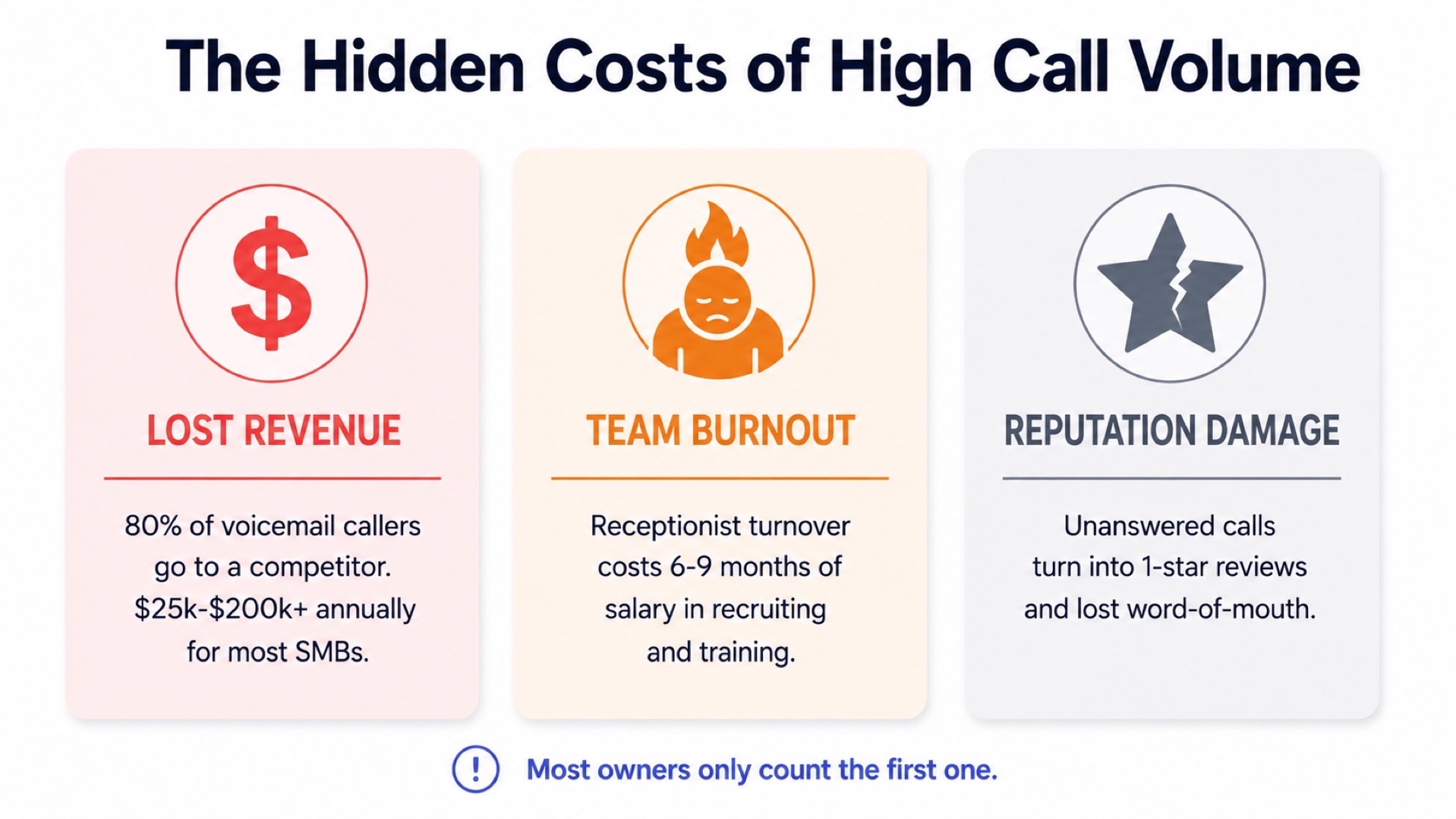
The cost is bigger than most small business owners realize. Three places it shows up:
- Lost revenue. Industry studies put voicemail-to-callback conversion at around 15-20%. The other 80% of missed callers go to a competitor. Use our missed call revenue calculator to see the dollar figure for your business.
- Team burnout. A front desk staffer or solo operator fielding 80 calls a day for weeks at a time will quit. Replacing them costs 6-9 months of salary in recruiting, training, and lost productivity.
- Reputation damage. Unanswered calls turn into 1-star reviews, declining word-of-mouth, and gradual market share loss to competitors who pick up the phone.
None of these show up on a P&L line item, which is why most small businesses underinvest in fixing them. The cost is real but invisible until it's not.
12 Ways to Handle High Call Volume
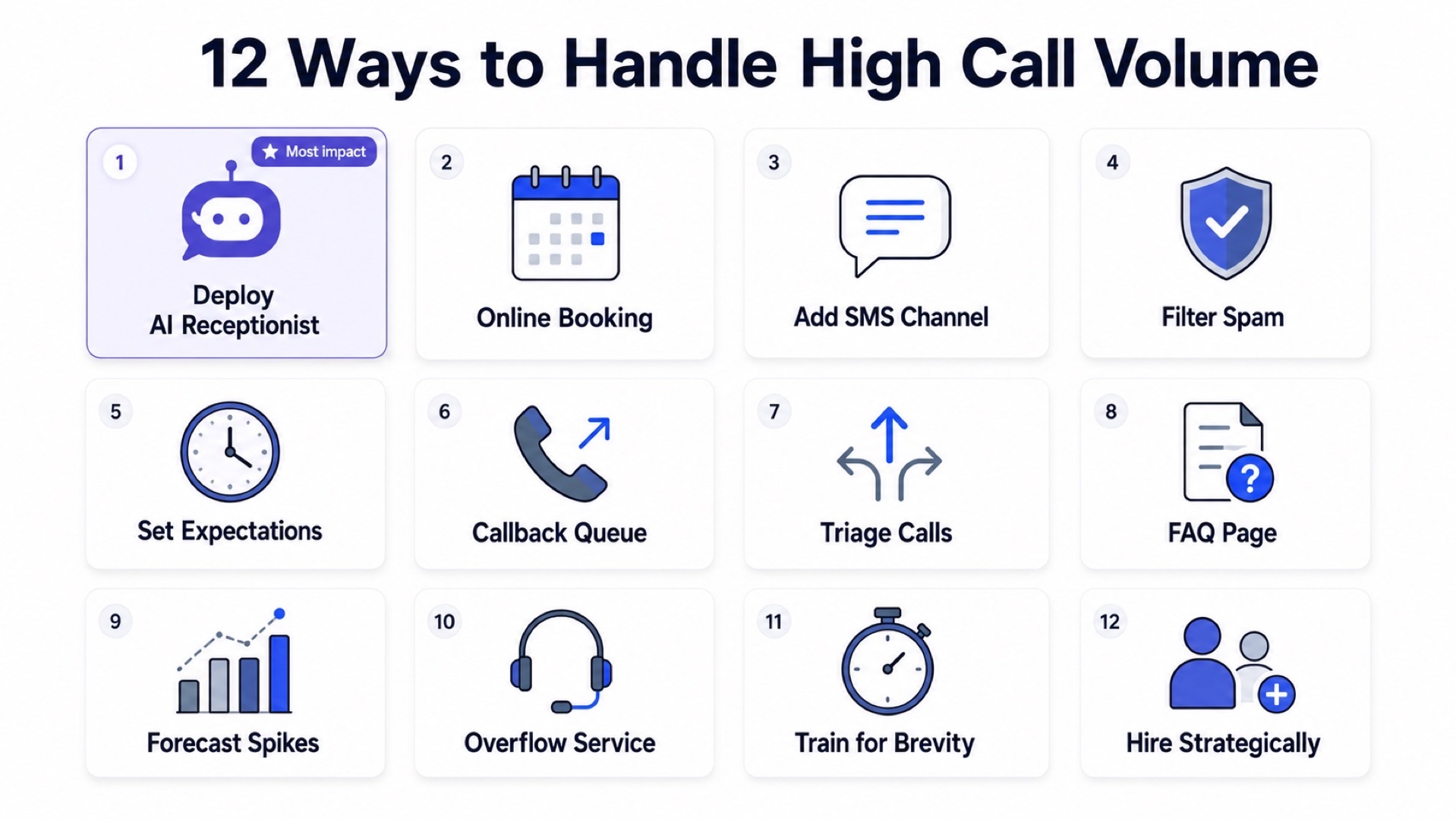
Here are 12 specific strategies, ordered roughly from fastest impact to longest payoff. Most businesses end up combining 3-5 of them.
1. Deploy an AI Receptionist
The single highest-impact move for most small businesses. An AI receptionist answers every call instantly, takes detailed messages, books appointments via SMS, routes urgent calls to your team, and filters spam. Unlimited concurrent calls, 24/7, no hold times.
Modern services like Zinng cost $49/month and are self-serve to set up. Compared to hiring even one additional receptionist (~$40k/year), the math is not close. See our 10 best auto call answering apps roundup for options.
2. Enable Online Appointment Booking
If 30% of your inbound calls are people trying to schedule an appointment, you can cut those calls dramatically by letting customers book online. Calendly, Acuity, Square Appointments, and others handle this for $0-$30/month. See our 10 best appointment scheduling apps guide for picks.
3. Add SMS as a Customer Channel
Many customers prefer texting over calling, especially for simple questions ("are you open?", "do you take walk-ins?"). Adding a business texting line through Google Business Profile, your phone provider, or a dedicated SMS tool offloads a meaningful share of inbound calls. Cost: typically $0-$20/month.
4. Filter Spam and Robocalls
If you're a small business with a published phone number, 20-40% of your inbound calls may be spam, robocalls, or wrong numbers. Most VoIP providers and AI answering services filter these automatically. Live answering services charge you for spam calls, which is one of the worst-hidden costs in the category.
5. Set Clear Caller Expectations
If callers know "the average wait is 90 seconds" or "we'll call you back within 2 hours," they're far less frustrated than if they're left guessing. Modern phone systems can announce wait times automatically. Voicemail greetings can promise specific callback windows. Setting an expectation and meeting it builds more trust than over-promising and missing.
6. Offer a Callback Queue Instead of Hold
"Press 1 to be called back instead of waiting" is a feature most modern phone systems support and most small businesses underuse. Customers do not have to sit on hold; they get a call back when an agent is available. Satisfaction goes up, abandonment rate drops, your team's pace stays sustainable.
7. Triage Urgent vs Routine Calls
Not every call deserves immediate attention. A pricing question can wait. An active emergency cannot. An AI receptionist or a smart IVR can ask 1-2 quick questions upfront and route the urgent calls directly to your team while logging routine inquiries for later follow-up. This single change makes your team's pace 2-3x more sustainable.
8. Build a Genuinely Useful FAQ Page
Look at the questions your team answers on the phone every single day. Hours, location, pricing ranges, services offered, what to bring to an appointment. Put detailed answers on a single FAQ page on your website. Then add a clear link to it from your voicemail greeting and your auto-attendant menu. Some businesses report 10-20% call volume reduction from this alone.
9. Forecast and Staff for Predictable Spikes
If your call volume triples in April every year because of tax season or storm season, schedule extra staffing for those periods in advance. Workforce management tools (Deputy, Homebase, When I Work) make this easy. The key is acting on the forecast, not just acknowledging it.
10. Use an Overflow Answering Service for Spikes
Live answering services like PATLive, AnswerConnect, or MAP Communications can handle calls that overflow your team. You pay only for the minutes they handle. For seasonal businesses, this is often cheaper than hiring full-time staff. See our best answering services review for picks.
11. Train Your Team on Call Brevity
The longer each call takes, the lower your team's call capacity. Train staff to greet, identify the need, resolve or route, and close, all in under 3 minutes for routine calls. Listen to a sample of calls each week and identify where time is being wasted. Small improvements compound: shaving 60 seconds off the average call increases your daily capacity by 20%.
12. Hire Strategically When Demand Is Sustained
If your call volume is permanently higher than your team can handle and the strategies above are not enough, hire. But hire strategically. A second receptionist costs $35-$50k/year fully loaded. An AI receptionist plus one additional human is often cheaper than two humans and handles peak load better. Run the math before assuming hiring is the answer.
Frequently Asked Questions
What is considered high call volume for a small business?
There is no universal number. The practical definition is whenever your inbound call volume exceeds your team's capacity to answer within a reasonable response time (under 60 seconds for most industries). For a solo operator that may be 20 calls per day; for a 5-person team it may be 100+. The real test is whether callers are routinely waiting on hold, hitting voicemail, or hanging up.
How many calls can one receptionist handle per day?
A well-trained receptionist handling routine inbound calls can manage 60-100 calls per 8-hour shift, assuming average call lengths of 2-4 minutes. Complex calls (intake forms, troubleshooting, sensitive conversations) significantly reduce that count. Industries with high emotional intensity (healthcare, legal) often cap at 30-50 calls per receptionist per shift.
Is high call volume a good problem to have?
It can be, but only if you handle it. High call volume usually signals demand, growth, or successful marketing. Mismanaged, it creates lost revenue, team burnout, and reputation damage. The businesses that handle it well capture the growth; the ones that don't lose customers to competitors who pick up the phone.
Can AI really replace a receptionist for high call volume?
For routine call handling, yes. AI receptionists answer instantly, handle unlimited concurrent calls, take detailed messages, book appointments, and route urgent calls. For emotionally complex calls, hybrid models (AI handles routine, escalates to humans when needed) work better than pure AI or pure human. Most small businesses benefit from this hybrid approach.
What's the cheapest way to handle high call volume?
For most small businesses, the cheapest effective fix is an AI answering service ($29-$99/month) combined with online appointment booking (often free). Together, those two tools typically cut inbound call volume by 40-60% while improving customer satisfaction. Hiring is the most expensive option and rarely the right first move.
Ready to get started?
Set up your AI phone agent in minutes. Try it free for 7 days.
Try Zinng Free for 7 Days
About the Author
Timothy Bramlett
Co-Founder & CEO, Zinng
Timothy Bramlett is an American entrepreneur, software engineer, and product strategist. He is the founder of Zinng, an AI-powered phone agent platform that helps businesses never miss a customer call with intelligent call handling, real-time transcripts, and instant summaries.