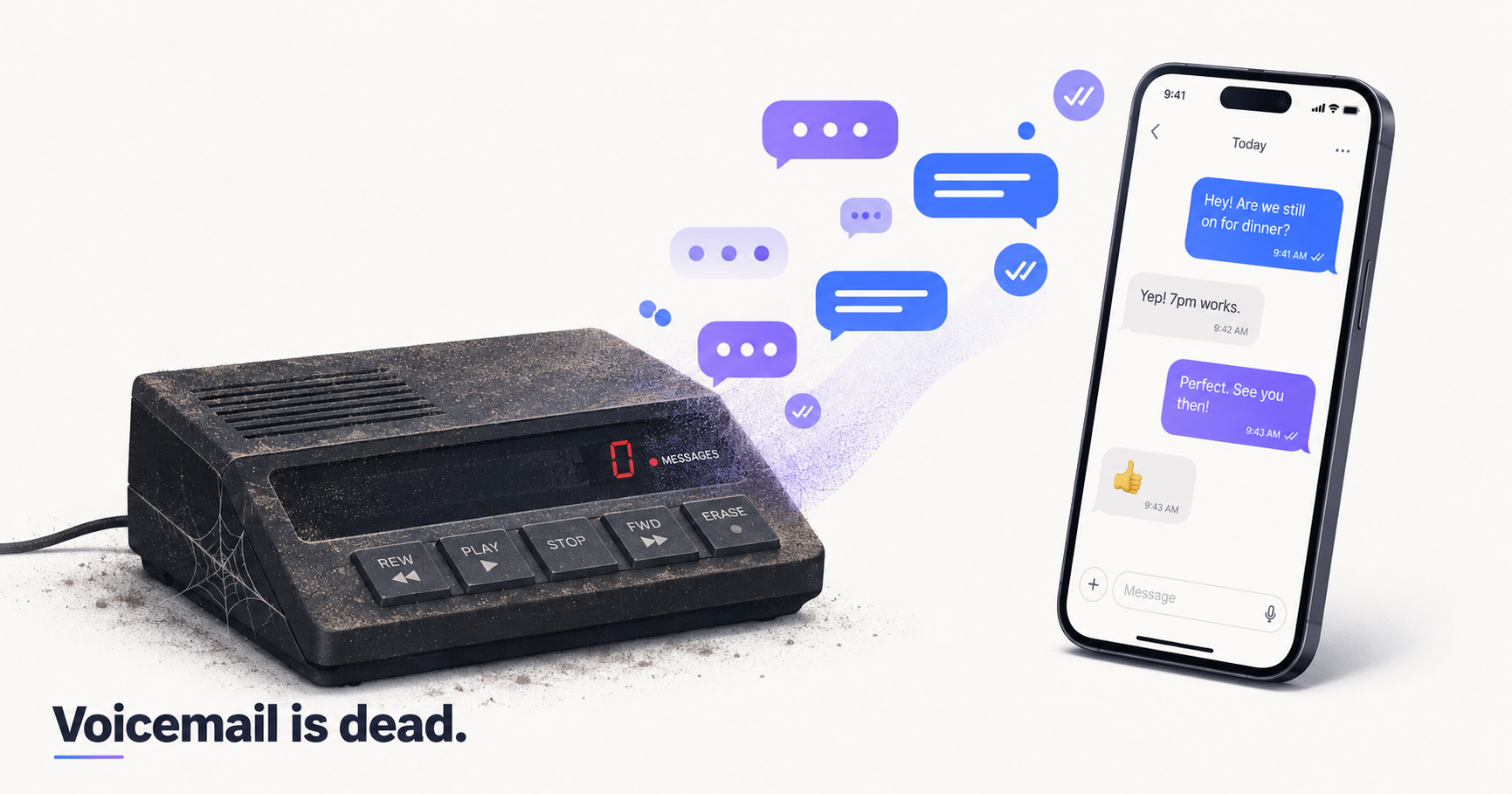
Think about the last voicemail you actually listened to. Not glanced at the transcript, actually listened to.
Struggling to remember? You are not the only one.
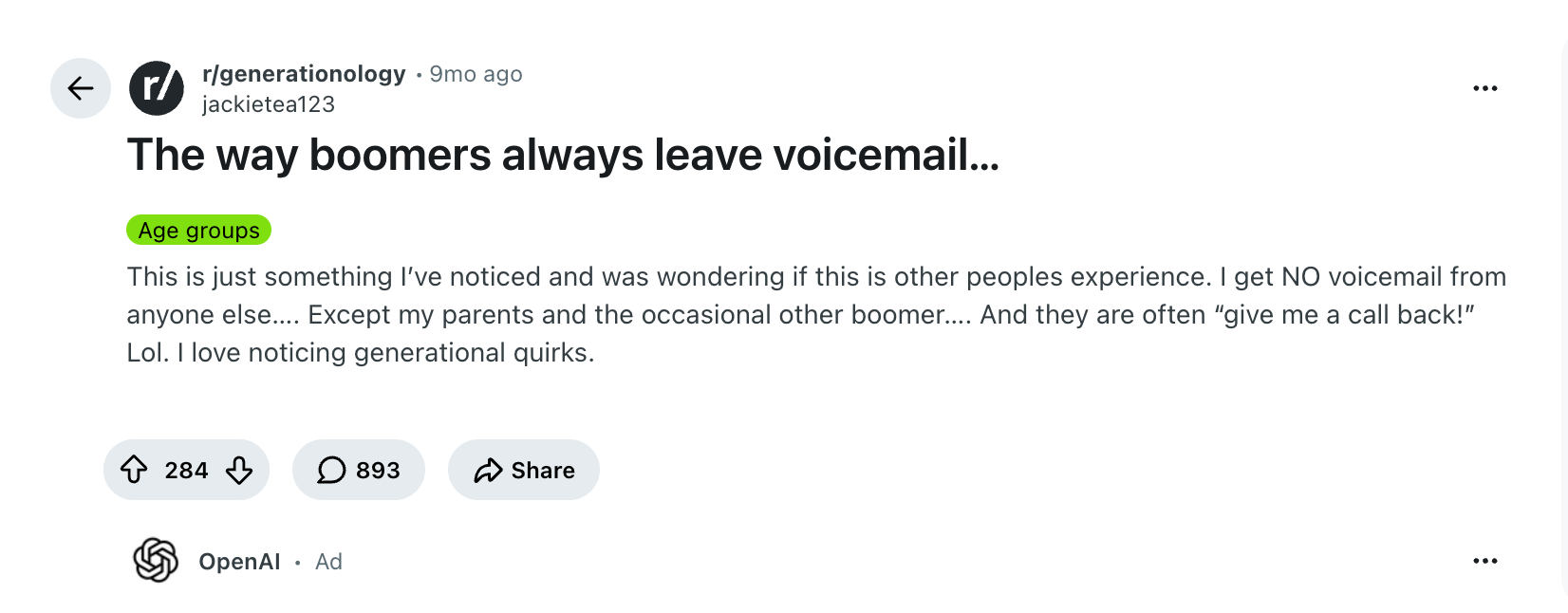
Somebody noticed the same thing and posted about it in r/generationology, under the title "The way boomers always leave voicemail…"
It picked up 284 upvotes and almost 900 comments. Most were some version of "yep, my parents are the only people who still do this."
So here is the honest answer, and then the part that matters for your business.
Does anyone still leave voicemails anymore?
Barely. Voicemail did not get banned or shut off, it just quietly stopped being the thing people do.
If a call is not picked up, most people hang up and send a text. Leaving a 20-second recording someone has to call in and listen to feels like mailing a letter to ask what time dinner is.
The one big exception is older callers, which is exactly why that Reddit thread hit a nerve.
One commenter, a self-described boomer, summed up the shift better than any survey could:
"Boomer here. We text our kids. Voicemail is too annoying. Texts are more likely to get my attention." via r/generationology
When the people who invented the habit are talking themselves out of it, the habit is done.
What percentage of callers actually leave a voicemail?
The short answer
Only about 15 to 20% of callers leave a voicemail. The other 80 to 85% just hang up.
Estimates. The leave-a-voicemail and call-back figures are industry data; see Sources.
Nobody runs a perfect national study on this, so treat any single number with a little suspicion. But the ones that exist all point the same direction: most people who hit a voicemail box just hang up.
Industry data from answering-service providers like PATLive puts the share of callers who leave a message when they reach voicemail somewhere around 15 to 20 percent. Flip that around and roughly four out of five callers hang up without saying a word.
It gets worse after the hang-up. The same industry data pegs the share who never call back at about 85 percent.
They do not wait around. They call the next business on the list.
A lot of those calls were never answered live in the first place. A 2024 study by 411 Locals, monitoring 85 small businesses across 58 industries, found only about 38 percent of calls reached a person.
The rest went to voicemail or got nothing. The math stacks up fast, and none of it is in your favor.
Why don't people leave voicemails anymore?
A few things happened at once.
A missed call just gets a text back. Faster for everyone, and you reply on your own time.
Most voicemails are robocalls now. Nobody checks the box, so nobody fills it.
Many younger callers avoid calls entirely. A voicemail is out of the question.
That last one is not a stereotype, it shows up in the numbers. A Uswitch survey reported by the BBC in August 2024 found about a quarter of 18-to-34-year-olds never answer calls, and 68 percent only pick up when they are expecting it.
A separate 2023 survey of Gen Z workers found roughly 60 percent dread making phone calls. If someone will not even answer, they are certainly not leaving you a voicemail.
One line from the r/Millennials thread sums up the whole shift:
"Voicemails are podcasts your mom makes." via r/Millennials
Is it rude or unprofessional not to leave a voicemail?
Socially, no. The etiquette flipped.
For most people under 50, a quick text back is the polite move, and a long voicemail is the mild annoyance. Some even find an immediate second call-back more irritating than a missed one.
For your business, though, the question is backwards. The problem is not whether your customer is being rude by skipping the voicemail.
The problem is that when they skip it, you have no idea they called. That is the part worth caring about.
Here's the part that costs your business money
Picture a plumber on a roof, or a salon owner mid-appointment. A call rings out and goes to voicemail.
The caller, pipe leaking and card in hand, hangs up without a word. Then dials the next plumber in the search results.
What happens to 100 missed calls
Illustrative, using the estimates above. Your numbers vary, the shape does not.
You never see any of it. No message, no name, nothing to call back.
That is what makes it dangerous. A voicemail box nobody uses does not look broken, it just quietly loses you customers.
What to do instead of relying on voicemail
The fix is not "check your voicemail more." Nobody leaves one to check.
The fix is to turn a missed call into a conversation. For a small business, that means an AI phone agent that does four things when you cannot pick up:
Picks up on the first ring, so the caller gets a voice, not a beep.
Gets their name and what they need, and answers the basics.
Sends a booking or payment link while they are still on their phone.
Name, number, and a summary, so a missed call becomes something to follow up on.
This is where everything is already headed. Gartner predicts that by 2028, 70% of customer service interactions will start and end inside an AI assistant, not a phone tree.
Voicemail asked your customer to remember you. An AI agent catches them in the two minutes before they call your competitor.
Voicemail is not coming back, and you do not need it to. You just need something on the other end of the line when you cannot be.
Sources
A quick note on honesty, so you know how solid each number is. The generational and trend stats below are from named, verifiable sources.
The hang-up and won't-call-back percentages are widely-cited industry figures from answering-service companies, not peer-reviewed research. We label them as industry data rather than dress them up as science.
- Gartner (Feb 2025 press release): by 2028, 70% of customer service interactions will begin and end in a conversational AI assistant. gartner.com
- Uswitch survey, reported by BBC News (Aug 2024): ~25% of 18-to-34-year-olds never answer calls, and 68% only answer expected calls. bbc.com
- 411 Locals study (2024): across 85 small businesses in 58 industries, only ~38% of calls were answered live.
- PATLive / answering-service industry data: roughly 15 to 20% of callers leave a voicemail; about 85% of missed callers do not call back.
- 2023 Gen Z workforce survey: roughly 60% of young workers dread making phone calls.
- Reddit: r/generationology and r/Millennials.
Frequently asked questions
What percentage of callers leave a voicemail?
Industry data from answering-service providers puts it at roughly 15 to 20 percent. In other words, about four out of five callers who reach a voicemail box hang up without leaving a message.
Do people still leave voicemails in 2026?
Rarely, and mostly older callers. For most people under 50, a missed call gets a text back, not a recorded message.
Is it unprofessional not to have a voicemail?
For a business, the bigger risk is relying on voicemail as your safety net. Most callers will not leave a message and most of those will not call back, so it quietly loses you leads.
Does Gen Z leave voicemails?
Mostly no. Surveys show a quarter of 18-to-34-year-olds never answer calls at all, and if they will not answer, they are not leaving a voicemail either.
What should a business use instead of voicemail?
An AI phone agent that answers missed calls live, talks to the caller, texts them a booking or callback link, and sends you their details as a lead. That turns a call you would have missed into a conversation, instead of a message nobody leaves.
Ready to get started?
Set up your AI phone agent in minutes. Try it free for 7 days.
Try Zinng Free for 7 Days
About the Author
Timothy Bramlett
Co-Founder & CEO, Zinng
Timothy Bramlett is an American entrepreneur, software engineer, and product strategist. He is the founder of Zinng, an AI-powered phone agent platform that helps businesses never miss a customer call with intelligent call handling, real-time transcripts, and instant summaries.