This is a start-to-finish walkthrough of buying a domain for your business on Namecheap, from the search box to the DNS settings. Our founder Tim Bramlett recorded it while buying a real domain, so every screenshot below is from that purchase.
Still deciding between registrars? Our guide on how to get a domain name for your business compares Namecheap, GoDaddy and Cloudflare, with real prices. Prefer GoDaddy? See how to buy a domain on GoDaddy.
Watch the video
The video runs about 12 minutes. The first six cover what to know before you buy; the purchase starts at 6:08. Everything in it is written out below.
The short answer
- Go to namecheap.com and type your business name in the search box.
- Pick the .com if it's available, and check the renewal price, not just the first-year price.
- Click Add to cart and ignore the "Frequently bought together" offers.
- In the cart, choose how many years, keep Domain Privacy and auto-renew on, and leave PremiumDNS and hosting off.
- Click Confirm Order, sign in or create your account (turn on two-factor authentication), and click Pay Now.
Before you buy: what to know
A domain is just your business's name on the internet. Without one, people would have to type your web server's IP address, a string of numbers. A domain lets them type amazingbusiness.com instead.
A domain is not a website, and it's not email. Buying one doesn't give you either. You set those up separately, and you point the domain at them.
- Get the .com. Most customers aren't technical, and they'll type .com no matter what ending you pick. Avoid hyphens and numbers too.
- If the .com is taken, try variations. Add your city (joesplumbingirvine.com), add your service (joesplumbing.com), or change the order (plumbingbyjoe.com). An AI chatbot is handy for brainstorming more.
- One year is fine to start. Buying several years can lock in a better price and means fewer renewals to worry about. Just keep a card on file that will still work, and watch for emails from Namecheap.
- You never own a domain outright. You rent it year by year. Even Google once forgot to renew google.com, and someone else briefly owned it.
- Keep domain privacy on. Without it, your name, address, phone number and email can be public.
- Keep auto-renew on and save a reliable card. Losing your domain is a horrible situation: your website and email go down with it.
- Skip the upsells. Registrars are good at selling extras. Most businesses only need the domain.
- Watch for promo pricing. The first year is often discounted, so know what you'll pay at renewal.
- Register it yourself. Don't let an agency or web designer buy it for you. Use your own Namecheap account, tied to an email you'll always have, and turn on two-factor authentication.
Step 1: Search for your domain
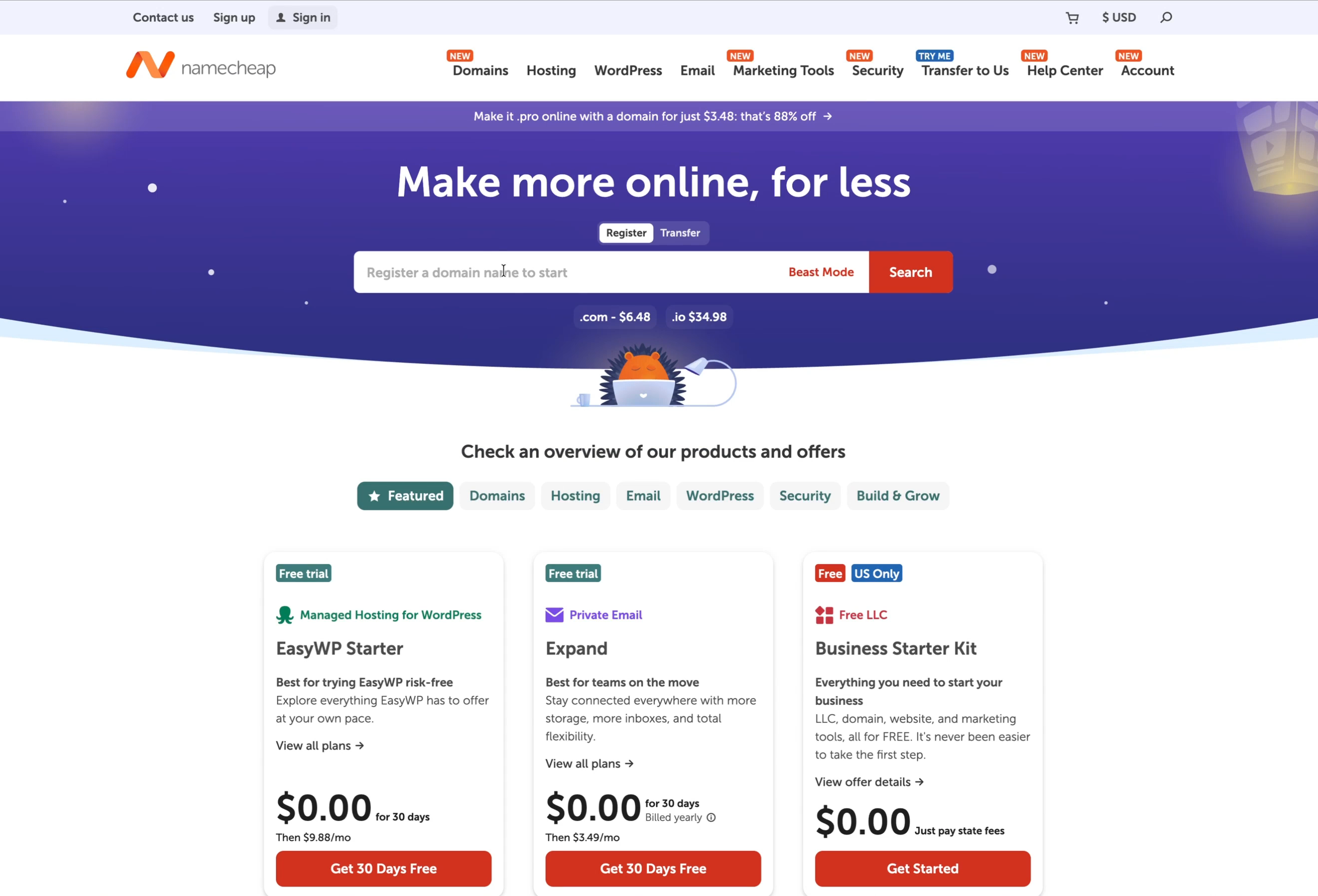
Go to namecheap.com. Type the name you want into the Register a domain name to start box and click Search.
Step 2: Pick your domain and check the renewal price
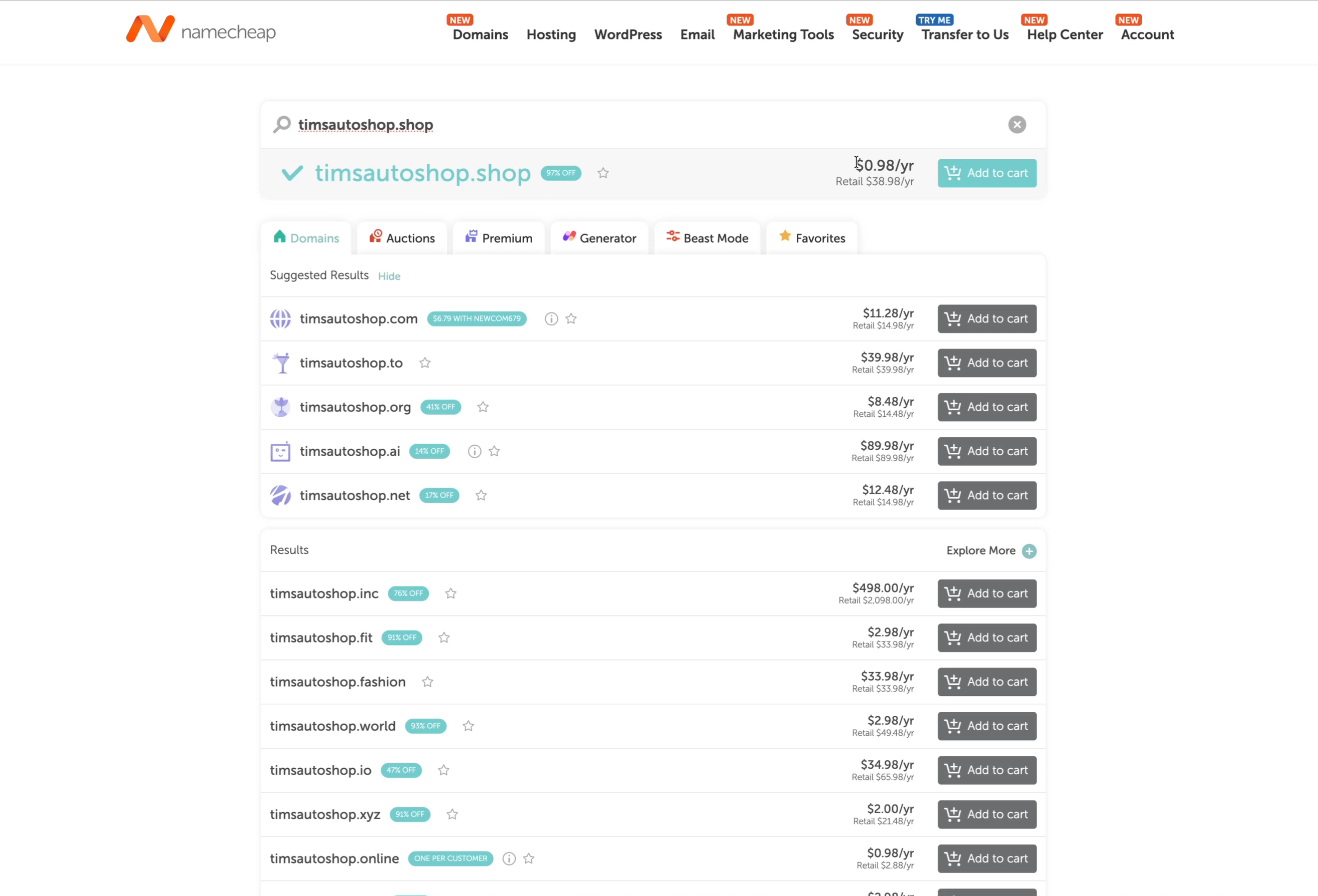
Namecheap shows your exact name first, then suggested endings. Each line shows two prices: the price you pay now and, in small print, the retail price.
For the video, Tim bought timsautoshop.shop rather than the .com, purely as a demo. Notice the trap: $0.98 for the first year, then a retail price of $38.98 a year. That's why you should buy the .com, which showed $11.28 for the first year.
Step 3: Add to cart and skip the upsells
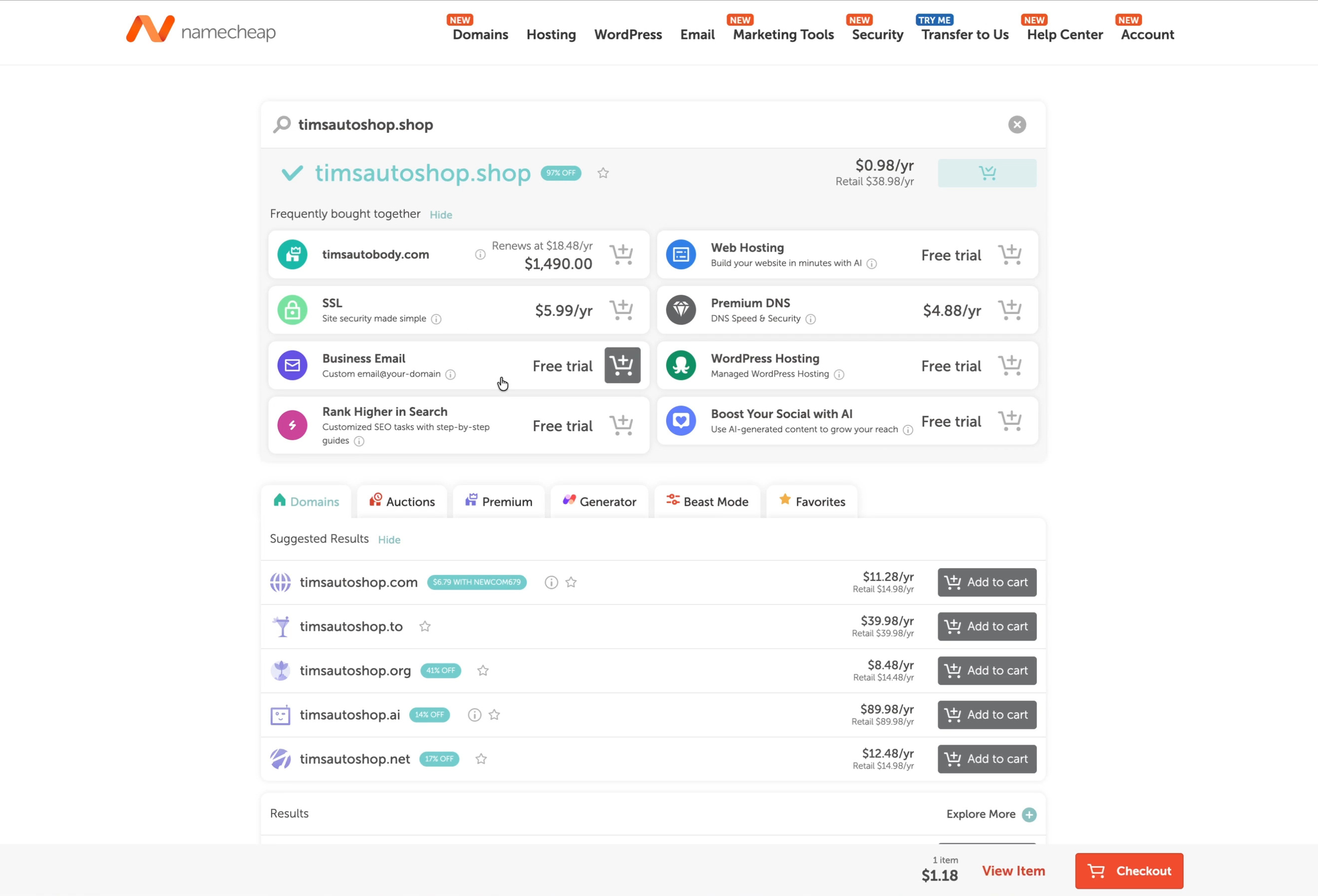
Click Add to cart. A "Frequently bought together" panel opens with SSL, Premium DNS, business email, hosting and more, and even a similar .com priced at $1,490.
You don't need any of them to own your domain. Click Checkout.
Step 4: Choose how many years
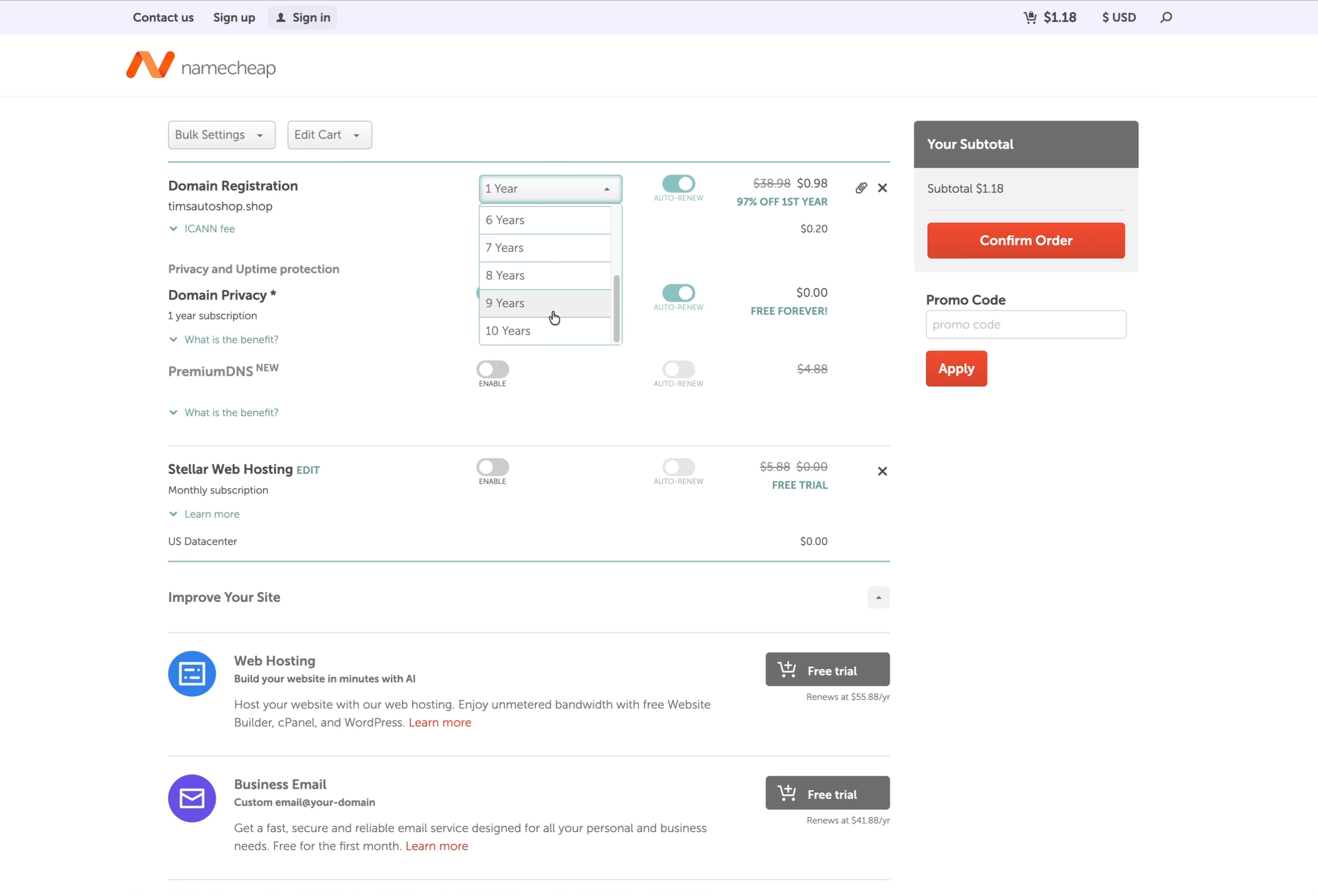
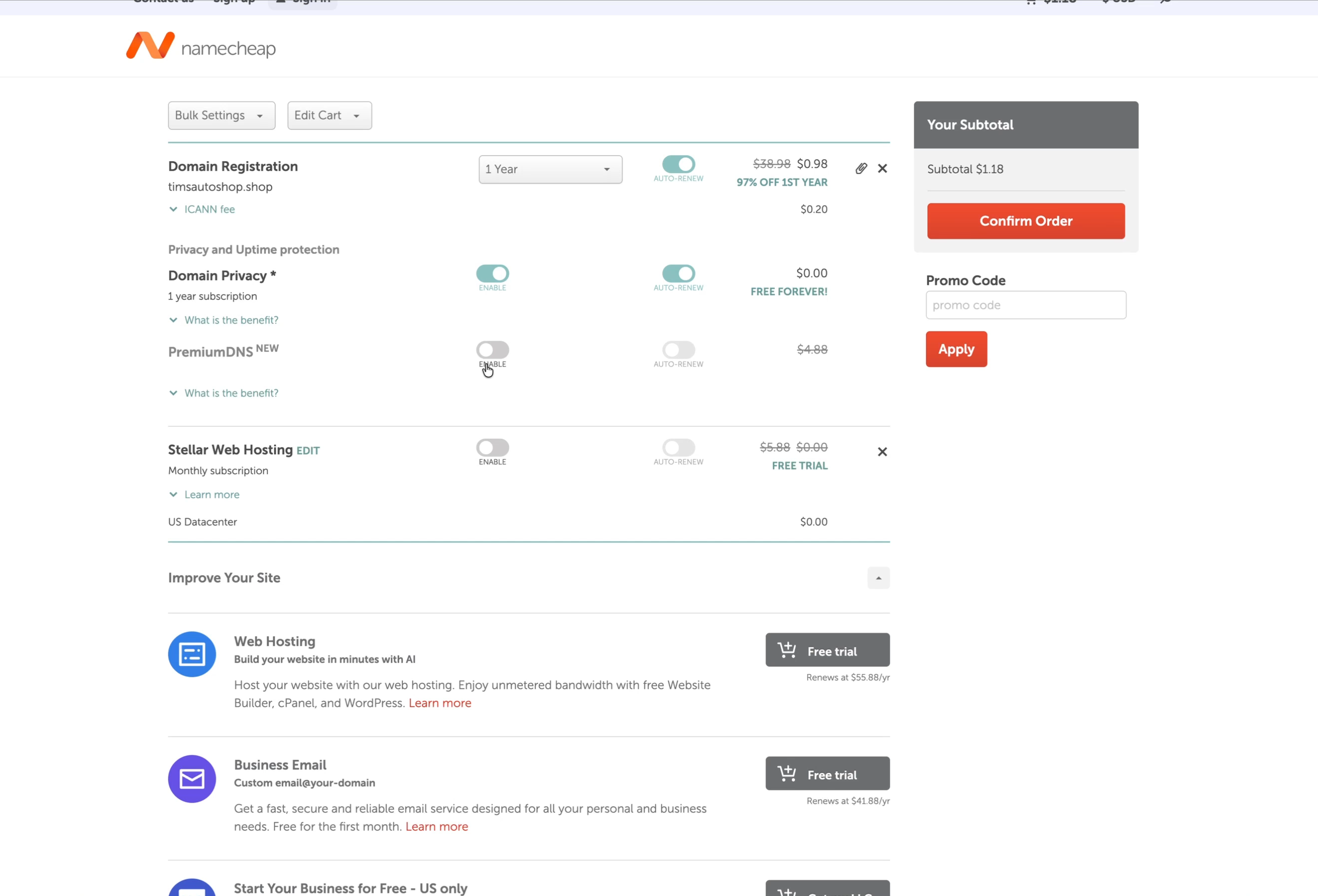
In the cart, the dropdown next to Domain Registration goes from 1 to 10 years. One year is fine; more years mean fewer renewals to remember.
Step 5: Keep privacy and auto-renew on, leave the rest off
Check each line in the cart before you confirm:
- Domain Registration auto-renew: on. It was on in our cart; make sure yours is too.
- Domain Privacy: on. It's free ("FREE FOREVER!") and on by default. It hides your contact details from public domain records.
- PremiumDNS: off. Most businesses don't need it. If you want faster DNS, move your DNS to Cloudflare for free (see below).
- Stellar Web Hosting: off. You don't need hosting to own a domain.
- "Improve Your Site" offers: skip them. Tim's take on Namecheap's business email: it works, but it isn't the one he'd choose.
Our cart total was $1.18: $0.98 for the domain plus the $0.20 ICANN fee. Click Confirm Order.
Step 6: Sign in and pay
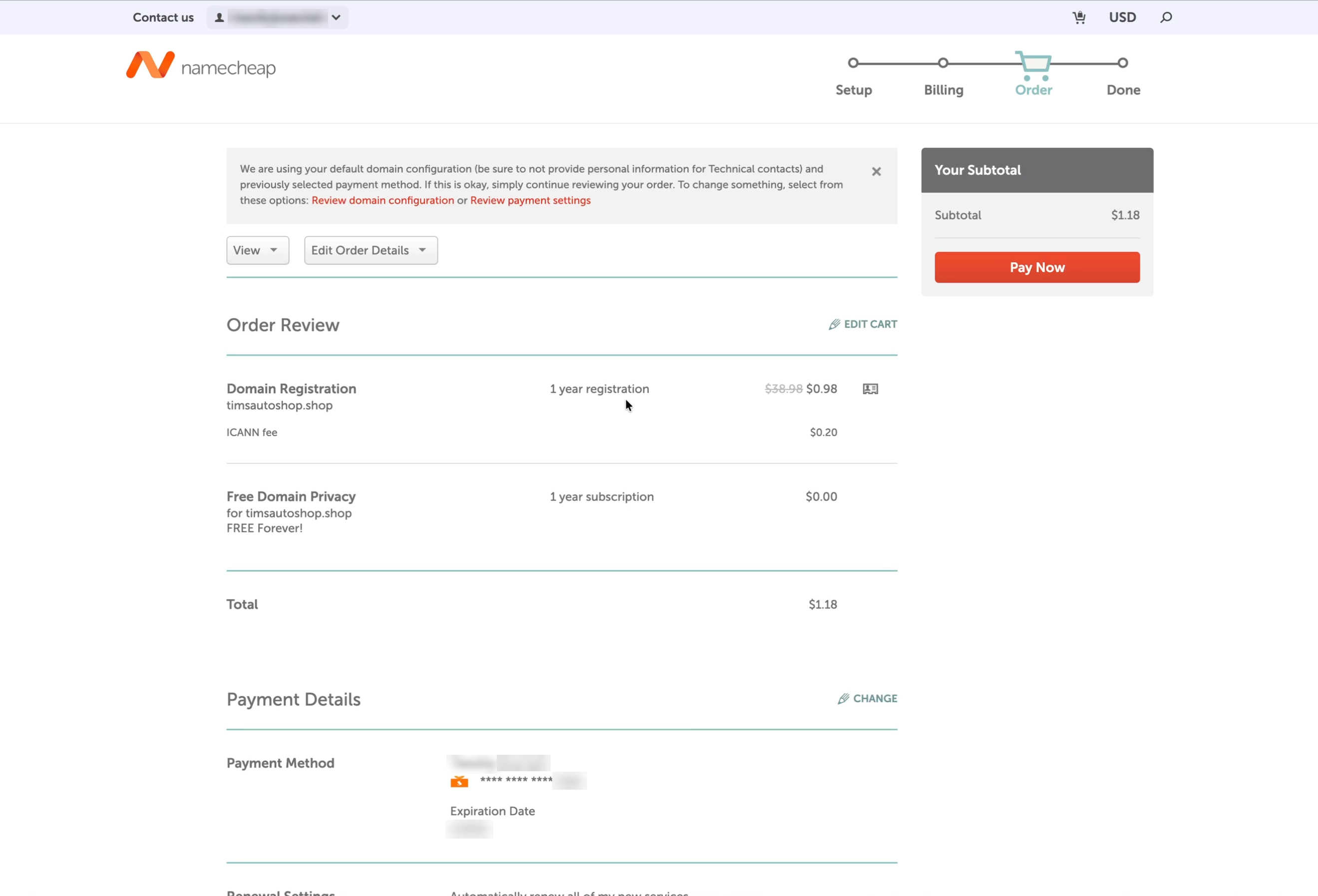
Sign in, or create a Namecheap account if you don't have one. Turn on two-factor authentication; it makes it much harder for anyone to break into your account and take your domain. Any registrar that doesn't support it is one to avoid.
Add your billing details and card, check the order review, and click Pay Now. The domain is yours as soon as the order completes.
Next: point your domain at your website
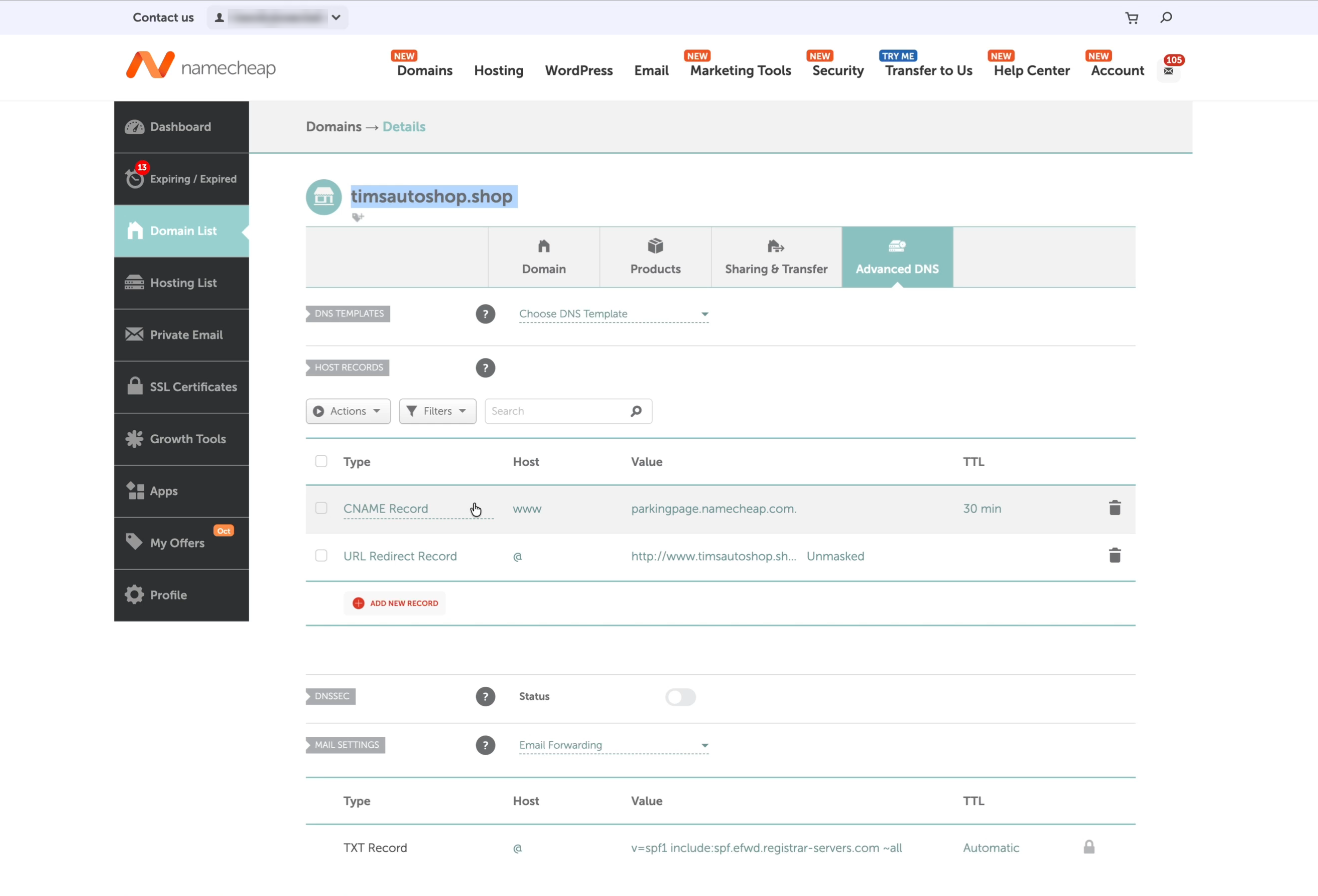
Owning the domain is step one. To make it do something, go to Domain List, click Manage next to your domain, and open the Advanced DNS tab. That's where your domain's records live.
A new domain has only Namecheap's placeholder records, which send visitors to a parking page. Your website builder will give you the records to enter here so your domain points at their servers.
Optional: move your DNS to Cloudflare
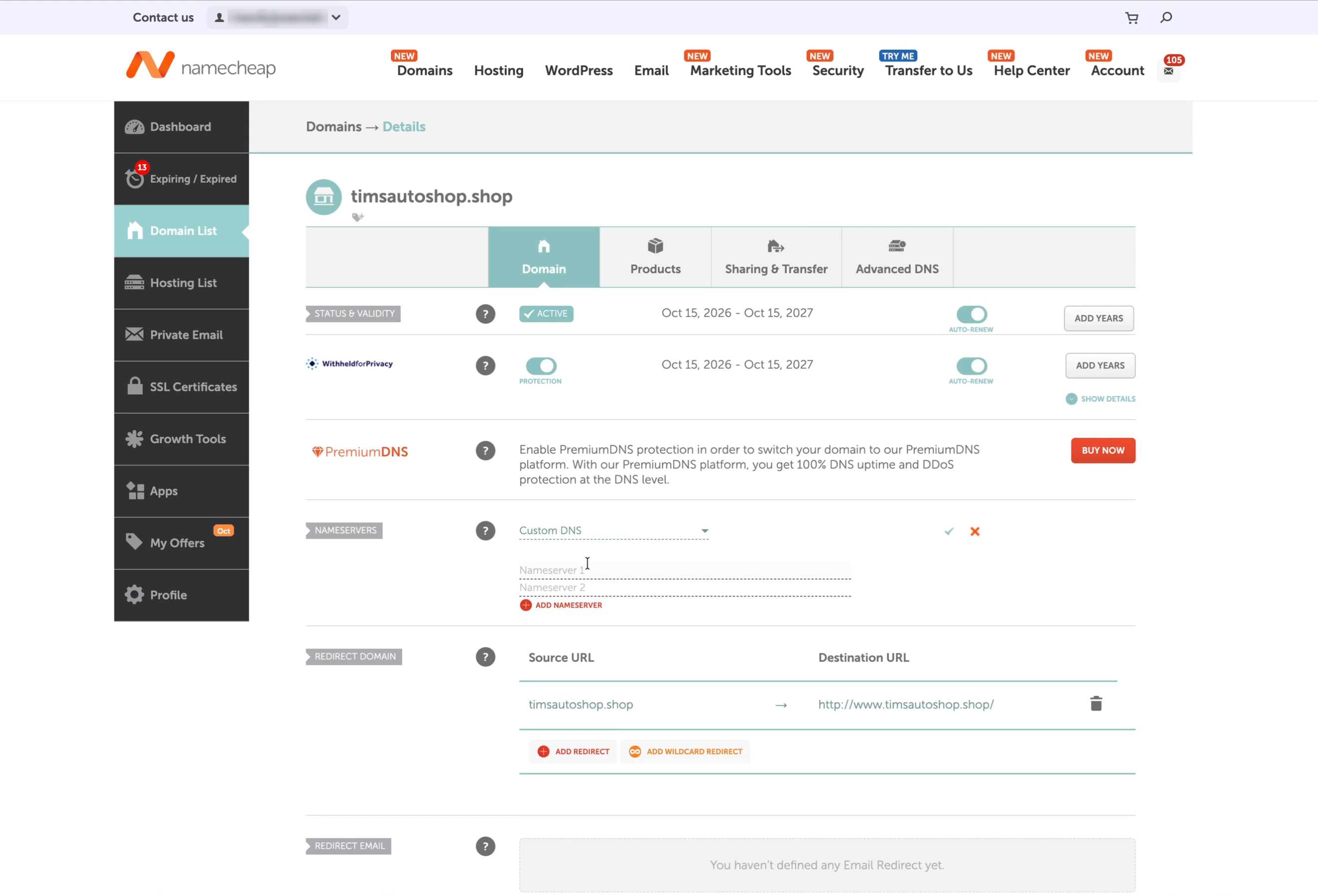
This is more advanced, and you can skip it. You can keep the domain registered at Namecheap but let Cloudflare manage its DNS. On the Domain tab, change Nameservers to Custom DNS and enter the two nameservers Cloudflare gives you. Then you set up your records in Cloudflare instead.
Why bother? You can manage all your domains in one place, wherever you bought them. And Cloudflare speeds up and protects your website on its free plan, which Tim calls the best free plan on the internet.
Once your domain is set up, check that email sent from it reaches inboxes with our free SPF, DKIM and DMARC checker. Need a business phone number to go with it? See how to get a business phone number.
Frequently asked questions
How do I buy a domain on Namecheap?
Search for your name on namecheap.com, click Add to cart on the one you want, choose how many years, keep Domain Privacy and auto-renew on, skip the add-ons, then click Confirm Order, sign in and click Pay Now.
How much does a .com cost on Namecheap?
When we checked in October 2026, a .com was $11.28 for the first year and $18.48 a year to renew, plus a $0.20 ICANN fee. Namecheap often shows new-customer codes that lower the first year.
Is domain privacy free on Namecheap?
Yes. Namecheap includes domain privacy free for as long as you keep the domain, and it's on by default in the cart.
Do I need PremiumDNS, SSL or hosting from Namecheap?
Not to own your domain. Most businesses can skip them at checkout. Your website builder usually handles hosting and SSL, and you can move your DNS to Cloudflare for free.
Does buying a domain give me a website or email?
No. A domain is only the name. You set up a website and business email separately, then point the domain at them.
Ready to get started?
Set up your AI phone agent in minutes. Try it free for 7 days.
Try Zinng Free for 7 Days
About the Author
Timothy Bramlett
Co-Founder & CEO, Zinng
Timothy Bramlett is an American entrepreneur, software engineer, and product strategist. He is the founder of Zinng, an AI-powered phone agent platform that helps businesses never miss a customer call with intelligent call handling, real-time transcripts, and instant summaries.