The way people reach a business is changing fast, and here is the uncomfortable truth. People do not really want to talk to a human first.
We say we do. But we only mean the people we choose, our friends and our family.
For everything else, we would rather not. We already proved it once, when texting and email quietly killed the phone call.
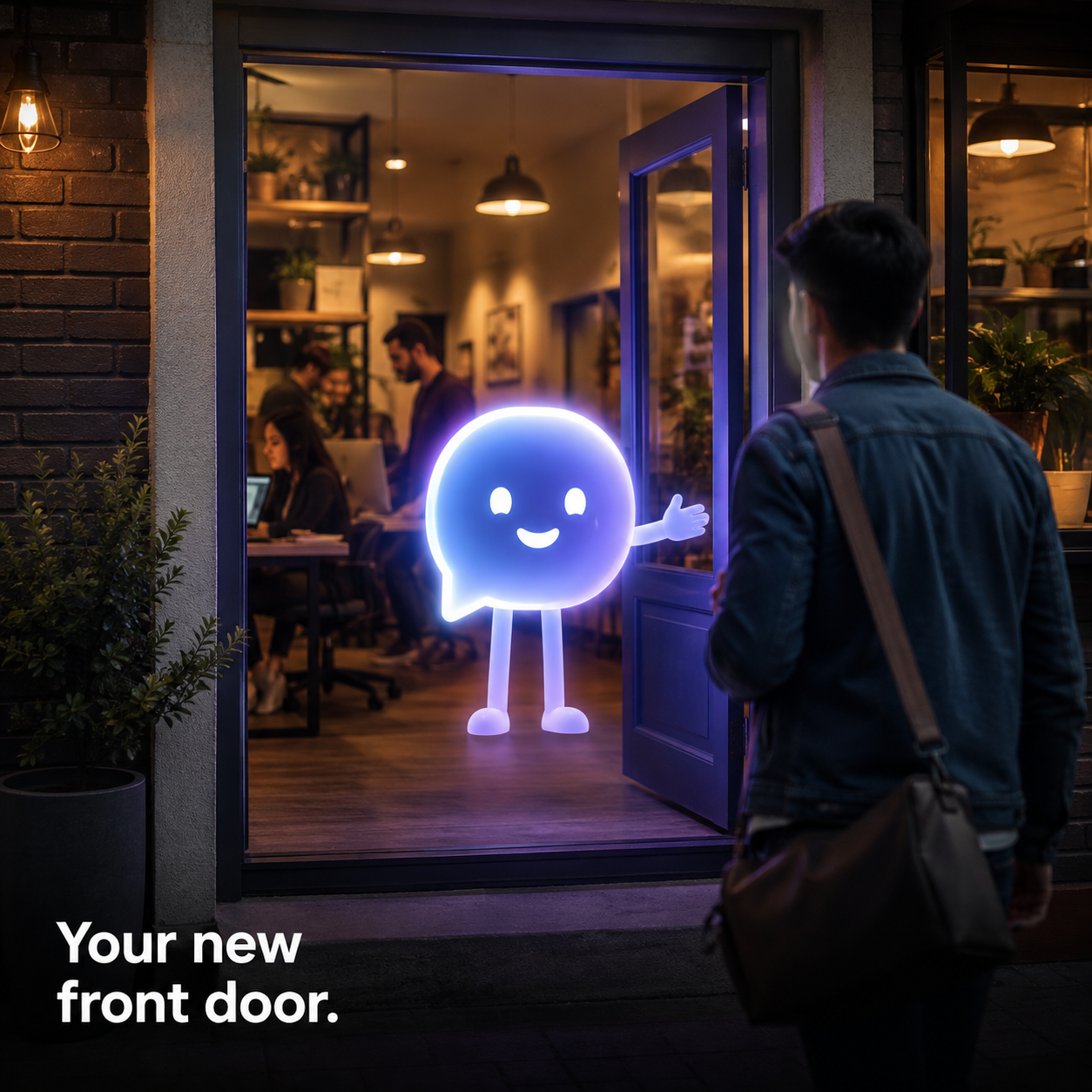
Your business has a new front door
The first thing a customer touches is not you anymore. It is whatever you put at the front of the line.
More and more, that first thing is conversational AI: software that talks or texts back like a person, handles the simple stuff on the spot, and pulls in a human when it matters. It is quietly becoming the front door to businesses everywhere.
The rest of this is why that shift is happening, and where the humans still win.
Texting and email already killed the call
This is not a new fight. People voted with their thumbs a decade ago.
A Twilio report found 69 percent of people prefer to be contacted by text over a call from an unfamiliar business. A survey from Avochato put the share who want the option to text a business at 78 percent.
Read those numbers back. Given the choice, most people pick the quiet lane over the phone every time.
Gen Z is speeding it up
For younger customers, a phone call is the thing they avoid most. And they are flooding into the workforce right now, bringing these habits with them.
The first two come from a Uswitch survey reported by the BBC in August 2024. The 90 percent is from texting-platform data, so treat it as directional, but it points the same way as everything else.
If a quarter of your future customers will not even pick up, a voicemail greeting is not a safety net. It is a closed door.
This isn't a guess
You do not have to take the vibe on faith. The analysts are already calling it.
of customer service journeys will begin and be handled inside conversational AI by 2028.
Gartner, Feb 2025. See Sources.
Not a phone tree. Not a voicemail box. An actual AI that talks back.
One honest caveat: Gartner is talking about conversational AI assistants broadly, the mobile and chat kind, not specifically your business phone line. But the direction is unmistakable, and it is pointed at the front line.
What conversational AI for customer service actually is
Strip away the buzzword and it is simple. Conversational AI for customer service is software that holds a real back-and-forth with your customer, by voice or text, and gets something done.
It is not a menu that says "press 1 for hours." It understands what the person actually asked and responds in plain language.
On a good setup, the AI does four things when a customer reaches out:
- Answers instantly, on the first ring or the first text, day or night.
- Handles the routine, like booking, quick questions, and getting a new lead started.
- Knows its limits and hands off to a human the moment things get complex.
- Leaves a record, so no request disappears the way a missed call does.
Think of it as the front line, not the whole army. It catches everything and sorts it, so nothing hits the floor.
This isn't about replacing humans
Here is where most takes get it wrong. People do not hate humans, they just want the fast lane first.
The data backs the split cleanly. A Five9 survey found 74 percent of people prefer an AI or chatbot for simple, routine questions.
But the same people still want a person for the hard stuff. A SurveyMonkey report in early 2026 found 79 percent still prefer human customer service overall, and 84 percent think humans give more accurate answers.
Who handles what
So the winning setup is not AI instead of people. It is AI on the front line, and your team on what actually matters.
The bottom line
An AI frontline is a tool, not a replacement. It kills your voicemail and your missed calls, and there are still real humans behind it.
Everyone is quietly adopting this right now. Wait too long, and you become the business that feels harder to deal with than the one down the street.
If you want to see the phone side of this in action, that is exactly what a Zinng AI phone agent does: answers live, texts a link, books the appointment, and hands you the lead. It is the front door, staffed 24/7.
So, one honest question before you go. Would you rather text a business or call it?
Sources
A quick note on honesty, so you know how solid each number is. Gartner and the Uswitch/BBC figures are the strongest.
The text-preference and AI-versus-human stats come from named vendor and platform surveys, not peer-reviewed research. We cite them by name rather than dress them up as neutral fact.
- Gartner (Feb 2025 press release): by 2028, 70% of customer service journeys will begin and be resolved in conversational AI assistants. gartner.com
- Uswitch survey, reported by BBC News (Aug 2024): ~25% of 18-to-34-year-olds never answer calls, and 68% only answer expected calls. bbc.com
- Twilio, State of Customer Engagement: 69% prefer to be contacted by text over a call from an unfamiliar business.
- Avochato: 78% want the option to text a business; ~90% of Gen Z prefer texting over calling (platform data, directional).
- Five9 survey (Nov 2024): 74% prefer an AI or chatbot for simple, routine questions.
- SurveyMonkey (Feb 2026): 79% still prefer human customer service overall; 84% think humans give more accurate support.
Frequently asked questions
What is conversational AI for customer service?
It is software that holds a real back-and-forth with your customer by voice or text and gets something done, like booking an appointment or answering a question. Unlike a phone menu, it understands plain language and hands off to a human when things get complex.
Does conversational AI replace human staff?
No. It handles the fast lane (simple, routine requests) so your team is free for the complex, high-trust work.
Do customers actually want to deal with AI?
For simple tasks, yes. A Five9 survey found 74% prefer an AI for routine questions, while a SurveyMonkey report found most still prefer a human for anything complex.
Why not just use voicemail?
Because most callers never leave one, and most who reach voicemail never call back. An AI front line answers live and captures the lead instead of losing it.
Ready to get started?
Set up your AI phone agent in minutes. Try it free for 7 days.
Try Zinng Free for 7 Days
About the Author
Timothy Bramlett
Co-Founder & CEO, Zinng
Timothy Bramlett is an American entrepreneur, software engineer, and product strategist. He is the founder of Zinng, an AI-powered phone agent platform that helps businesses never miss a customer call with intelligent call handling, real-time transcripts, and instant summaries.