"For sales, press 1. For support, press 2." In a survey of 501 Americans by Clutch, 70% said they've pressed zero just to get out of a menu like that.
That menu is an auto attendant, and its bigger cousin is called IVR. Here's what each one does, what it costs, and which one a small business actually needs.
The quick answer
An auto attendant is a recorded menu that sends callers to the right person when they press a key. An IVR (interactive voice response) system routes calls too, but it can also understand spoken answers and do things on its own, like read an account balance.
Auto attendant
Routes the call
"Press 1 for sales." Keypad only. Usually included free with a business phone plan.
IVR
Routes and does tasks
"Say or enter your account number." Looks up data, takes payments. Built and paid per minute.
AI receptionist
Has the conversation
"How can I help?" The caller just talks. It answers, books, or transfers. No menu.
Most small businesses with a few people need an auto attendant at most. A full IVR is built for banks, airlines and call centers.
What is an auto attendant?
An auto attendant answers your business line with a recorded greeting and a short menu. The caller presses a number and gets sent to a person, a department, or a voicemail box.
Microsoft's Teams documentation puts it simply: its job is "to direct a caller to an appropriate person or department based on the caller's input to the provided menu options." Nextiva, which sells phone systems, draws the line with IVR in one sentence:
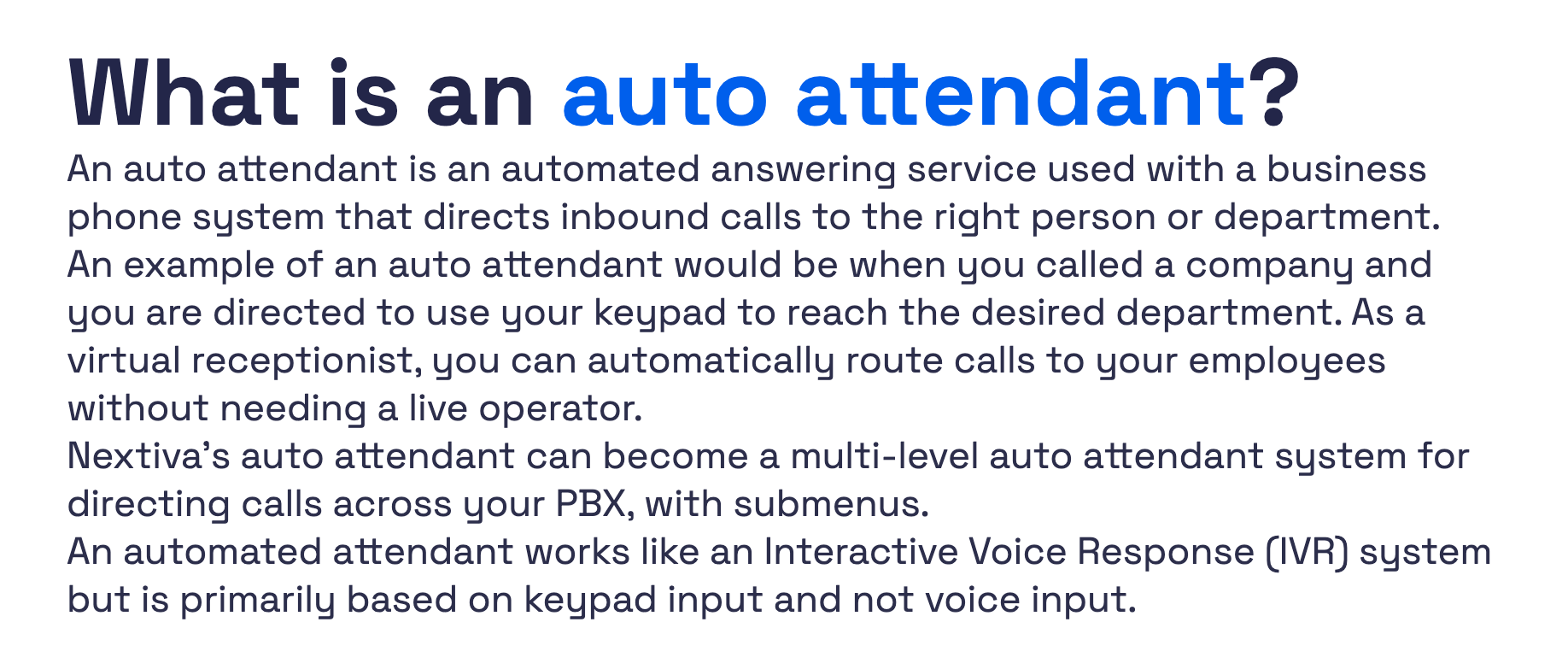
You'll also hear it called an automated attendant, a virtual receptionist menu, or a phone tree. A "multi-level" auto attendant just means the menu has submenus, like "press 2 for service, then 1 for heating."
What is IVR?
IVR stands for interactive voice response. Webex by Cisco defines it as a system that "interacts with callers, gathers information, and routes calls to the appropriate recipient or department without human intervention."
The difference is the "gathers information" part. Nextiva's own comparison gives a clean example:
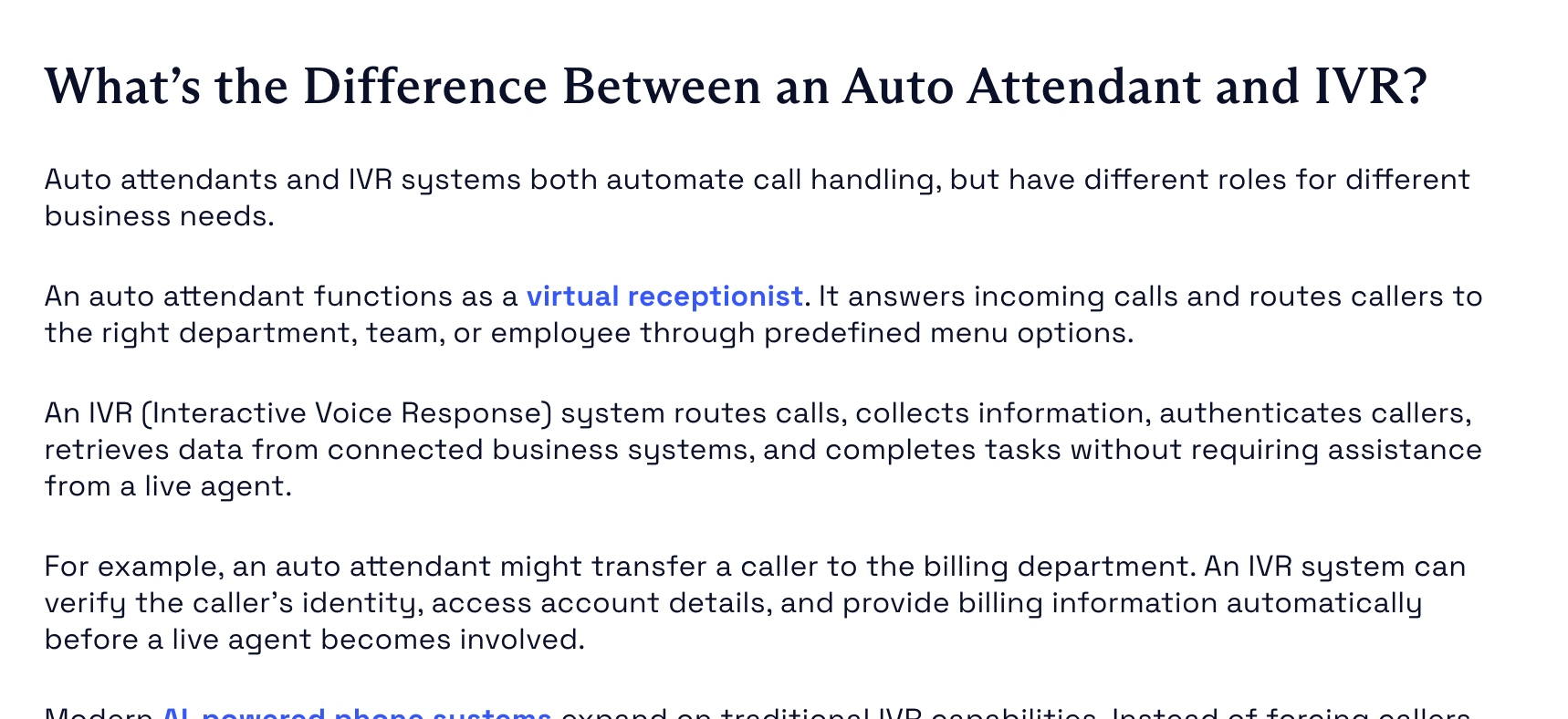
Fair warning: vendors blur the two terms. RingCentral sells a "Multi-Level IVR (also known as Auto-Attendant)," so check what a feature actually does before you pay for it.
Auto attendant vs IVR: what's the difference?
An auto attendant only routes calls, and the caller does all the work with the keypad. An IVR routes calls and also handles tasks, often by voice, and usually needs to connect to your other software.
| Auto attendant | IVR | AI receptionist | |
|---|---|---|---|
| What the caller does | Presses keys | Presses keys or says short answers | Talks normally |
| Main job | Send the call to the right place | Route calls and complete tasks | Answer, help, then transfer if needed |
| Answers questions? | No | Only scripted ones | Yes, from your business info |
| Takes info or bookings? | No (voicemail only) | Yes, if connected to your systems | Yes |
| Setup | Minutes in your phone admin | A project, often with a developer | Usually done for you |
| Typical cost | Included with $15 to $30 per user plans | Per minute plus build cost | Monthly plan by minutes |
| Best for | Offices with a few departments | Banks, utilities, call centers | Small businesses that miss calls |
Do callers hate phone menus?
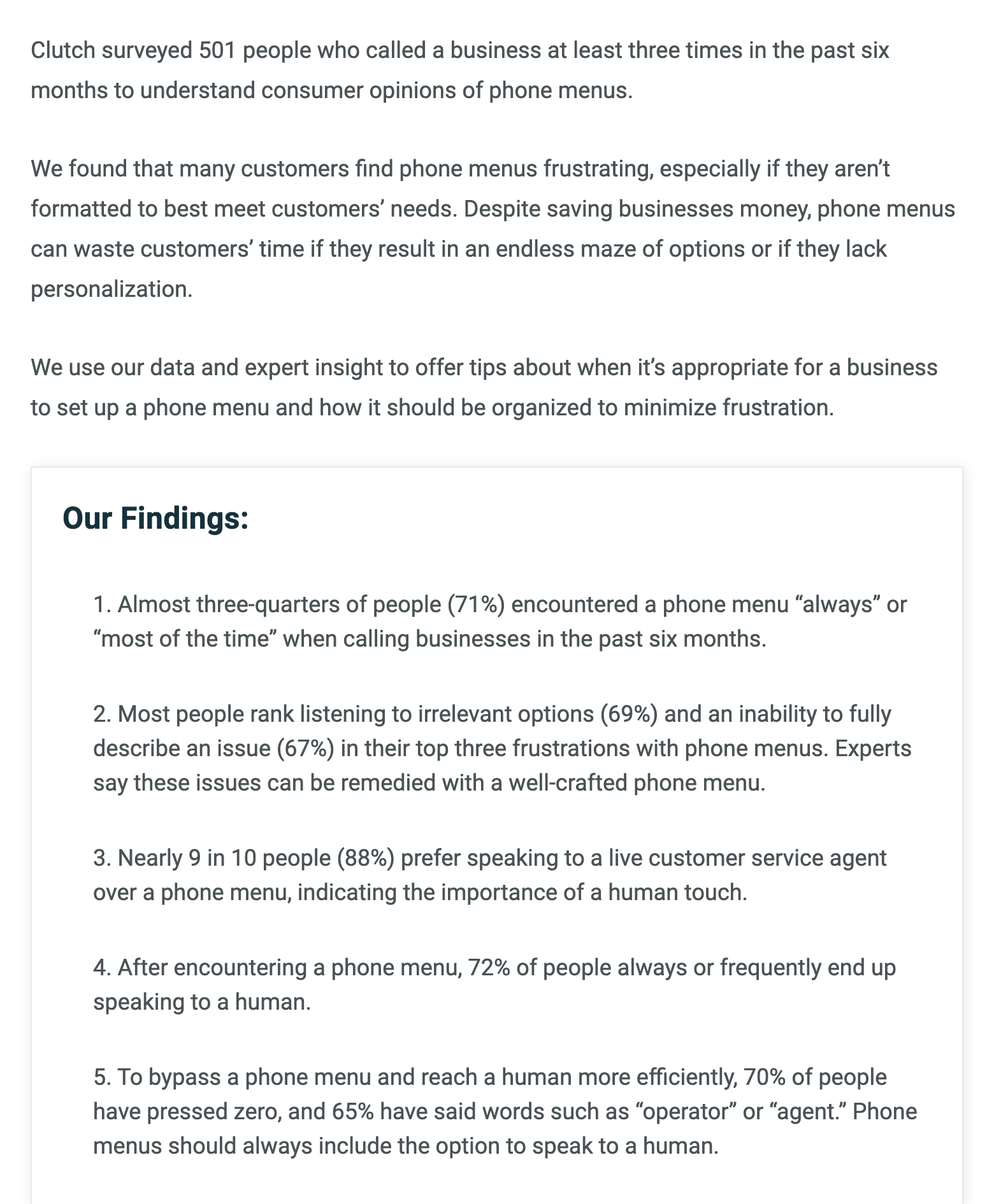
Mostly, yes. Clutch surveyed 501 people in the U.S. who had called a business at least three times in the past six months.
What 501 callers told Clutch
Read that second bar again. Nearly three in four callers sit through the menu and still end up asking for a person.
eGain, which sells customer service software, ran its own IVR survey of 500 people. 67% said they'd wrestled with a phone menu for five minutes or more to get an answer.
What do business owners say about auto attendants?
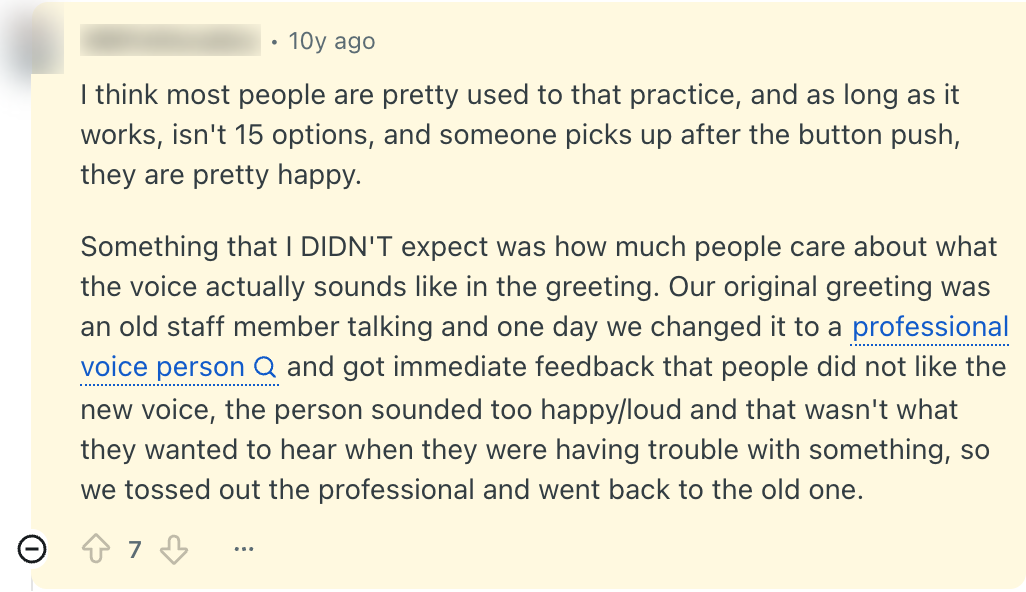
The owners who like them say the same thing: keep it short and make sure a person picks up. This IT company owner in r/msp put it well:
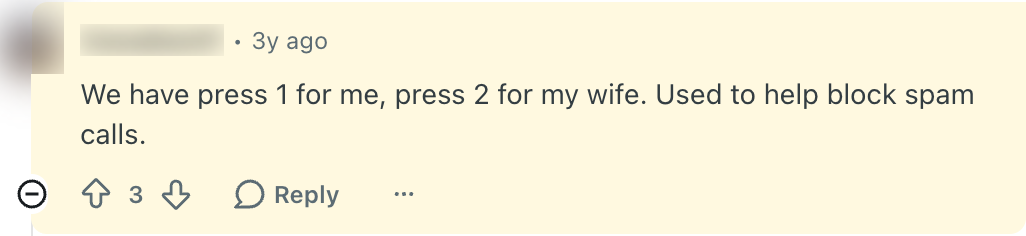
Another reason owners add one has nothing to do with customers. It stops robocalls, which can't press a button.
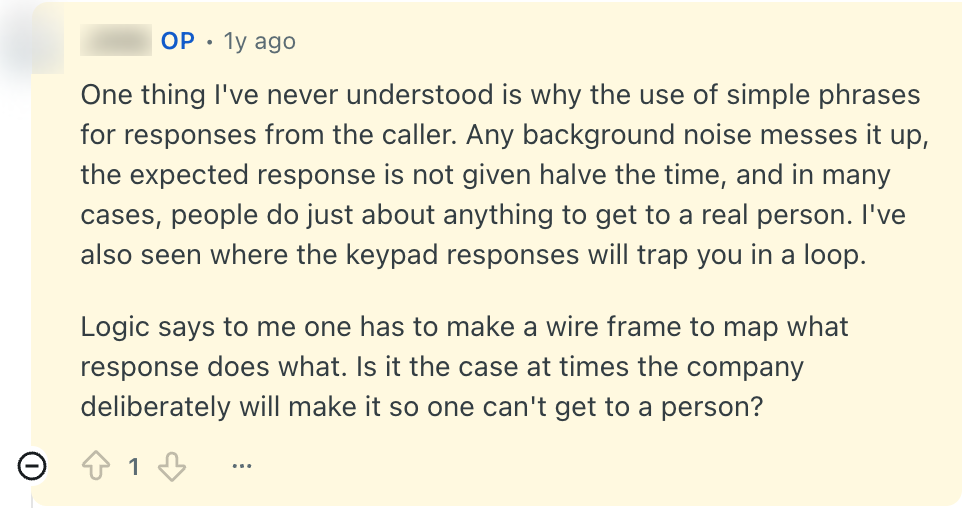
The people who dislike them describe the callers' side. An IT admin who started a thread on automated phone trees in r/sysadmin wrote:
Auto attendant greeting examples
If you do set one up, keep it to three or four options and put the most common reason first. Always give callers a way to reach a person.
Small office
- "Thanks for calling Bright Dental."
- "To book or change an appointment, press 1."
- "For billing, press 2."
- "For anything else, press 0 and we'll pick up."
Home services
- "Thanks for calling Oak HVAC."
- "If you have no heat or no cooling right now, press 1."
- "To schedule a tune-up, press 2."
- "For a quote, press 3."
After hours
- "You've reached Miller Law, open 9 to 5, Monday to Friday."
- "If this is about an existing case, press 1 to leave a message for your attorney."
Two-person business
- "Thanks for calling Rivera Landscaping."
- "For Maria, press 1."
- "For Dan, press 2."
Need the words for your voicemail too? Our business voicemail greeting scripts cover that.
How do you set up an auto attendant in Google Voice?
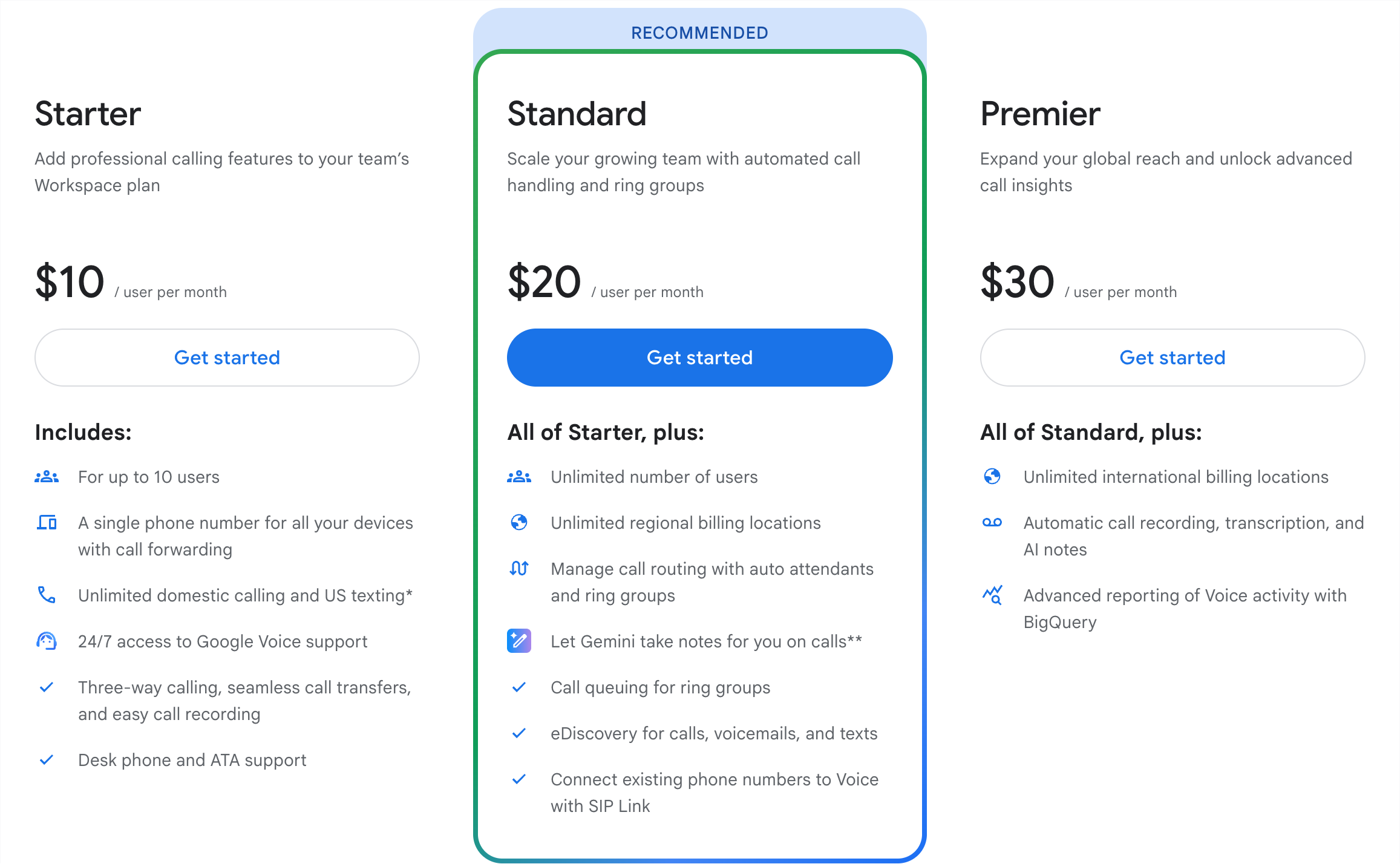
Google Voice includes auto attendants on its Standard ($20 per user a month) and Premier ($30) plans. The Starter plan ($10) does not, so check yours first.
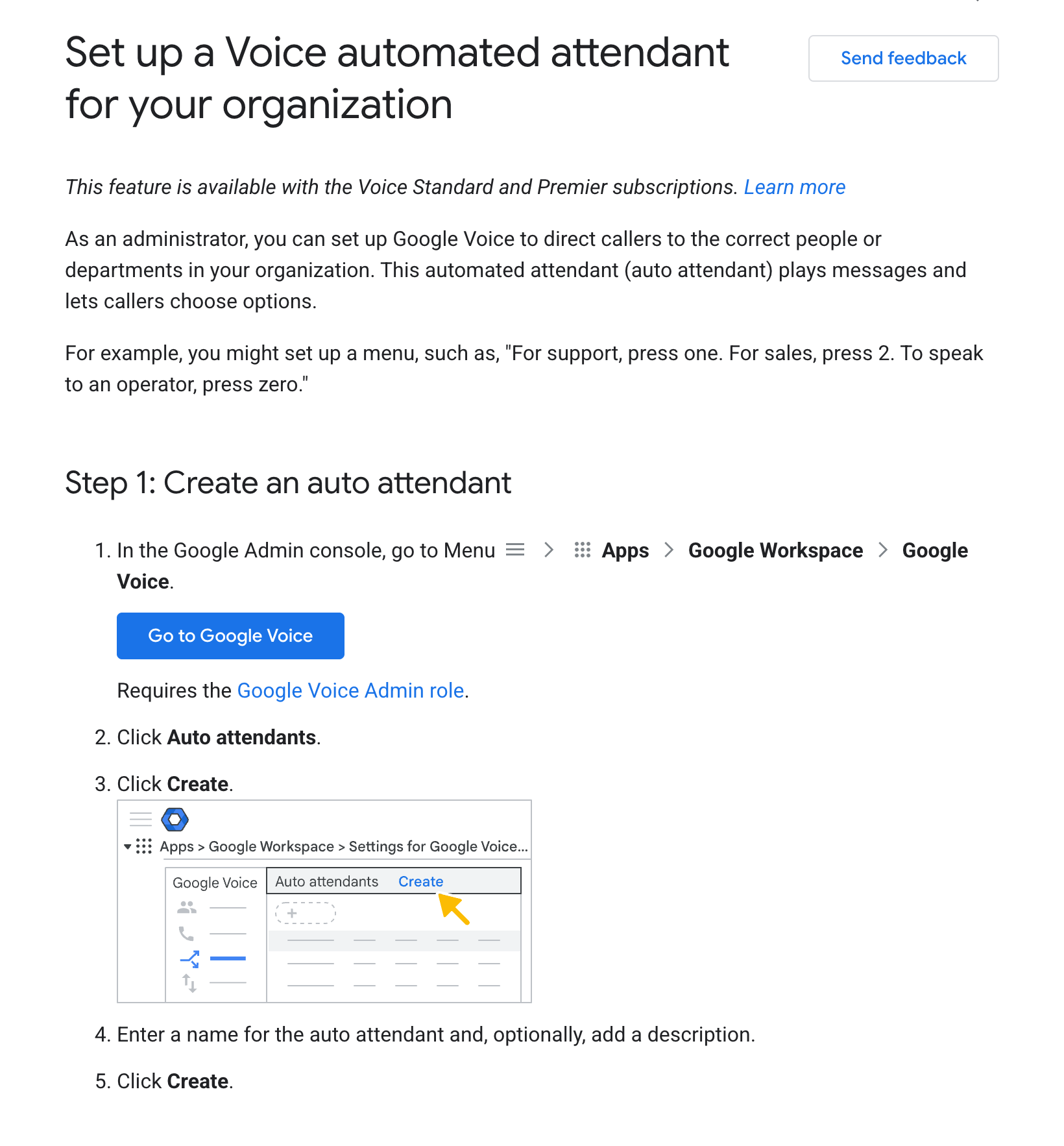
Google's admin help page lays out seven steps. You need the Google Voice Admin role to do them.
Google Voice auto attendant setup
Thinking about Google Voice for the whole business? Our Google Voice for business guide covers the plans and the catches.
How much does an auto attendant or IVR cost?
An auto attendant usually costs nothing extra, because it comes with a business phone plan. An IVR is usually priced per minute, plus the time to build it.
Auto attendant, included in
- Nextiva from $15 per user a month (paid annually)
- Google Voice Standard $20 per user a month
IVR, built on
- Twilio $0.0085 a minute to receive local calls, plus building the flow
- Amazon Connect $0.038 a minute, plus phone line charges
Nextiva says auto attendants "are included in our phone service plans." The per-minute IVR rates look tiny, but someone has to design, build and maintain the call flow, and that's the real cost.
Prices are from each company's pricing page on October 23, 2026. RingCentral's plans start at $20 per user a month (paid annually), but its pricing page doesn't say which plan includes its multi-level IVR, so ask before you buy.
Which one does a small business need?
It depends on what your callers want when they call. Most small businesses get the same handful of questions over and over.
Pick an auto attendant if
You have a few departments or people, someone is always there to pick up, and callers already know who they want.
Pick an IVR if
You get thousands of calls asking for the same lookups, like balances or order status, and you have a developer.
Pick an AI receptionist if
Calls go unanswered when you're busy, and callers want answers, quotes or appointments, not a department.
The honest catch: a menu still isn't an answer
An auto attendant and an IVR both assume someone is there to take the call at the end. For a small business, that's exactly the problem: you're on a job, with a patient, or closed for the night.
Then the menu sends the caller to voicemail, and a lot of callers won't leave one. We wrote about that in does anyone actually leave voicemails anymore?
One commenter in the same r/msp thread summed up the other side:

An AI phone answering agent skips the menu entirely. The caller says what they need, and it answers the question, books the appointment, or transfers the call to the right person.
It also handles the thing owners use menus for: spam. You can tell Zinng's agent to end robocalls and sales calls, and blocked spam calls don't count against your minutes.
Zinng starts at $49 a month for 300 minutes, with done-for-you setup and a 7-day free trial. You can hear a demo built from your own website in about a minute.
So before you record "press 1 for sales," ask yourself one thing. When your callers press 1, is anyone actually there?
Sources
All pages were checked and captured on October 23, 2026. Clutch is an independent survey; eGain, Nextiva, RingCentral and Twilio sell phone or customer service products, so treat their framing as industry data.
- Clutch, How Businesses Should Set Up Their IVR Menu (survey of 501 U.S. consumers, updated April 14, 2025).
- eGain, State of IVR Customer Experience (500 responses; the page shows no survey year).
- Definitions: Microsoft Learn, Webex by Cisco, Twilio, Nextiva, Nextiva blog, RingCentral.
- Google Voice: plans and pricing and auto attendant setup help.
- Pricing: Nextiva, RingCentral, Twilio Voice, Amazon Connect.
- Owner quotes: public Reddit threads in r/msp, r/smallbusiness and r/sysadmin, linked where quoted. These are individual opinions, not research, and the r/msp thread is from 2017.
- Zinng: zinng.ai pricing.
FAQ
What is the difference between an auto attendant and IVR?
An auto attendant only routes calls based on which key the caller presses. An IVR also gathers information and completes tasks, often by voice, like looking up an account or taking a payment.
What is an auto attendant?
An auto attendant is a recorded phone menu that answers your business line and sends callers to a person, department or voicemail when they press a key. It's sometimes called an automated attendant or a phone tree.
Is an auto attendant the same as a virtual receptionist?
Not quite. An auto attendant only plays a menu, while a virtual receptionist is a live or AI person who talks with the caller; see what is a virtual receptionist.
Does Google Voice have an auto attendant?
Yes, on the Google Voice Standard ($20 per user a month) and Premier ($30) plans. The Starter plan doesn't include it.
How much does an auto attendant cost?
Usually nothing extra, because it's included in business phone plans that start around $15 to $20 per user a month. A custom IVR is priced per minute plus the cost of building it.
Do customers hate phone menus?
Many do. In Clutch's survey of 501 Americans, 88% preferred a live person and 70% had pressed zero to skip a menu.
Ready to get started?
Set up your AI phone agent in minutes. Try it free for 7 days.
Try Zinng Free for 7 Days
About the Author
Timothy Bramlett
Co-Founder & CEO, Zinng
Timothy Bramlett is an American entrepreneur, software engineer, and product strategist. He is the founder of Zinng, an AI-powered phone agent platform that helps businesses never miss a customer call with intelligent call handling, real-time transcripts, and instant summaries.