The cheapest growth in your business is not a new lead. It is the customer you already did great work for, calling you again instead of someone else.
Most service businesses barely try for it. They finish the job, they leave, and they hope.
Here is a dead-simple move that beats hoping, and the one catch that decides whether it actually pays off.
The one-pager that quietly brings people back
An appliance-repair owner on Reddit shared what he started doing after every job. He leaves a single useful sheet on a fridge magnet.
On it: what he fixed, what to watch for, and the two things people always call back about. Nothing salesy, just genuinely handy.
He says his repeat calls are noticeably up since he started, and it costs him pennies to print. Take his exact numbers with a grain of salt, but watch what happened in the comments.
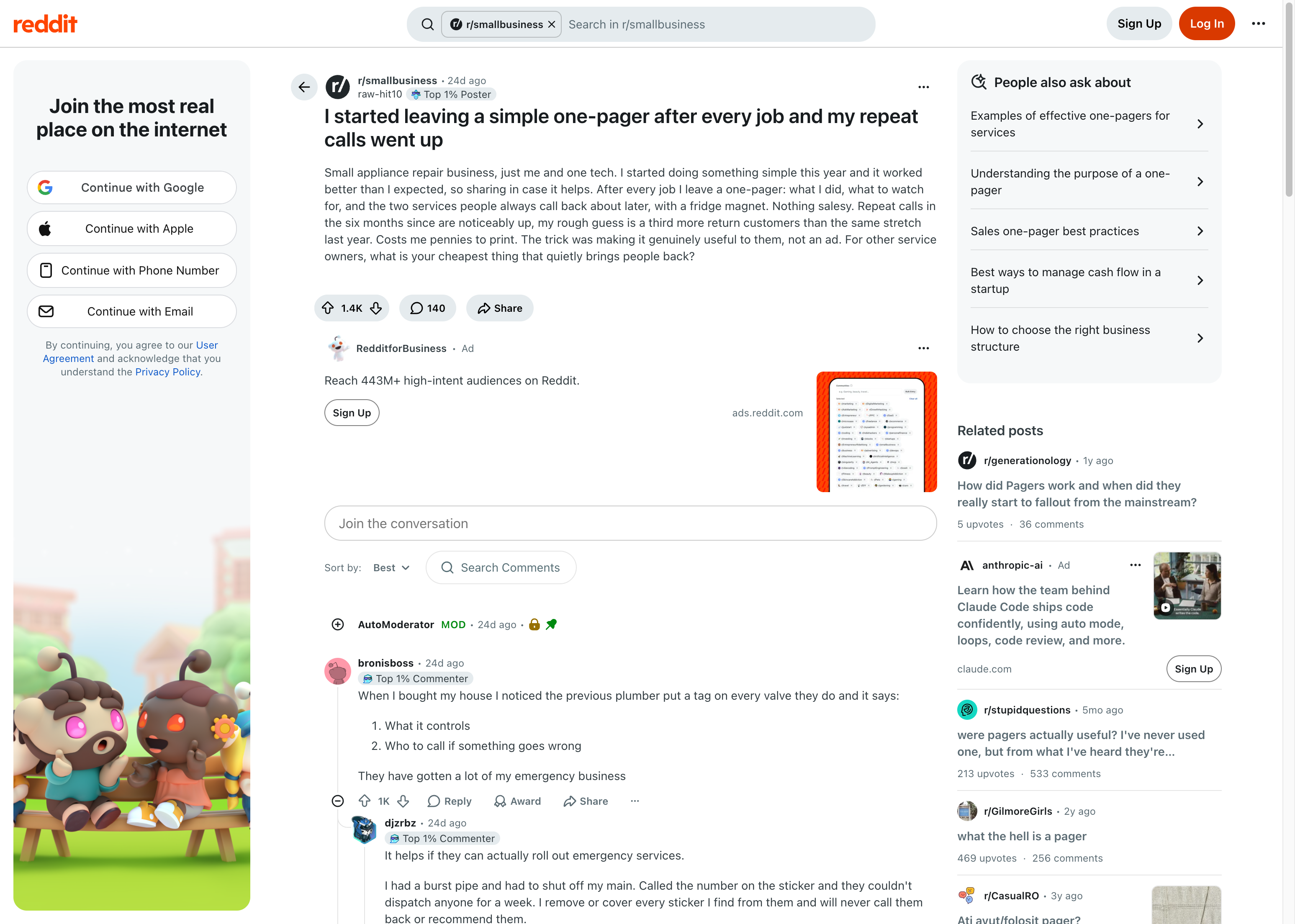
The strongest proof was not the original poster. It was a customer describing his plumber, in a comment that pulled over 1,000 upvotes.
"The previous plumber put a tag on every valve they do and it says: 1. What it controls. 2. Who to call if something goes wrong. They have gotten a lot of my emergency business." via r/smallbusiness
Different trade, same move. A dentist does it with a post-op instruction sheet, a plumber does it with valve tags, an appliance tech does it with a fridge magnet.
Why a useful leave-behind works
A coupon is an ad, so it goes in the trash. A sheet that tells someone how to shut off their water is useful, so it goes on the fridge.
That is the whole trick. It earns a permanent spot in their house, and it has your name on it.
Now you are the one they think of the second something breaks. As one commenter put it, being the person who makes a customer's future problems easier to solve is a real advantage.
The math on keeping a customer
This is not just a nice idea, the customer acquisition versus retention numbers are lopsided. Keeping the customer you have is the cheap side by a wide margin.
The close rate is the part that really stings. You are far more likely to sell to someone who already knows you.
Chance of making the sale
Figures from HBR, Bain, and Marketing Metrics. See Sources.
So a scrap of paper that keeps you top of mind is not a cute idea. It is retention marketing at pennies a customer, aimed at the cheapest sale you will ever make.
Steal these leave-behinds
Pick the one that fits your trade and print it this week. They all do the same job: be useful, and put your name where the problem happens.
What you did, what to watch for, what people call back about. On a fridge magnet.
Tag valves, panels, and units with what they control and who to call.
Aftercare and what is normal. Works for dental, medical, salons, and detailing.
Write the date they should book you again, right on the sheet or tag.
A small code that opens your Google review page while the work is fresh.
A quick "how is everything holding up?" a week later, with your number saved.
The catch: you have to answer when they call
Here is where it falls apart. The magnet only works if a human, or something, actually picks up when they call back.
A commenter on that same thread laid out exactly how it goes wrong.
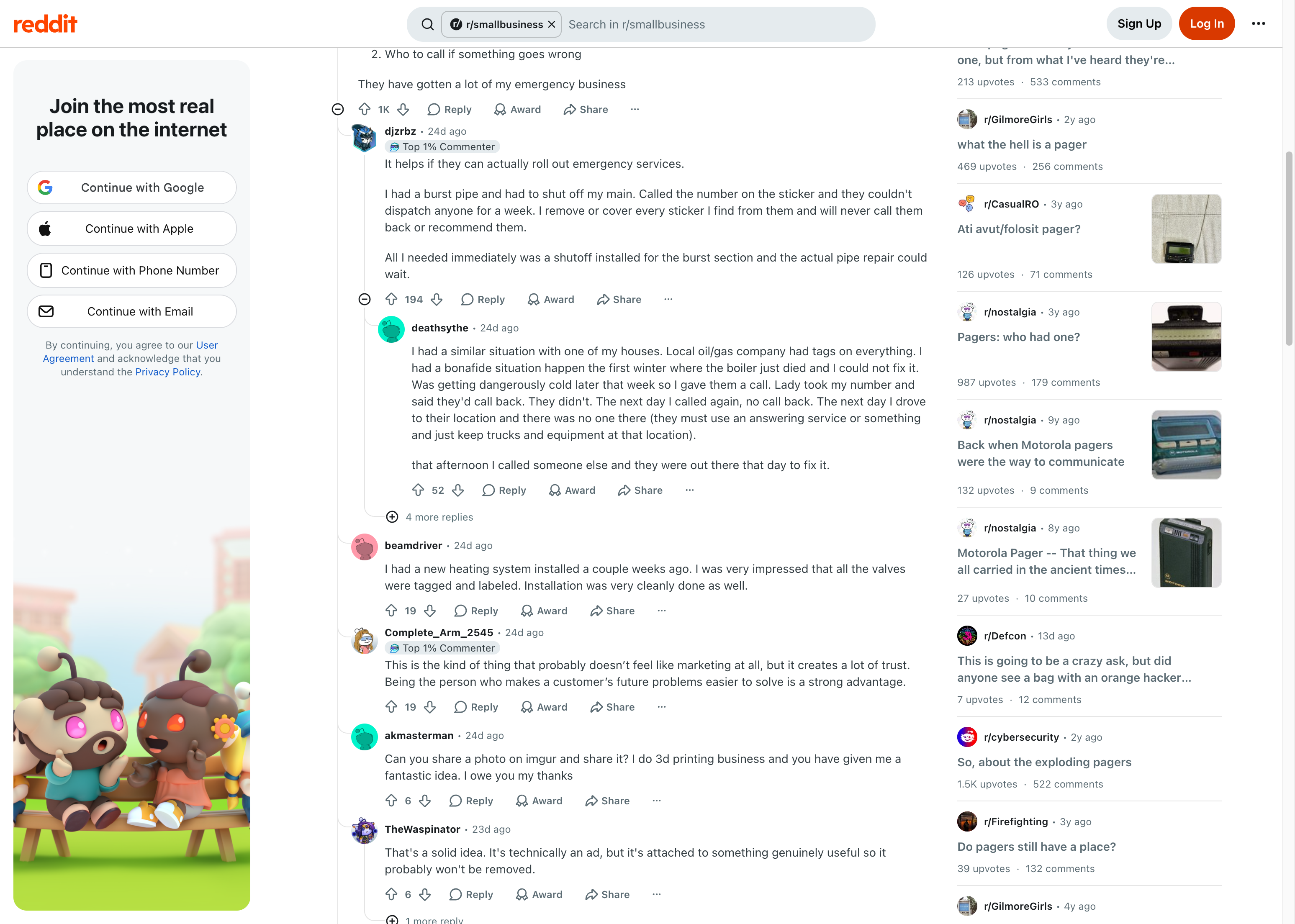
"I had a burst pipe... Called the number on the sticker and they couldn't dispatch anyone for a week. I remove or cover every sticker I find from them and will never call them back or recommend them." via r/smallbusiness
Read that again. The leave-behind worked perfectly, it sent the customer straight to the phone, and the missed callback turned a fan into someone who tears down your stickers.
You do not just lose that job. You train your best repeat customer to call the competitor instead.
This is the honest half of the strategy. Be useful, and be reachable, or the useful part backfires.
That second half is exactly what an AI phone agent is for. It answers the callback live, day or night, books the job or takes the details, and texts the customer back so nobody who bothered to call you slips away. It is the same reason voicemail quietly loses you customers and why the AI front line is spreading: the callback is the whole ballgame.
So the real play is both halves together. Leave something useful, and make sure the phone never goes unanswered.
One question to leave you with. What is the cheapest thing that quietly brings your customers back?
Sources
A quick note on honesty. The retention numbers below are widely-cited industry canon, not fresh 2026 research, so we attribute each to its named source.
- Harvard Business Review: acquiring a new customer costs 5 to 25 times more than retaining one.
- Bain & Company (Fred Reichheld): a 5% increase in retention can lift profit by 25 to 95%.
- Marketing Metrics (Farris et al.): a 60 to 70% chance of selling to an existing customer, versus 5 to 20% for a new prospect.
- Invesp / OutboundEngine (aggregating the above): existing customers spend about 31% more per order than new buyers.
- Reddit: the r/smallbusiness thread and its comments.
Frequently asked questions
What is the cheapest way to get repeat customers?
Leave something genuinely useful behind after every job, like a one-pager or an equipment tag with your name and number on it. It costs pennies and keeps you top of mind for the next problem.
Is it really cheaper to keep a customer than find a new one?
Yes. Harvard Business Review puts the cost of winning a new customer at 5 to 25 times that of keeping one, and Bain found a 5% retention bump can raise profit 25 to 95%.
Why does a useful leave-behind beat a coupon?
A coupon reads as an ad and gets tossed, while a useful sheet or tag earns a permanent spot in the customer's home. Whatever they keep has your name on it when something breaks.
What is the catch with leave-behinds?
They only pay off if you actually answer when the customer calls back. Miss that callback and you have trained your best repeat customer to call a competitor instead.
Ready to get started?
Set up your AI phone agent in minutes. Try it free for 7 days.
Try Zinng Free for 7 Days
About the Author
Timothy Bramlett
Co-Founder & CEO, Zinng
Timothy Bramlett is an American entrepreneur, software engineer, and product strategist. He is the founder of Zinng, an AI-powered phone agent platform that helps businesses never miss a customer call with intelligent call handling, real-time transcripts, and instant summaries.